10 Best Coupon Code Scrapers for E-commerce Data in 2025
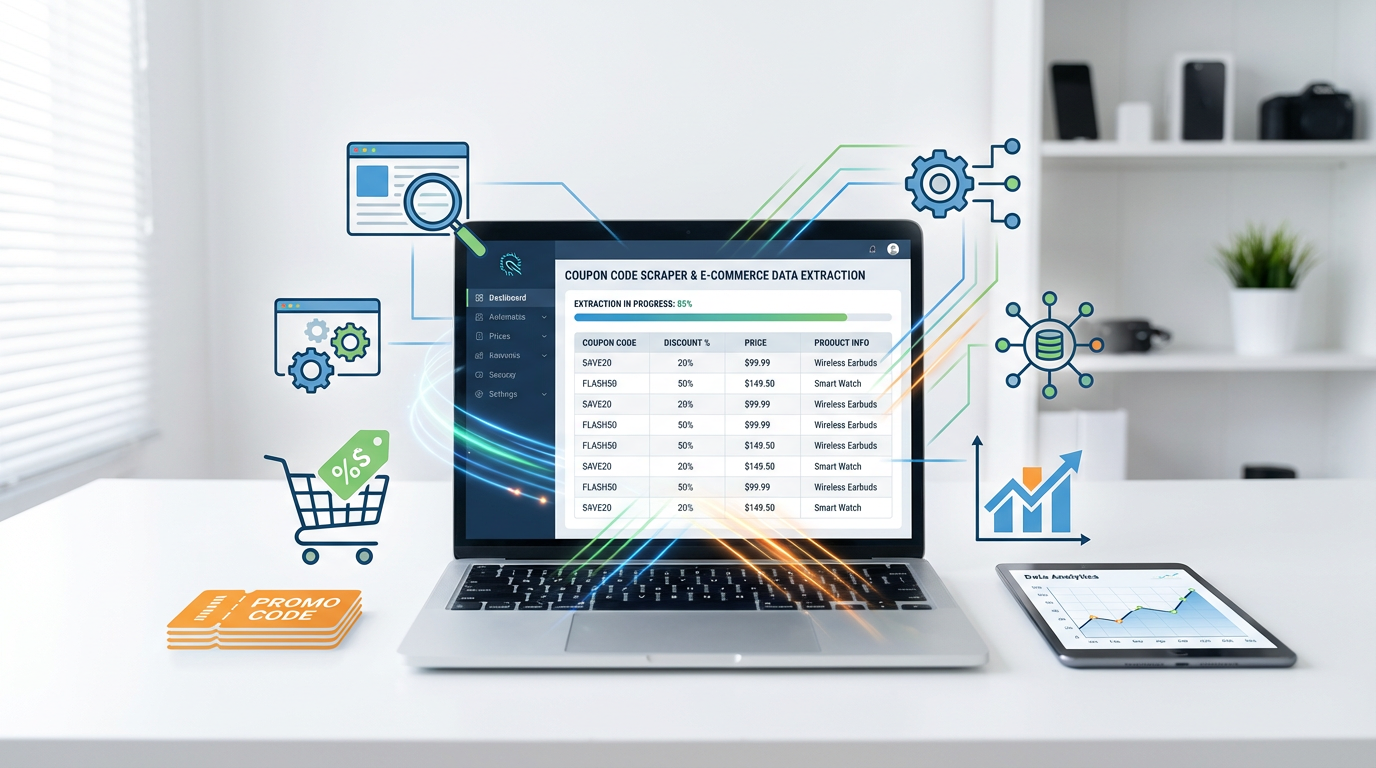
In the hyper-competitive world of e-commerce, data is king, and one of the most valuable datasets is pricing and discount information. Coupon codes, promotional offers, and flash sales are the lifeblood of online retail, driving customer behavior and influencing purchasing decisions. For businesses, affiliate marketers, and price comparison websites, having access to this data in real-time is not just an advantage—it’s a necessity. But with thousands of deals appearing and disappearing across countless websites every day, how can anyone possibly keep up?
The answer lies in automation. Coupon code scrapers, a specialized category of web scraping tools, are designed to automatically navigate the web, identify discount information, and extract it into a structured, usable format. These tools have become indispensable for anyone looking to gain a competitive edge, monitor pricing strategies, or provide consumers with the most up-to-date deals.
But not all scrapers are created equal. The modern web is a complex environment, with JavaScript-heavy sites, CAPTCHAs, and anti-bot measures designed to block automated access. Choosing the right tool is critical. Do you need a powerful API for a large-scale data operation, a simple no-code tool for marketing insights, or a flexible open-source library for a custom project? This guide will break down the 10 best coupon code scrapers for e-commerce data in 2025, helping you find the perfect solution for your data extraction needs.
What is Coupon Code Scraping?
Coupon code scraping is the process of using automated software (a “scraper” or “bot”) to browse websites, identify coupon and promo codes, and extract this information. The extracted data can include the code itself, the discount amount or percentage, the products it applies to, and the expiration date. This data is then typically saved in a structured format like a CSV file or a database for analysis or display.
This practice is crucial for various business intelligence activities:
•Competitive Analysis: Brands can monitor their competitors’ pricing and promotional strategies to stay competitive.
•Affiliate Marketing: Coupon affiliate sites can automatically populate their platforms with the latest deals, ensuring their content is always fresh and relevant.
•Price Monitoring: E-commerce businesses can track how their products are being discounted across the web, helping to enforce pricing policies and understand market dynamics.
However, it’s important to approach web scraping ethically and legally. Always check a website’s robots.txt file and terms of service to understand their policies on automated access. Responsible scraping involves making requests at a reasonable rate to avoid overloading the website’s servers.
The 10 Best Coupon Code Scrapers in 2025
The best tool for you will depend on your technical expertise, budget, and the scale of your project. Our list includes a mix of powerful APIs for developers, user-friendly no-code tools for marketers, and flexible open-source libraries for those who want full control.
1. ScraperAPI
ScraperAPI is a powerful and versatile web scraping API that simplifies the process of data extraction. Instead of building and maintaining your own proxy infrastructure, ScraperAPI handles everything for you, allowing you to focus on parsing the data you need.
Key Features:
•Proxy Management: Automatically rotates through a massive pool of residential, mobile, and data center proxies to avoid IP bans.
•JavaScript Rendering: Capable of rendering JavaScript-heavy websites, which is essential for scraping modern e-commerce sites.
•CAPTCHA Solving: Handles CAPTCHAs automatically, ensuring uninterrupted scraping.
•Easy Integration: Simple to integrate into any project with just a single API call.
Pricing: Offers a free trial, with paid plans starting at $49 per month.
Who is it for? Developers and businesses that need a reliable, scalable, and easy-to-use solution for scraping e-commerce sites without the headache of managing proxies and headless browsers.
2. Bright Data
Bright Data (formerly Luminati Networks) is the undisputed heavyweight champion of the web scraping world. It offers an enterprise-grade data collection platform with an unparalleled proxy network and a suite of powerful tools for large-scale scraping operations.
Key Features:
•Massive Proxy Network: Access to over 72 million residential proxies, providing the best-in-class solution for avoiding blocks.
•Web Scraper IDE: A development environment for creating and managing custom scrapers.
•Pre-built Datasets: Offers ready-to-use datasets for various industries, including e-commerce.
•Search Engine Crawler: A specialized tool for scraping search engine results pages.
Pricing: Bright Data uses a pay-as-you-go model and offers custom enterprise plans. It is generally more expensive than other options, reflecting its premium capabilities.
Who is it for? Large enterprises and data-driven businesses that require a highly reliable, scalable, and robust data collection infrastructure for mission-critical projects.
3. Apify
Apify is a cloud-based web scraping and automation platform that offers a unique, actor-based model. An “actor” is a cloud program that can perform any arbitrary web scraping or automation task. You can either build your own actors or use one of the hundreds of pre-built actors available in the Apify Store.
Key Features:
•Apify Store: A marketplace of pre-built scrapers for common tasks, including scraping e-commerce sites and coupon aggregators.
•Cloud-Based Platform: All scraping runs in the cloud, so you don’t need to manage your own servers.
•JavaScript Rendering and Proxy Management: Includes built-in tools for handling modern websites and avoiding blocks.
•Scheduling and Integrations: Easily schedule your scraping tasks and integrate the results with other tools via API or webhooks.
Pricing: Apify offers a generous free tier, with paid plans starting at $49 per month.
Who is it for? Developers and businesses who want a flexible, all-in-one platform that can handle everything from simple scraping tasks to complex automation workflows.
4. Octoparse
For those who don't have a background in coding, Octoparse is one of the best no-code web scraping tools on the market. It provides a visual, point-and-click interface that allows you to build a scraper by simply interacting with a website as you normally would.
Key Features:
•Visual Scraper Builder: No coding required. You just point, click, and extract the data you need.
•Template Mode: Offers pre-built templates for scraping popular websites like Amazon and eBay, which can be easily adapted for coupon hunting.
•Cloud-Based Scraping: Run your scraping tasks in the cloud 24/7, with automatic IP rotation.
•Advanced Features: Handles infinite scrolling, logins, and dropdown menus with ease.
Pricing: Octoparse has a free plan with limited features. Paid plans start at $75 per month.
Who is it for? Marketers, researchers, and business owners who need to extract e-commerce data but do not have the technical resources to build a custom scraper.
5. ParseHub
ParseHub is another powerful visual web scraper that is excellent at handling complex, interactive websites. It is a desktop application that offers a high degree of flexibility and control, making it a favorite among non-developers who need to tackle challenging scraping projects.
Key Features:
•Handles Modern Websites: ParseHub is particularly good at scraping sites that rely heavily on JavaScript, AJAX, and cookies.
•Flexible and Powerful: Can handle complex logic, navigate through forms and dropdowns, and scrape data from behind a login.
•IP Rotation: Automatically rotates IP addresses to help avoid being blocked.
•API Access: The paid plans offer API access, allowing you to integrate the extracted data into other applications.
Pricing: ParseHub offers a free plan that is quite capable for smaller projects. Paid plans start at $189 per month.
Who is it for? Non-developers who need to scrape complex, dynamic websites. Its free plan is one of the most powerful available.
6. Scrapy
For developers who want maximum power and flexibility, Scrapy is the industry-standard open-source web scraping framework for Python. It is an incredibly fast, efficient, and extensible tool for building custom scrapers for any purpose.
Key Features:
•Fast and Asynchronous: Built on a fast, asynchronous networking framework, Scrapy can handle a large volume of requests with high efficiency.
•Highly Extensible: Scrapy has a rich ecosystem of middleware and extensions, allowing you to add functionality like proxy rotation and JavaScript rendering (with tools like Scrapy-Splash).
•Full Control: As a programming framework, it gives you complete control over every aspect of the scraping process.
Pricing: Free and open-source.
Who is it for? Python developers who need to build custom, high-performance web scrapers for large-scale or complex data extraction projects.
7. Beautiful Soup + Selenium
This is not a single tool, but a powerful combination of two Python libraries that is a favorite among developers for its flexibility. Beautiful Soup is a library for parsing HTML and XML documents, while Selenium is a browser automation tool that can control a real web browser.
Key Features:
•Ultimate Flexibility: This combination can handle any website, no matter how complex or interactive. Selenium can execute JavaScript, click buttons, and fill out forms, and Beautiful Soup can then parse the resulting HTML.
•Simulates Human Behavior: Because it controls a real browser, it is very effective at scraping sites with heavy anti-bot measures.
•Large Community: Both libraries have a massive community and extensive documentation, making it easy to find help and examples.
Pricing: Free and open-source.
Who is it for? Developers who need to scrape the most challenging, JavaScript-heavy websites and require the ultimate level of control and flexibility.
8. Instant Data Scraper
Instant Data Scraper is a simple but surprisingly effective Chrome extension for quick and easy data extraction. It uses AI to automatically detect tabular data on a webpage and allows you to scrape it with a single click.
Key Features:
•One-Click Scraping: Incredibly easy to use. Just navigate to a page, click the extension icon, and it will automatically find and highlight the data.
•No-Code: Requires absolutely no coding knowledge.
•Export to CSV/Excel: Easily download the scraped data for use in a spreadsheet.
Pricing: Free.
Who is it for? Anyone who needs to quickly scrape a simple table of data from a single webpage. It’s perfect for quick marketing research or building a small list of deals.
9. WebScraper.io
WebScraper.io offers both a free Chrome extension and a cloud-based scraping platform. It uses a unique “sitemap” approach, where you build a visual plan of how the scraper should navigate through a website and what data it should extract.
Key Features:
•Visual Sitemap Builder: A more structured approach to visual scraping that is great for handling sites with complex navigation and pagination.
•Handles Dynamic Sites: The extension can handle JavaScript and AJAX, allowing it to scrape modern e-commerce sites.
•Cloud-Based Service: The paid cloud service allows you to run large-scale scraping jobs with IP rotation and scheduling.
Pricing: The Chrome extension is free. The cloud service has plans starting at $50 per month.
Who is it for? A wide range of users, from beginners who can use the free extension for small projects to businesses that need the power of the cloud service for larger-scale data extraction.
10. ScrapeStorm
ScrapeStorm is an AI-powered desktop scraping tool that aims to simplify the data extraction process for non-coders. It offers both a “Smart Mode” for automatic data detection and a more manual “Flowchart Mode” for building custom scrapers.
Key Features:
•AI-Powered Scraping: The Smart Mode can automatically identify and extract data from most websites with minimal user input.
•Visual Flowchart Interface: For more complex sites, you can build a visual flowchart to define the scraping logic.
•Desktop Application: Runs on your local machine, giving you more control over the process.
Pricing: ScrapeStorm offers a free starter plan, with paid plans starting at $49.99 per month.
Who is it for? Non-developers who want a powerful, AI-driven tool that can handle a wide range of websites without requiring any coding.
Fan-Out Queries Answered
1.Is it legal to scrape coupon codes? It depends. While scraping publicly available data is generally legal, you must respect a website’s terms of service and robots.txt file. Aggressive scraping that harms a website’s performance can lead to legal issues.
2.What is the easiest coupon scraper to use? For single-page scrapes, Instant Data Scraper is the easiest. For more complex projects, no-code tools like Octoparse and ParseHub are the most user-friendly.
3.Can I scrape websites that require a login? Yes, tools like Octoparse, ParseHub, and Selenium can be configured to handle logins.
4.What is a proxy and why do I need one for scraping? A proxy is an intermediary server that masks your IP address. Using a pool of rotating proxies is essential for large-scale scraping to avoid having your IP address blocked by the target website.
5.How do I handle CAPTCHAs? Many paid scraping services, like ScraperAPI and Bright Data, have built-in CAPTCHA solving capabilities. For custom scrapers, you may need to integrate a third-party CAPTCHA solving service.
6.What is JavaScript rendering? Many modern websites use JavaScript to load content dynamically. A scraper needs to be able to “render” or execute this JavaScript to see the full content of the page, just like a real browser. Tools like ScraperAPI and Selenium are essential for this.
7.What is the best free coupon scraper? For developers, Scrapy and the Beautiful Soup/Selenium combination are the best free options. For non-developers, the free plans of ParseHub and WebScraper.io are very powerful.
8.Can I scrape coupon codes from a mobile app? This is much more difficult than scraping a website and typically requires advanced techniques like reverse-engineering the app’s API.
9.How often should I scrape for new coupon codes? This depends on the website. For major e-commerce sites, you may need to scrape daily or even hourly to catch flash sales. For smaller sites, weekly might be sufficient.
10.What is the best data format for scraped coupon codes? CSV or JSON are the most common and versatile formats. They can be easily imported into a spreadsheet, database, or other application.
The Final Verdict: Choosing Your Data Extraction Partner
Selecting the best coupon code scraper in 2025 comes down to a trade-off between power, price, and ease of use. There is no single “best” tool for everyone, but there is a right tool for every project.
For developers and businesses with technical resources, a powerful API like ScraperAPI offers the perfect blend of performance and convenience, while open-source frameworks like Scrapy provide ultimate control for custom projects.
For marketers and non-developers, visual scraping tools have democratized data extraction. Octoparse and ParseHub empower you to build sophisticated scrapers without writing a single line of code, turning complex e-commerce sites into structured data sources.
And for large enterprises that view data as a strategic asset, a comprehensive platform like Bright Data provides the infrastructure and reliability needed for mission-critical data operations.
Ultimately, the ability to automatically extract and analyze coupon and pricing data is a superpower in the e-commerce world. By choosing the right tool for your needs, you can unlock a wealth of insights, stay ahead of the competition, and deliver unparalleled value to your customers.