DALL-E 3 vs Craiyon: The Ultimate AI Image Generator Showdown
The landscape of AI image generation is broadly divided into two camps: the high-fidelity, premium models backed by major tech companies, and the accessible, free-to-use tools built by independent developers. At the pinnacle of the former stands DALL-E 3, OpenAI’s latest and most sophisticated model, renowned for its stunning visual quality and deep integration with natural language understanding. Representing the latter is Craiyon (formerly DALL-E mini), a tool that has become synonymous with free, quick, and often hilariously surreal AI art.
For anyone looking to create visual content in 2025, the choice between these two is a fundamental one, representing a clear trade-off: unparalleled quality and control versus absolute accessibility and zero cost. This comprehensive 2500-word analysis will dive deep into the core differences, comparing everything from image fidelity and prompt adherence to pricing models and commercial viability. By the end, you will have a clear answer to the question: which tool is the right fit for your creative needs? The contest between DALL-E 3 vs Craiyon is more than just a technical comparison; it's a look at the future of AI art distribution.
1. Aesthetic and Output Quality: High Fidelity vs. Surreal Distortion
The most immediate and striking difference between the two models is the quality of the final output. DALL-E 3 and Craiyon operate on entirely different levels of visual sophistication, which is a direct result of their training data, model size, and computational resources.
DALL-E 3: The Standard for High Fidelity
DALL-E 3 is trained on a massive, curated dataset, allowing it to produce images that are consistently high-resolution, photorealistic, and aesthetically polished.
•Resolution and Detail: DALL-E 3 generates images at a significantly higher resolution (typically 1024x1024 or higher) with intricate details, realistic textures, and sophisticated lighting. The images often look like professional digital art or photography.
•Anatomical Coherence: The model excels at maintaining anatomical correctness and logical composition, successfully rendering complex subjects like hands, faces, and detailed machinery without the "melting" or distorted effects common in earlier models.
•Artistic Range: While highly polished, DALL-E 3 can convincingly execute a vast range of styles, from hyper-realism and cinematic lighting to specific artistic movements like Impressionism or Pop Art, all while maintaining a high degree of quality.
Craiyon: The Charm of the Surreal and Low-Res
Craiyon, on the other hand, is a much smaller, less resource-intensive model. Its outputs are characterized by a distinct, often bizarre, and low-fidelity aesthetic.
•Resolution and Artifacts: Craiyon typically generates a grid of nine smaller images (256x256), which are often blurry, pixelated, and contain noticeable compression artifacts.
•Surrealism and Distortion: The model is famous for its inability to render coherent anatomy or composition, often resulting in surreal, dream-like, or even nightmarish images. While this is a technical limitation, it has ironically become a source of its charm and popularity for meme generation and abstract art.
•Consistency Issues: Craiyon struggles with complex prompts, frequently mixing elements, misspelling words, or generating entirely unrelated objects within the scene.
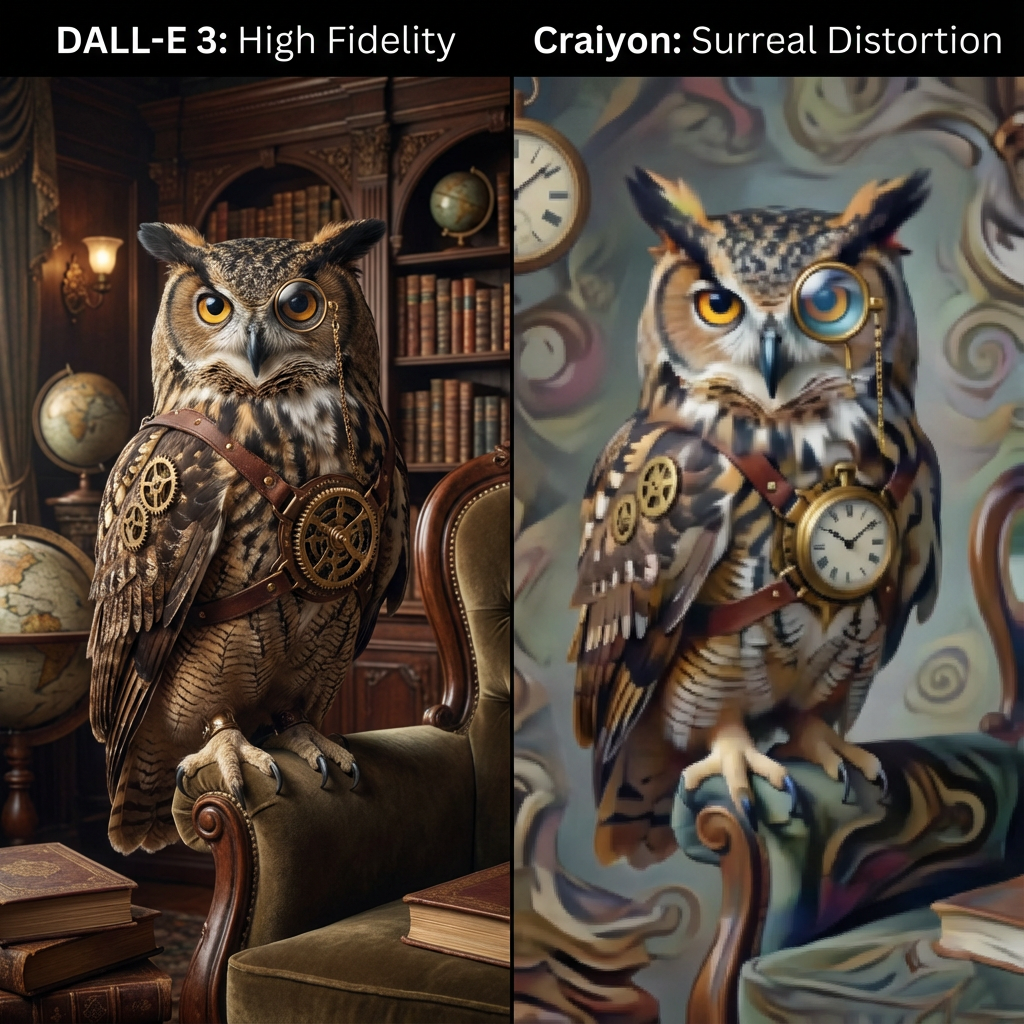
A side-by-side comparison of a complex image prompt result. On the left, a photorealistic image of a "steampunk owl wearing a monocle in a Victorian library," generated with high detail and perfect anatomy (DALL-E 3 style). On the right, the same prompt resulting in a distorted, slightly "melting" or surreal, low-resolution image with anatomical errors (Craiyon style). Label the left 'DALL-E 3: High Fidelity' and the right 'Craiyon: Surreal Distortion'.
2. Prompt Adherence and Text Rendering: The Power of Integration
The ability of an AI model to accurately translate a user's text prompt into a visual image is the ultimate measure of its utility. This is where the architectural difference between DALL-E 3 vs Craiyon is most pronounced.
DALL-E 3: Conversational Prompt Refinement
DALL-E 3’s greatest strength is its native integration with OpenAI’s large language models (LLMs), such as ChatGPT.
•LLM-Powered Refinement: When a user enters a prompt into ChatGPT, the LLM first interprets the request, expands it into a highly detailed, optimized prompt, and then sends this refined text to the DALL-E 3 image model. This two-step process ensures that the final image adheres to the user's intent with exceptional accuracy and nuance 1
.
•Superior Text Rendering: DALL-E 3 is one of the first image models capable of reliably rendering text within an image. While not perfect, it can accurately spell and integrate short phrases and words into the scene, a feature that is critical for logos, signs, and graphic design elements.
Craiyon: Direct and Literal Interpretation
Craiyon operates as a standalone text-to-image model, lacking the sophisticated pre-processing layer of an LLM.
•Literal Interpretation: Craiyon takes the user's prompt directly, leading to less nuanced results. Complex or ambiguous prompts often result in a chaotic mashup of elements rather than a coherent scene.
•Text Rendering Failure: Craiyon is notorious for its inability to render legible text. Any attempt to include words in a prompt will typically result in gibberish, distorted letters, or random symbols, a classic hallmark of older, less capable image models.
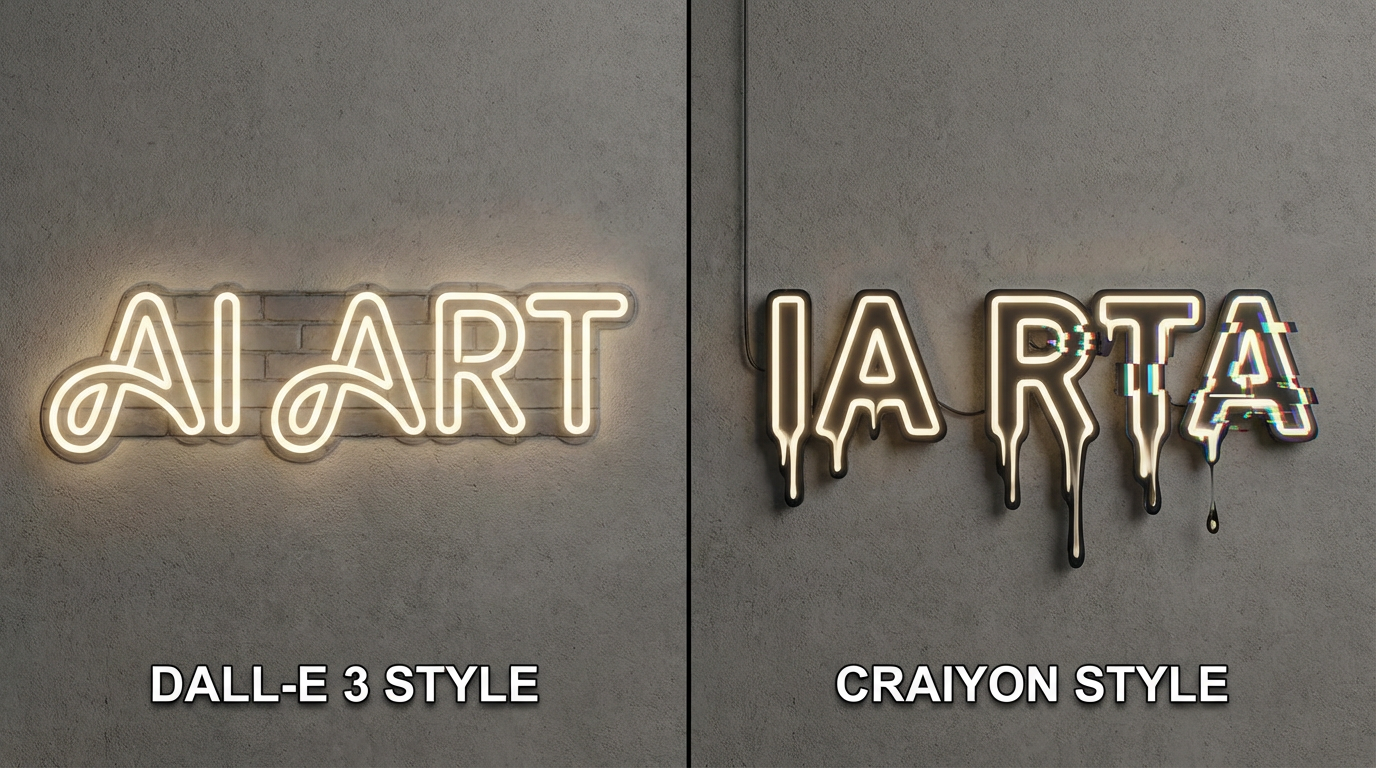
A side-by-side comparison of text rendering. On the left, a clean, perfectly rendered sign that says "AI ART" in a stylized font, integrated naturally into the image (DALL-E 3 style). On the right, a sign with the same text, but the letters are jumbled, misspelled, or melted (Craiyon style). The background should be a simple, neutral wall.
3. Workflow and User Experience: Premium Integration vs. Ad-Supported Simplicity
The user experience is heavily influenced by the business model and the platform through which the tool is accessed.
DALL-E 3: Seamless and Premium
Access to DALL-E 3 is primarily through a paid subscription to ChatGPT Plus or via the OpenAI API.
•Integrated Workflow: The experience is seamless. Users can iterate on an image through a conversation, asking the model to "change the color of the hat" or "make the background cinematic." This conversational workflow is a massive advantage for creative iteration.
•Clean Interface: The interface is clean, modern, and ad-free, reflecting its premium status. The focus is entirely on the creative process and the quality of the output.
•Safety and Moderation: DALL-E 3 includes robust safety measures and content moderation, preventing the generation of harmful, violent, or explicit content, which is a key feature for commercial and enterprise users 2
.
Craiyon: Quick, Direct, and Ad-Cluttered
Craiyon is accessed directly through its website, offering a fast, no-login-required experience.
•Direct Workflow: The workflow is simple: type a prompt, wait for the generation, and download the image. There is no conversational refinement, meaning each change requires a new, full prompt.
•Ad-Supported Interface: To support its free service, the Craiyon interface is heavily reliant on advertisements, which can clutter the screen and slow down the user experience.
•Unique Features: Craiyon does offer a few unique features, such as an "Expert Mode" for fine-tuning and a "Negative Words" feature to exclude unwanted elements, giving advanced users a degree of control not found in the DALL-E 3 interface.
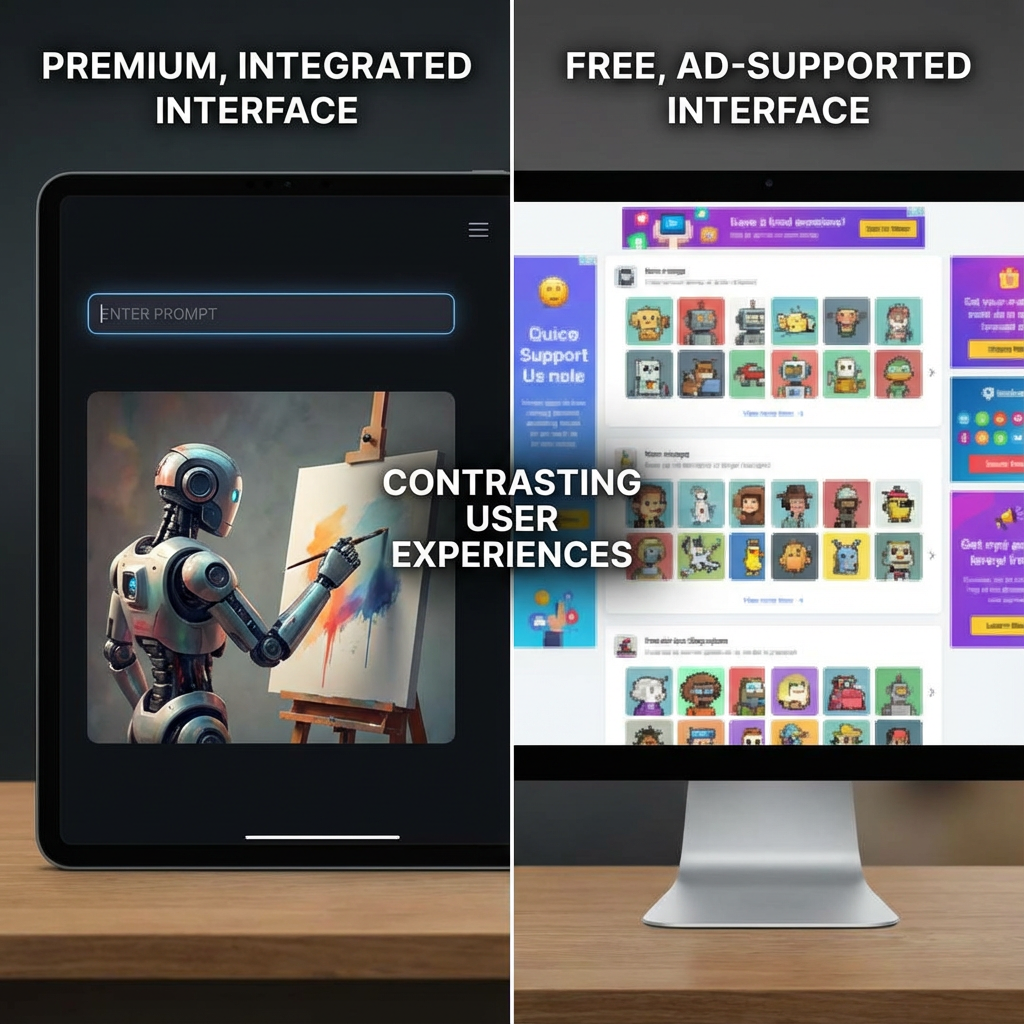
A visual metaphor contrasting a premium, integrated interface with a free, ad-supported one. On the left, a clean, minimalist, dark-mode interface with a single prompt box and a large, high-quality image preview (representing DALL-E 3 via ChatGPT). On the right, a cluttered, bright interface with multiple small image grids, surrounded by blurred-out advertisement banners (representing Craiyon).
4. Pricing, Accessibility, and Commercial Use
The most significant factor for many users when comparing DALL-E 3 vs Craiyon is the cost of entry.
Craiyon: The Free-to-Use Champion
Craiyon’s primary value proposition is its accessibility.
•Free Tier: The basic service is completely free, supported by ads and slower generation times. This makes it an invaluable tool for students, hobbyists, and casual users who want to experiment with AI art without any financial commitment.
•Paid Tiers: Craiyon offers affordable paid tiers (starting around $5/month) that remove ads, speed up generation, and allow for commercial use of the images.
•Commercial Rights: While the free tier is generally for personal use, the paid tiers offer commercial rights, making it a highly cost-effective option for small-scale commercial projects.
DALL-E 3: The Premium Subscription Model
DALL-E 3 is a premium product, reflecting the massive investment in its training and infrastructure.
•Subscription Required: Access is bundled with a ChatGPT Plus subscription (typically $20/month) or through the OpenAI API, where generation is charged per image. This cost barrier immediately positions DALL-E 3 as a tool for professionals, businesses, or serious enthusiasts.
•Commercial Rights: Images generated with DALL-E 3 are generally granted full commercial rights to the user, provided they adhere to OpenAI’s content policy. This clear-cut licensing is a major benefit for businesses and content creators.
•Value Proposition: The higher cost is justified by the superior quality, reliability, and the integrated workflow that saves time and reduces the need for post-processing and prompt engineering.

A visual metaphor for the free vs. paid model. On the left, a polished, perfectly cut diamond on a velvet cushion, representing the paid, premium service (DALL-E 3). On the right, a large, rough, unpolished stone that is easily accessible on the ground, representing the free, accessible service (Craiyon). The background should be a subtle, contrasting color.
5. Output Format and Batch Generation: Quality vs. Quantity
The way each model delivers its final images speaks volumes about its design philosophy.
Craiyon: The 9-Image Grid
Craiyon’s default output is a 3x3 grid of nine small, low-resolution images.
•Quantity over Quality: This format is designed to give the user a wide variety of interpretations for a single prompt, allowing them to quickly select the most promising result, despite the low quality of each individual image.
•Speed of Iteration: While the overall generation time is slow due to server load on the free tier, the ability to see nine variations at once speeds up the initial brainstorming and selection process.
DALL-E 3: Single, High-Resolution Image
DALL-E 3 typically generates a single, high-resolution image per prompt (or a small set of variations).
•Quality Focus: The model is confident in its ability to generate a high-quality image that adheres closely to the prompt, eliminating the need for a large grid of variations.
•Refinement: The focus shifts from batch selection to conversational refinement. Instead of generating nine new images, the user refines the single image through dialogue with ChatGPT, leading to a more focused and efficient creative process.
The difference in output format highlights the core market for each tool: Craiyon is for quick, exploratory, and often humorous generation, while DALL-E 3 is for focused, high-stakes creation where quality is paramount.
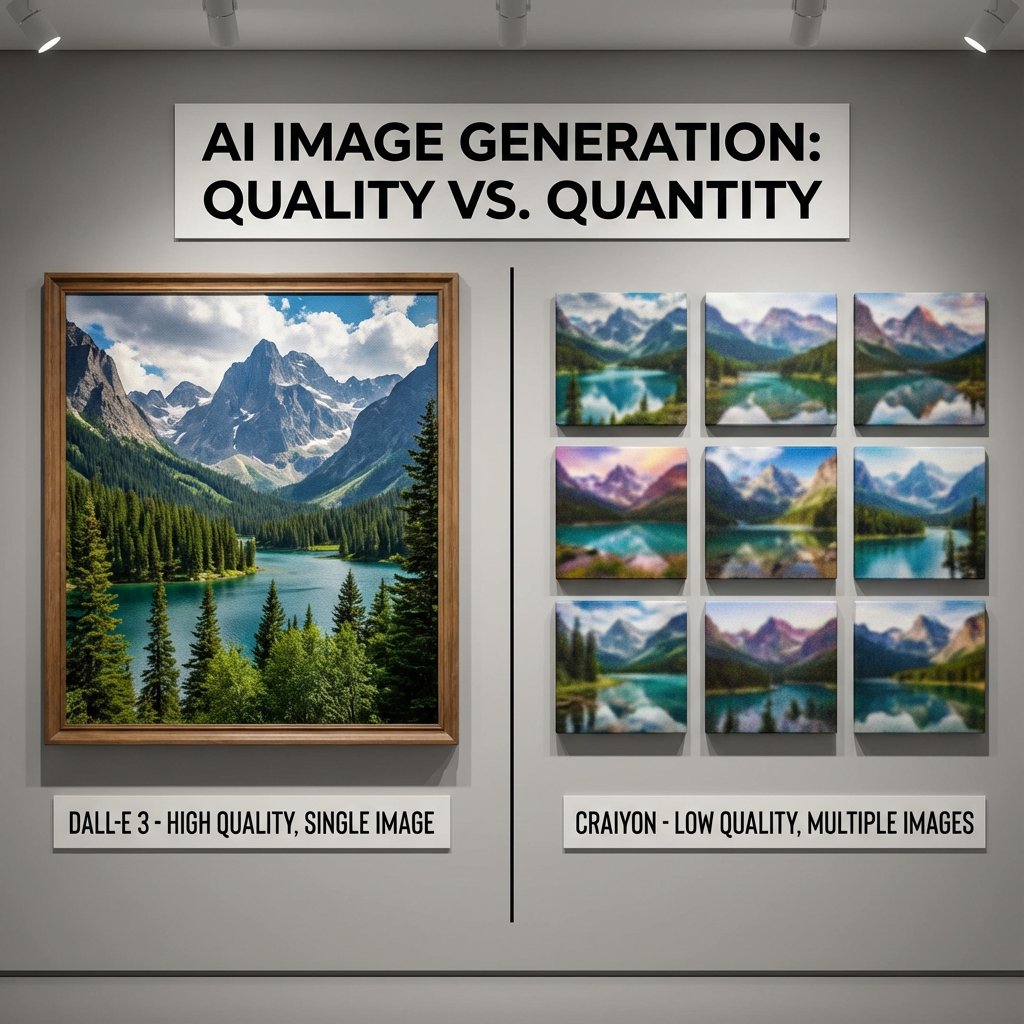
A visual comparison of output formats. On the left, a single, large, high-resolution image on a canvas (DALL-E 3). On the right, a 3x3 grid of nine small, low-resolution, slightly varied images on a canvas (Craiyon). The overall theme is quality vs. quantity.
6. The Technical and Ethical Divide
Beyond the user-facing features, the underlying technology and ethical considerations also draw a sharp line between the two platforms.
DALL-E 3: Ethical Sourcing and Safety
OpenAI has invested heavily in ensuring DALL-E 3 is a safe and ethically responsible tool.
•Training Data: While the exact composition is proprietary, OpenAI has stated its commitment to filtering out harmful content and protecting the rights of artists by allowing them to opt out of the training data 3
.
•Bias Mitigation: The model includes layers of filtering and bias mitigation to prevent the generation of harmful stereotypes or inappropriate content.
•API Access: DALL-E 3 is available via API, allowing developers to integrate its power into their own applications, a feature that is essential for enterprise adoption.
Craiyon: Openness and Unfiltered Output
Craiyon’s history as DALL-E mini and its open-source roots give it a different ethical profile.
•Training Data: The original DALL-E mini was trained on unfiltered data from the internet, which contributed to its surreal and often bizarre outputs. While the current Craiyon V3 model is more refined, its output can still be unpredictable.
•Lack of Moderation: The free, open nature of Craiyon means it has fewer content filters than DALL-E 3, making it more prone to generating questionable or inappropriate content, which can be a liability for commercial users.
•Community Focus: Craiyon remains a community-focused project, prioritizing accessibility and fun over the strict corporate safety standards of OpenAI.
7. Final Verdict: Which AI Generator is Right for You?
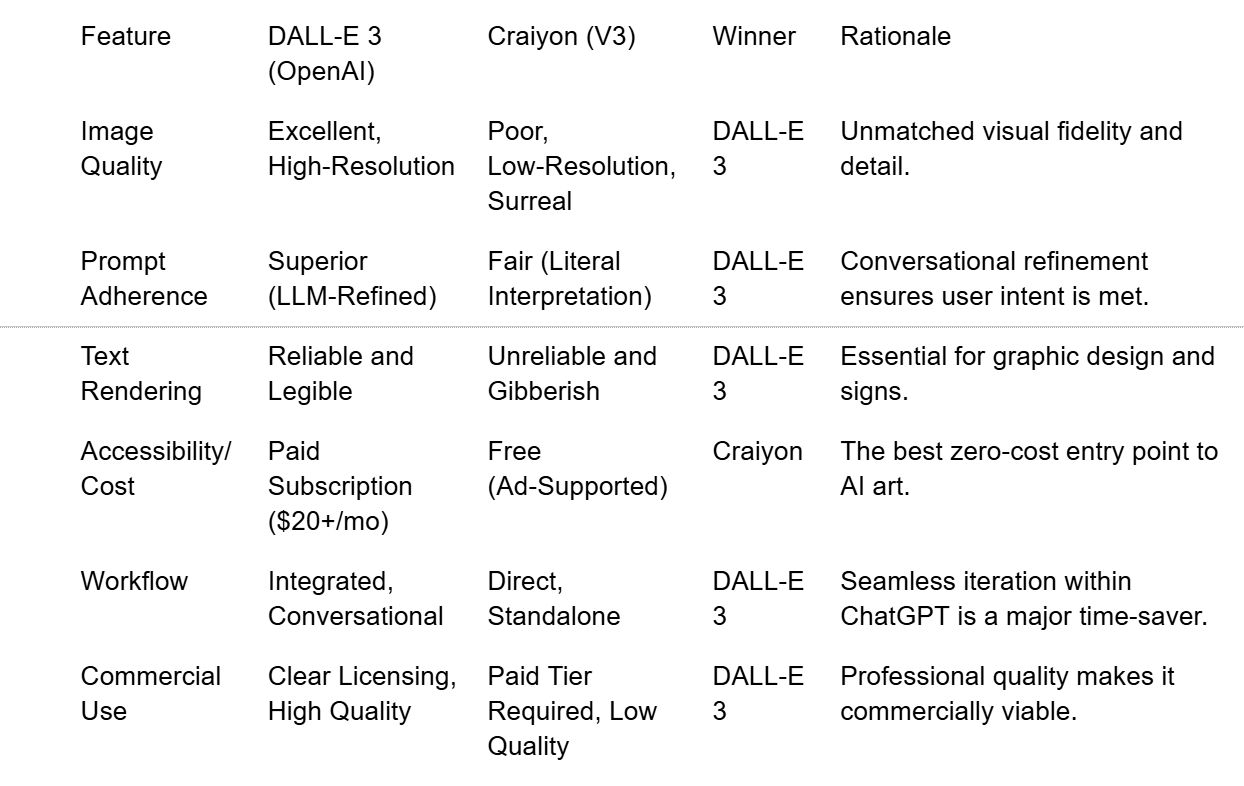
The comparison of DALL-E 3 vs Craiyon ultimately boils down to your budget, your creative goals, and your tolerance for technical imperfection. Both tools serve a valuable purpose in the AI art ecosystem, but they cater to vastly different user bases.
Choose Craiyon if:
•You are a casual user, student, or hobbyist who needs a completely free tool for quick, fun, and experimental image generation.
•You enjoy the surreal, distorted, and unpredictable aesthetic that Craiyon often produces.
•You prioritize seeing a large batch of variations (9 images) over the quality of a single image.
Choose DALL-E 3 if:
•You are a professional content creator, marketer, or designer who requires high-resolution, photorealistic, and commercially viable images.
•You need reliable text rendering and precise adherence to complex, nuanced prompts.
•You value a seamless, integrated, and conversational workflow that saves time and reduces the need for external editing.
In the final analysis, DALL-E 3 vs Craiyon is a contest between the future of premium, integrated AI and the enduring power of free, accessible technology. For serious creative work, DALL-E 3 is the clear professional choice. For pure, unadulterated fun and zero-cost experimentation, Craiyon remains an iconic and beloved tool