DALL-E 3 vs StarryAI: The Ultimate AI Art Generator Showdown
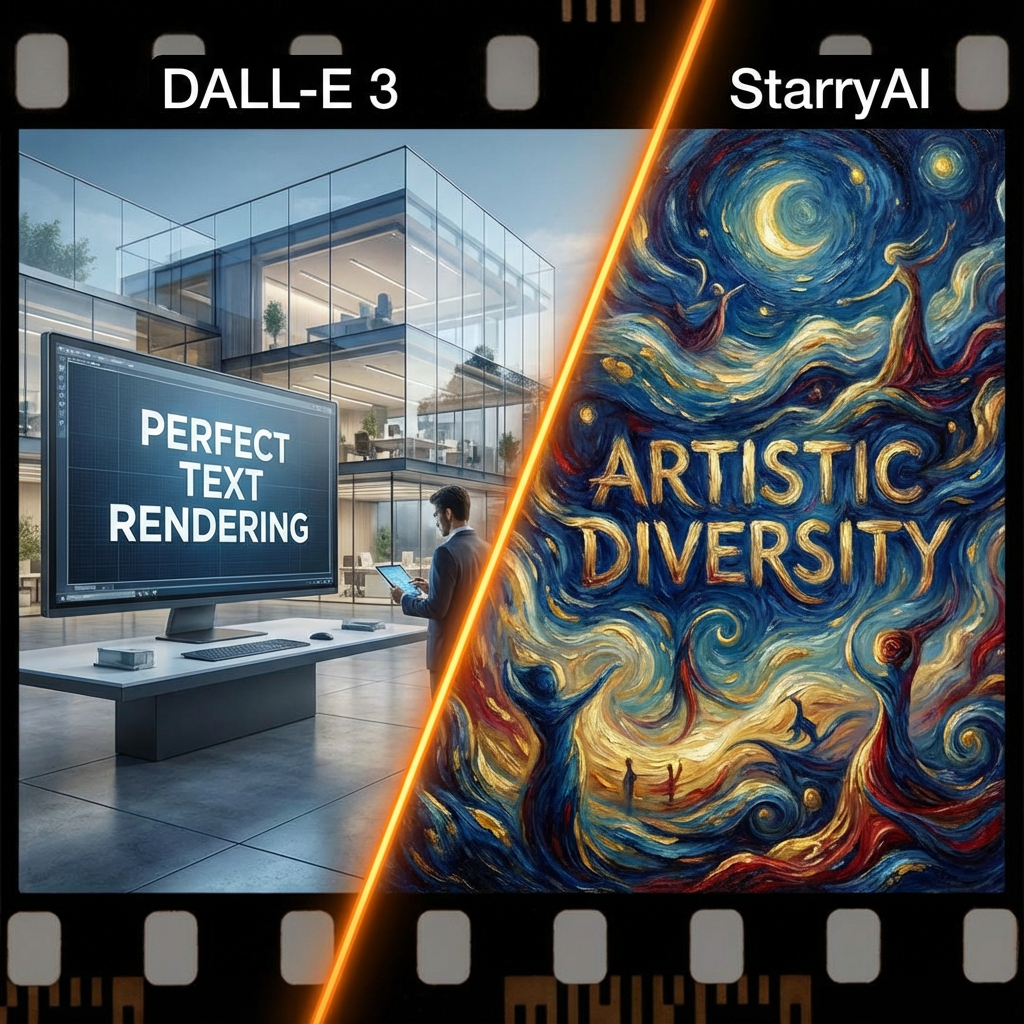
The landscape of AI image generation is a dynamic arena where two distinct philosophies are competing for the attention of millions of creators. On one side stands DALL-E 3, the powerful model from OpenAI, which has set the gold standard for photorealism, text adherence, and deep integration with natural language processing. On the other is StarryAI, a versatile, web-based platform that champions accessibility, a generous free tier, and a comprehensive suite of built-in editing tools.
For artists, designers, and content creators, the choice between DALL-E 3 vs StarryAI is not merely a matter of preference; it is a decision that dictates workflow, creative control, and even commercial viability. This comprehensive 2500-word analysis will dissect the core differences between these two platforms, helping you determine which tool is the ultimate fit for your creative journey.
1. The Core Technology: Precision vs. Versatility
The most significant difference between DALL-E 3 and StarryAI lies in their underlying architecture and, consequently, their approach to image generation. DALL-E 3 is a single, closed, and highly optimized model, while StarryAI is a platform that hosts a diverse collection of models, offering a wider stylistic range.
DALL-E 3: Unmatched Prompt Adherence and Text Rendering
DALL-E 3’s primary claim to fame is its unprecedented prompt adherence. Unlike earlier models that often struggled to correctly interpret complex, multi-clause prompts, DALL-E 3, especially when accessed through the conversational interface of ChatGPT, excels at translating nuanced ideas into accurate visual representations 1. This is particularly evident in its ability to render legible text within images—a task that was notoriously difficult for previous generative models.
The model's strength comes from its tight integration with the large language model (LLM) that powers ChatGPT. When a user enters a prompt, the LLM first refines and expands it into a highly detailed, machine-readable description before feeding it to the image generator. This "prompt-rewriting" process ensures that the final image is a near-perfect reflection of the user's intent, making DALL-E 3 the gold standard for precision and literal interpretation.
StarryAI: Model Diversity and Artistic Styles
StarryAI, in contrast, is a platform built on the principle of model variety. It offers users a selection of different AI models, including various iterations of Stable Diffusion (like SDXL) and its own proprietary models (such as Argo and Altair). This approach means that instead of one perfected aesthetic, users have a toolbox of distinct artistic styles at their disposal.
While StarryAI’s prompt adherence may not always match the literal precision of DALL-E 3, its strength lies in its stylistic versatility. A user can choose a model specifically tuned for photorealism, another for abstract painting, and yet another for anime or fantasy art. This flexibility makes StarryAI an ideal environment for artistic exploration and for creators who need to switch between vastly different visual aesthetics quickly.
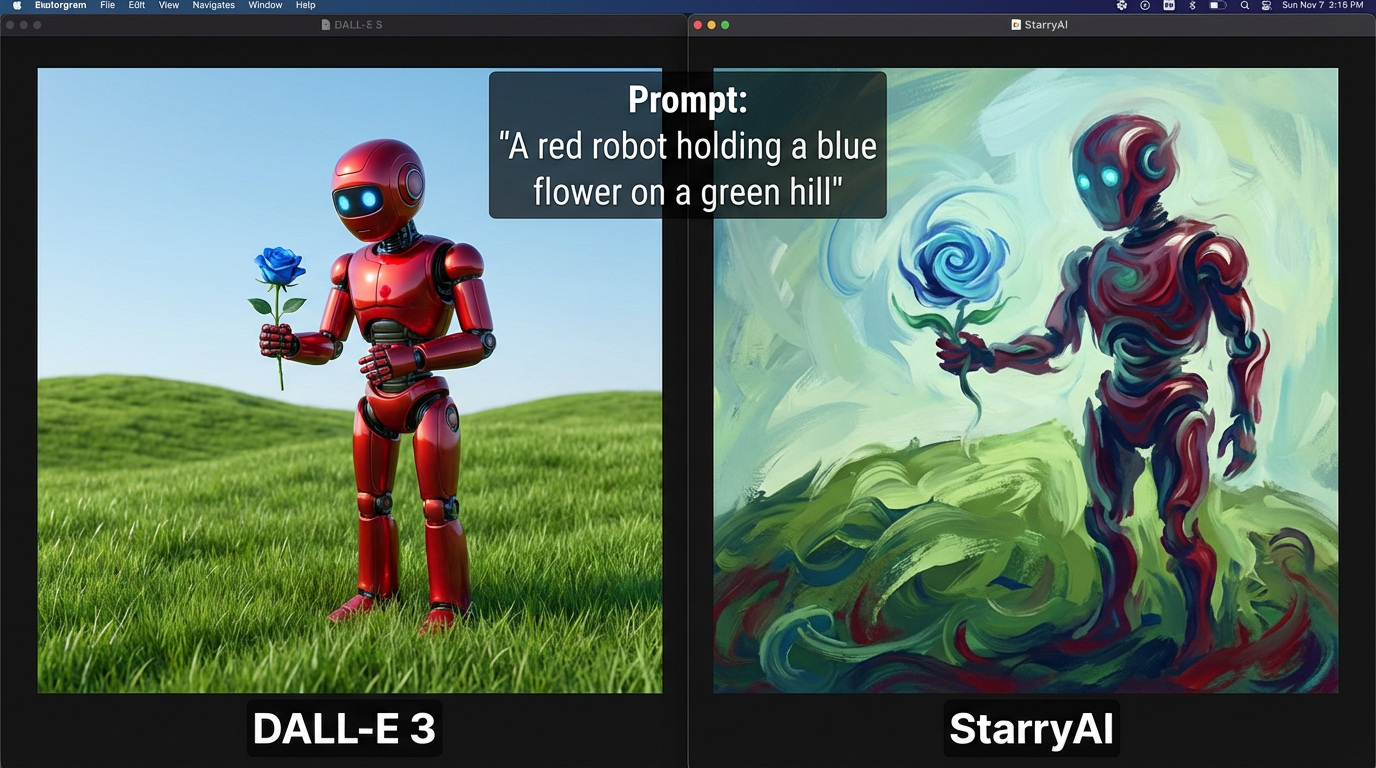
A visual comparison of DALL-E 3's literal interpretation versus StarryAI's artistic, stylized interpretation of the same complex prompt, highlighting the core difference in output philosophy.
2. Workflow and Accessibility: Conversational vs. Dedicated App
The way a user interacts with an AI generator is a critical factor in the overall creative experience. DALL-E 3 vs StarryAI offer radically different workflows, catering to different user habits and environments.
DALL-E 3’s Conversational Workflow
DALL-E 3 is most commonly accessed through the ChatGPT interface or Microsoft’s Bing Image Creator. This means the workflow is inherently conversational. The user doesn't just enter a prompt; they have a dialogue with the AI. This is a low-friction, iterative process where the user can ask the AI to "make the robot redder," "change the background to a sunset," or "add a small dog in the corner" without having to re-enter the entire prompt.
This conversational approach is incredibly intuitive for beginners and powerful for complex, iterative refinement. However, it is tied to the ChatGPT ecosystem, meaning users must be comfortable working within a chat window, which can sometimes feel restrictive for visual artists accustomed to dedicated design software.
StarryAI’s Dedicated App Experience
StarryAI is built as a dedicated mobile and web application. This provides a more traditional, visual-first interface. Users are presented with clear options for selecting models, styles, aspect ratios, and advanced settings like initial images (Image2Image) and negative prompts. The experience is structured and visual, making it feel more like a conventional art application.
The mobile app is a major advantage for StarryAI, allowing creators to generate and manage art on the go. The web interface, while structured, offers a clean, focused environment free from the conversational overhead of a chatbot. This dedicated workflow is often preferred by users who want explicit control over every parameter before generation.
.png)
A side-by-side view of the DALL-E 3 conversational interface (via ChatGPT) and the StarryAI mobile app interface, illustrating the difference between a dialogue-based and a dedicated, structured app workflow.
3. Creative Control and Customization
The level of control a user has over the final output is a key differentiator, especially for professional artists. Both platforms offer control, but they achieve it through different means.
DALL-E 3’s Implicit Control
DALL-E 3’s control is largely implicit, mediated by the LLM. The user controls the output by refining their natural language prompt. For example, instead of manually adjusting a "style" slider, the user describes the style they want ("a 19th-century oil painting of a robot"). The LLM then translates this into the necessary technical parameters.
While this is powerful for achieving high-level artistic goals, it lacks the granular, explicit control over technical parameters that advanced users often crave. There are no direct controls for samplers, steps, or CFG scale—parameters that are essential for fine-tuning the output in the open-source community.
StarryAI’s Explicit Control and Model Variety
StarryAI offers a high degree of explicit control. Users can select from a wide range of models, each with its own strengths and weaknesses. Furthermore, the platform provides direct controls for:
- Aspect Ratio: Easily adjustable for different social media or print formats.
- Initial Image (Image2Image): A core feature for transforming existing photos or sketches.
- Negative Prompts: Essential for steering the AI away from unwanted elements.
This explicit control, combined with the sheer model variety available on the platform, gives the user a broader creative palette. If one model fails to deliver the desired result, the user can simply switch to another, a flexibility that is not possible with DALL-E 3’s single-model architecture.
.png)
A visual metaphor comparing DALL-E 3 as a single, perfected diamond (unified model) versus StarryAI as a collection of diverse, colorful gemstones (multiple models and styles), symbolizing the difference in creative options.
4. Pricing, Free Tiers, and Commercial Licensing
For many users, the financial model is the deciding factor. The comparison between DALL-E 3 vs StarryAI reveals a stark contrast between a premium, subscription-based service and a freemium, credit-based model.
DALL-E 3’s Premium Model and Indemnity
Access to DALL-E 3 is typically bundled with a paid subscription to ChatGPT Plus or through the API, making it a premium service. While Microsoft offers DALL-E 3 access for free via Bing Image Creator, the highest-quality, most reliable access is generally tied to a paid tier.
The major commercial advantage of DALL-E 3, particularly when used through Adobe or Microsoft, is the promise of copyright indemnity. This means that the company stands behind the user's commercial use of the generated images, offering a crucial layer of legal protection against intellectual property claims. This feature alone makes DALL-E 3 the preferred choice for large enterprises and commercial artists who cannot afford legal risk.
StarryAI’s Generous Free Tier and Credit System
StarryAI operates on a generous freemium model. It offers users a set number of free credits daily, allowing casual users and hobbyists to generate high-quality art without any financial commitment. For power users, the platform uses a credit system where credits can be purchased in bundles.
This credit-based system offers flexibility: users only pay for what they generate. Furthermore, StarryAI grants users full ownership of their creations, allowing them to use the images commercially without restriction. While it does not offer the same legal indemnity as DALL-E 3, its clear ownership terms and accessible free tier make it a highly attractive option for independent artists and small businesses.
.png)
A visual comparing DALL-E 3's premium, subscription-based access (locked box) with StarryAI's generous free tier and credit system (open treasure chest).
5. Use Cases and Target Audience
The fundamental differences in architecture, workflow, and pricing mean that DALL-E 3 vs StarryAI appeal to distinct user bases and excel in different use cases.
When to Choose DALL-E 3
DALL-E 3 is the superior choice for use cases that demand precision, realism, and commercial safety.
- Marketing and Advertising: When a brand needs an image that perfectly matches a detailed brief, including specific text, logos, or product placement, DALL-E 3’s prompt adherence is unmatched. The legal indemnity further de-risks commercial campaigns.
- Specific Concept Art: For concept artists who need to quickly visualize a highly specific scene, character, or object with minimal prompt engineering effort, the conversational workflow and literal interpretation save significant time.
- Integration with LLMs: Users who are already heavily invested in the ChatGPT or Microsoft ecosystem will find DALL-E 3’s seamless integration a major productivity boost.
When to Choose StarryAI
StarryAI is the ideal tool for artistic exploration, mobile creation, and budget-conscious users.
- Artistic Exploration: The vast array of models and styles makes StarryAI a playground for artists looking to experiment with different aesthetics, from abstract expressionism to cyberpunk realism.
- Mobile Content Creation: The dedicated mobile app makes StarryAI the best-in-class tool for generating high-quality images directly on a smartphone or tablet, perfect for social media creators on the go.
- Budget-Conscious Users: The generous free tier and flexible credit system make StarryAI the most accessible entry point for hobbyists and students who want to explore AI art without a recurring subscription fee.
6. Technical Deep Dive: The Models Under the Hood
While the user experience is the most visible difference, a look under the hood reveals the technical chasm between the two platforms.
DALL-E 3 is a closed, proprietary model developed by OpenAI. Its architecture is not public, but its performance suggests a massive, highly curated training dataset and a novel method for aligning the image generation process with the LLM's understanding of the prompt. This unified, end-to-end approach is what gives DALL-E 3 its superior prompt adherence.
StarryAI, conversely, is an interface and hosting platform for multiple models. While it may have its own proprietary models, a significant portion of its offerings are based on the open-source Stable Diffusion architecture. This means that StarryAI’s performance is often a reflection of the latest advancements in the open-source community, such as the release of SDXL. The platform’s value is in curating, optimizing, and simplifying access to these diverse models, rather than developing a single, foundational model from scratch.
This difference is crucial: DALL-E 3 offers the cutting edge of a single, highly refined technology, while StarryAI offers the breadth and flexibility of the entire open-source ecosystem, packaged for ease of use.
7. The Future of the Rivalry
The competition between DALL-E 3 vs StarryAI is driving innovation in two distinct directions:
- DALL-E 3’s Trajectory: OpenAI will continue to push the boundaries of realism and temporal coherence, likely integrating DALL-E 3 more deeply into video and 3D generation tools. Its focus will remain on the enterprise and professional market, leveraging its technical superiority and legal protections.
- StarryAI’s Trajectory: StarryAI will continue to expand its model library, integrate new open-source advancements faster, and enhance its editing and social features. Its focus will remain on the independent creator, offering the most versatile and accessible platform for artistic expression.
The market is large enough for both to thrive. The professional will likely maintain a paid DALL-E 3 subscription for commercial work, while the artistic enthusiast will rely on StarryAI for daily creative exploration and stylistic variety.
8. Output Quality and Aesthetic Differences: Realism vs. Artistic Flair
While both platforms generate high-quality images, the aesthetic signature of DALL-E 3 vs StarryAI is markedly different, a direct consequence of their underlying design philosophies.
DALL-E 3: The Pursuit of Photorealism and Coherence
DALL-E 3, particularly when generating photorealistic images, excels at lighting, texture, and overall scene coherence. The images often possess a clean, polished, and highly professional look, making them immediately suitable for commercial use or high-end concept art. Its strength lies in its ability to render complex scenes with accurate physics and logical relationships between objects. This focus on realism and coherence is what allows it to be a "world simulator," where the generated image feels like a plausible snapshot from a real or imagined world.
However, this pursuit of perfection can sometimes lead to a characteristic "DALL-E look"—an aesthetic that is so polished it can feel slightly sterile or lacking in the raw, unpredictable texture of traditional art. When attempting to mimic specific artistic styles, DALL-E 3 often produces a highly accurate digital representation of that style, rather than the organic feel of the original medium.
StarryAI: Stylistic Depth and Traditional Media Mimicry
StarryAI, leveraging its diverse model base, offers a much broader spectrum of aesthetic outputs. Its models are often better at mimicking the texture and brushwork of traditional media. A prompt for an "oil painting" on StarryAI is more likely to produce an image with visible impasto and a painterly feel than DALL-E 3, which might produce a photorealistic image of an oil painting.
The platform's strength is its stylistic depth. Users can generate images that feel more like unique works of art, with a distinct flair that is less concerned with perfect photorealism and more focused on emotional impact and artistic interpretation. This is particularly true when using its proprietary models, which are often tuned for specific, highly stylized aesthetics. While this can sometimes result in less literal adherence to the prompt, it often leads to more surprising and artistically compelling results. This difference in aesthetic output is a key consideration for artists choosing between the two platforms.
This aesthetic divergence is a core part of the DALL-E 3 vs StarryAI debate. DALL-E 3 is the master of the literal and the real, while StarryAI is the champion of the stylized and the artistic.
9. Summary of the Showdown: DALL-E 3 vs StarryAI
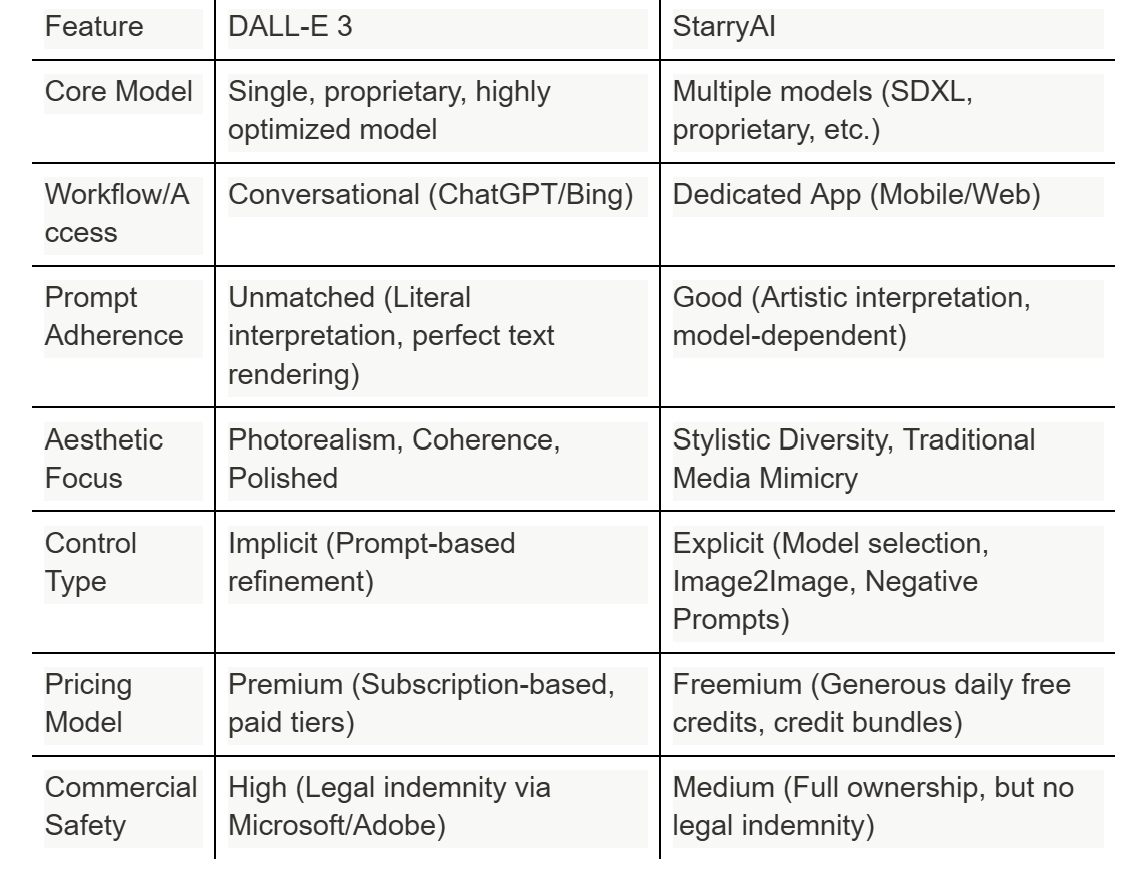
The following table summarizes the key differences between the two platforms, providing an at-a-glance comparison for quick decision-making.
Conclusion: Which AI Art Generator Reigns Supreme?
The question of which tool is "better" depends entirely on the user's priorities.
For the user who demands uncompromising precision, perfect text rendering, and commercial legal safety, DALL-E 3 is the clear and undisputed winner. Its integration with ChatGPT creates a powerful, low-effort workflow for achieving highly specific, photorealistic results.
For the user who prioritizes stylistic variety, a generous free tier, and a dedicated mobile/web editing experience, StarryAI is the superior choice. Its flexibility and accessibility make it the ultimate tool for artistic exploration and rapid content creation across multiple aesthetics.
Ultimately, the choice between DALL-E 3 vs StarryAI is a choice between Premium Precision and Accessible Versatility. Both are powerful, but they are designed for different creative missions.