Latenode Review 2025: Best No-Code Automation Platform?
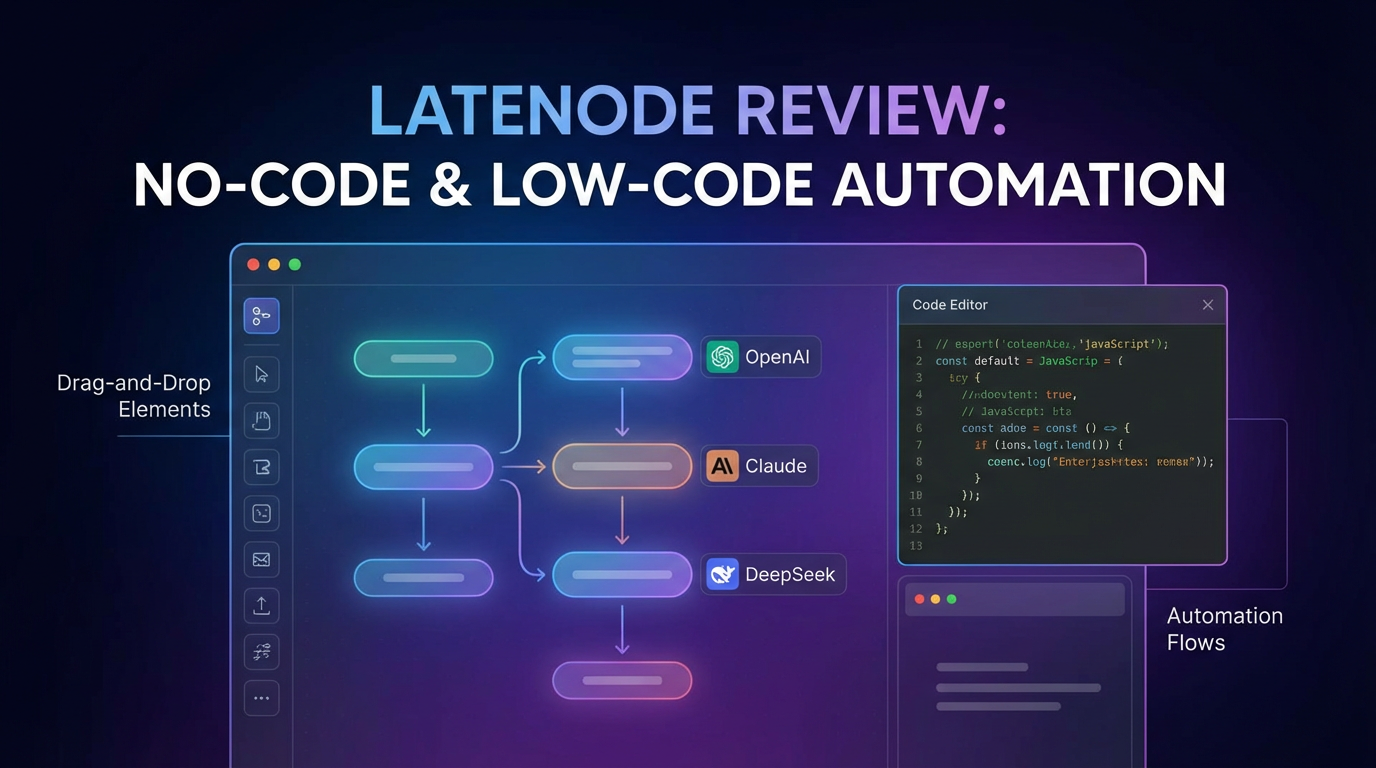
In the hyper-competitive landscape of 2025, digital transformation is not just a buzzword; it’s the engine of survival and growth. Businesses are in a relentless pursuit of operational efficiency, and at the heart of this quest lies workflow automation. For years, the no-code movement has been dominated by giants like Zapier and Make (formerly Integromat), empowering millions to connect apps and automate tasks. However, as business needs evolve, the limitations of traditional iPaaS (Integration Platform as a Service) solutions are becoming apparent. The demand is shifting towards more powerful, flexible, and AI-native platforms that can handle complex business process automation and true workflow orchestration.
Enter Latenode, a formidable contender that is rapidly redefining the boundaries of no-code automation. It doesn’t just aim to be another connector; it presents itself as a next-generation low-code platform designed for the age of AI. Latenode’s core premise is a powerful hybrid approach: the simplicity of a visual workflow builder for citizen developers combined with the raw power of JavaScript for professional developers. This dual identity, coupled with its groundbreaking unified access to over 400 AI models, positions it as a unique solution for building not just automations, but truly autonomous workflows and AI agents.
This 4000-word review will provide an exhaustive analysis of the Latenode platform. We will dissect its architecture, from the non-linear workflow builder to its revolutionary credit-based pricing. We’ll explore how its deep AI model integration is a game-changer for SaaS automation and data integration. By comparing it directly with established leaders, we will determine if Latenode truly delivers on its promise of superior flexibility, power, and cost optimization. Is it the key to unlocking the next level of hyperautomation, or just another player in a crowded market? Let’s find out.
What is Latenode? The Convergence of No-Code, Low-Code, and AI
Latenode is more than just an automation tool; it’s a comprehensive low-code platform for process automation. Unlike purely no-code tools that can feel restrictive, or full-code solutions that are inaccessible to non-developers, Latenode carves out a powerful middle ground. It empowers business users, analysts, and marketers to create sophisticated automations using a drag-and-drop interface, while giving developers an escape hatch to inject custom logic, perform complex data manipulation, and build bespoke integrations using JavaScript. This philosophy of extensibility is central to its appeal.
The platform’s second pillar is its AI-first architecture. While other platforms treat AI as an add-on, Latenode builds it into the core. It offers a single, unified subscription to access a massive library of over 400 AI models, including those from OpenAI, Anthropic (Claude), Google (Gemini), and open-source giants like LLaMA. This AI democratization eliminates the need for users to manage dozens of separate API keys and subscriptions, making the development of AI agents and intelligent autonomous workflows dramatically simpler and more cost-effective. This focus on integrated AI is a critical component of modern business intelligence and workflow efficiency.
A Deep Dive into Latenode’s Core Features
Latenode’s power lies in the synergy of its features, which collectively offer a robust environment for building, deploying, and scaling automations.
The Non-Linear Visual Workflow Builder
The foundation of Latenode is its intuitive yet powerful visual workflow builder. Unlike the strictly linear (Step A -> Step B -> Step C) approach of tools like Zapier, Latenode supports non-linear workflows with branching logic, loops, and complex routing. This is crucial for real-world business process automation, where processes are rarely straightforward.
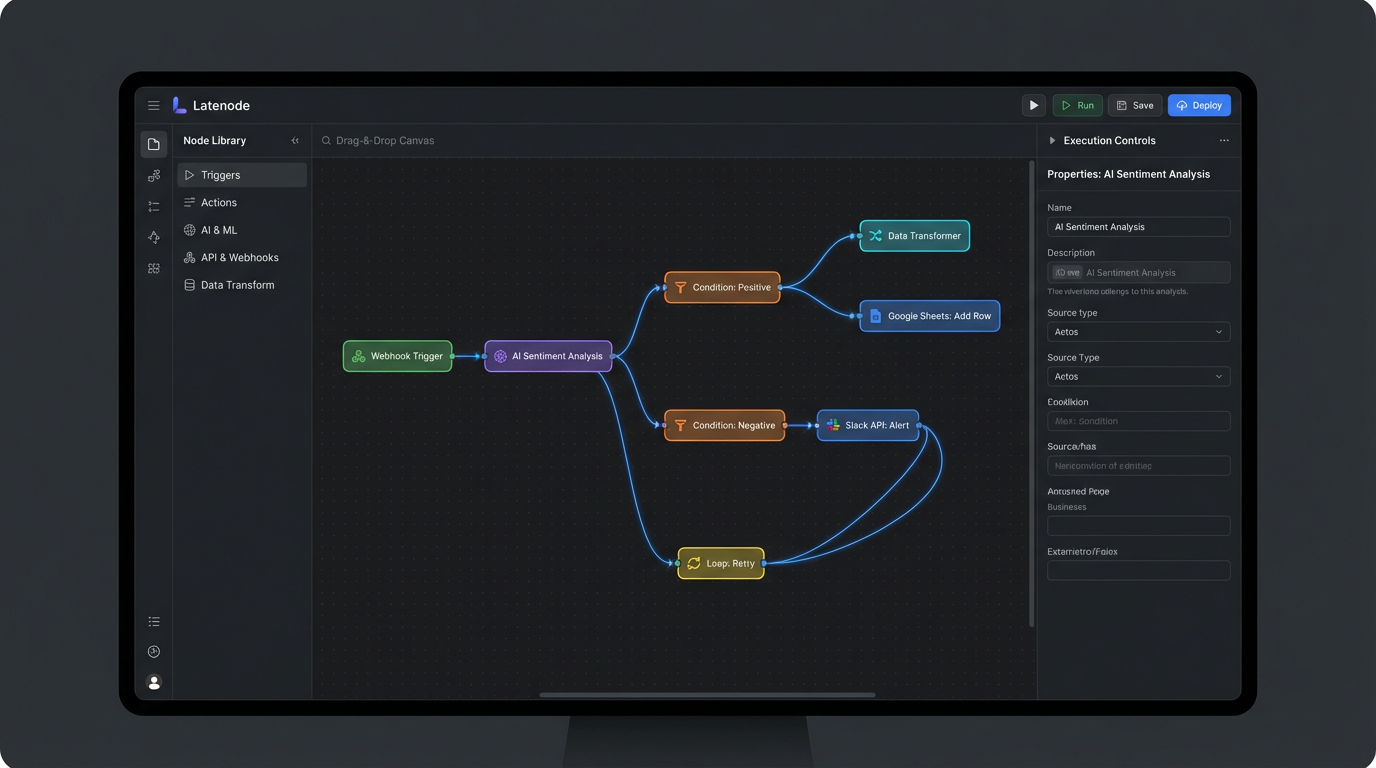
Caption: Latenode’s non-linear canvas allows for complex branching and routing, mirroring real-world business processes.
This non-linear design allows you to build sophisticated scenarios that can handle errors gracefully, retry failed steps, and route data based on conditional logic. For anyone who has felt constrained by the linear limitations of other platforms, Latenode’s canvas feels like a breath of fresh air, enabling true workflow orchestration rather than simple task automation.
Low-Code Flexibility with JavaScript
This is where Latenode truly separates itself from the no-code pack. At any point in a workflow, you can add a code node and write custom JavaScript. This unlocks limitless possibilities for API automation and data integration.

Caption: Developers can inject custom JavaScript directly into a workflow for advanced data manipulation and logic.
This feature is a game-changer for several reasons:
•Custom Data Transformation: You can parse complex JSON, reformat data, and perform calculations that are impossible with standard no-code tools.
•Bespoke API Calls: If a pre-built connector doesn’t exist, you can use a code node to make custom HTTP requests to any API.
•Enhanced Logic: Implement complex business rules and algorithms that go beyond simple if/then conditions.
This hybrid approach bridges the gap between citizen developers and professional programmers, fostering collaboration and enabling the creation of far more robust and scalable solutions. It’s a key element in achieving true hyperautomation.
Unified AI Model Access
Latenode’s most forward-thinking feature is its unified AI layer. Managing API keys and billing for multiple AI services is a significant pain point for businesses. Latenode solves this by offering a single subscription that provides access to a vast library of AI models.
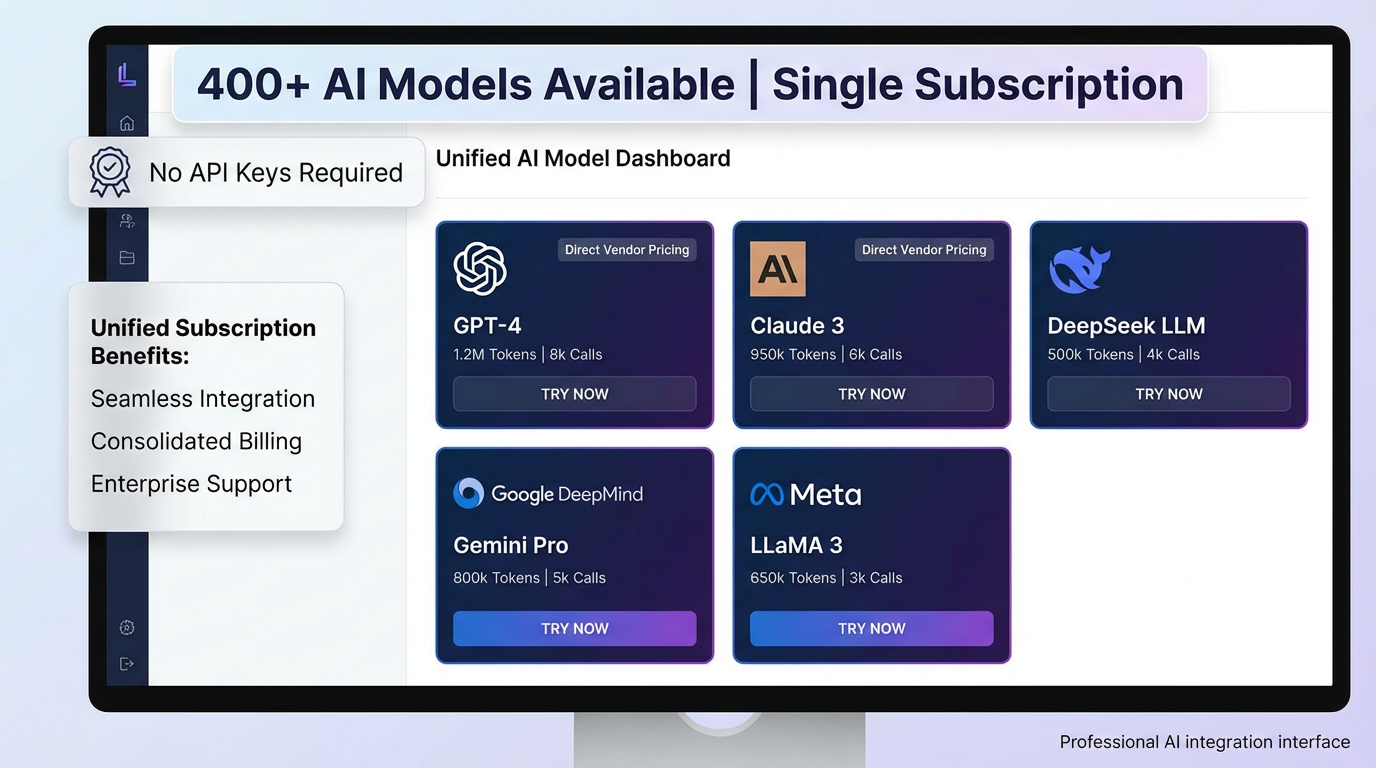
Caption: Latenode provides access to over 400 AI models through a single, unified subscription, simplifying AI integration.
This approach to AI model integration offers immense benefits:
•Cost & Simplicity: One bill, one subscription. This drastically simplifies cost optimization and administration.
•Flexibility: Easily switch between models (e.g., use GPT-4 for creative tasks and Claude for long-form analysis) within the same workflow to optimize for cost and performance.
•Future-Proofing: As new models emerge, Latenode adds them to the library, giving you instant access without any integration work.
Furthermore, with features like RAG (Retrieval-Augmented Generation), you can connect these AI models to your own knowledge bases, allowing you to build AI agents that have memory and can provide context-aware responses. This is the cornerstone of building intelligent, autonomous workflows.
Cost-Effective, Credit-Based Pricing
Latenode’s pricing model is a direct challenge to the task-based billing of its competitors. Instead of charging for every single task in a workflow, Latenode uses a credit system based on execution time. This is a more logical and cost-effective approach for complex workflow automation.
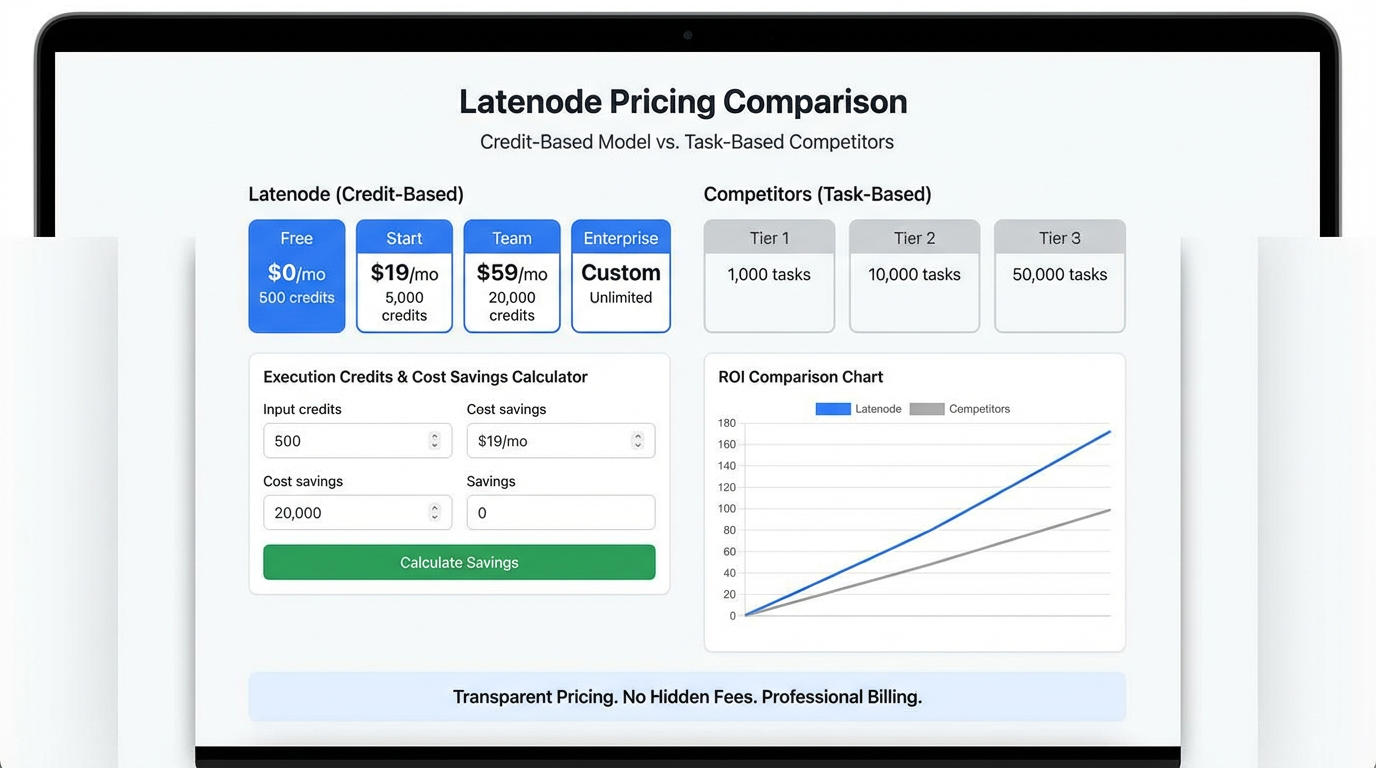
Caption: Latenode’s credit-based pricing offers a more predictable and often cheaper alternative to the task-based models of competitors.
Consider a workflow with 10 steps. On a task-based platform, this could consume 10 tasks from your monthly allowance. On Latenode, the entire workflow’s execution might only consume a few credits, depending on how long it takes to run. This encourages the creation of more comprehensive and robust automations without the fear of runaway costs, a critical factor for scalability and achieving a positive ROI on your productivity tools.
Latenode Pricing: Power and Predictability
Latenode’s pricing structure is designed to be transparent and scalable, directly reflecting its value proposition of cost optimization.
•Free Plan: Ideal for individuals and hobbyists looking to explore the platform. It includes a generous number of credits to get started with real process automation.
•Start Plan ($19/month): Aimed at freelancers and solopreneurs, this plan provides a significant boost in execution credits, making it perfect for automating core business tasks.
•Team Plan ($59/month): Designed for SMBs, this plan offers more credits, collaborative features, and the capacity to handle higher-volume workflow automation.
•Enterprise Plan (Custom): For large organizations requiring advanced security, dedicated support, and custom SLAs to support their digital transformation initiatives.
The key takeaway is the value derived from the credit-based system. It aligns cost with actual resource consumption, making Latenode a highly efficient choice for businesses looking to maximize their investment in cloud automation.
Pros and Cons: A Balanced Analysis
Pros:
•Unmatched Flexibility: The no-code and low-code hybrid model is a clear winner for both business users and developers.
•Superior AI Integration: The unified AI subscription is a revolutionary feature that simplifies building intelligent automations.
•Cost-Effective at Scale: The credit-based pricing model is significantly more affordable for complex workflows.
•Powerful Workflow Engine: Non-linear design allows for the creation of robust and realistic business process automations.
•Developer-Friendly: Direct JavaScript integration and a focus on developer tools make it a powerful platform for technical users.
•Active and Growing Community: A strong community provides support and shared knowledge, accelerating the learning curve.
Cons:
•Newer on the Scene: As a younger platform, its library of pre-built app connectors is smaller than Zapier’s massive ecosystem.
•Learning Curve for Advanced Use: While the basics are easy, leveraging the full power of JavaScript and non-linear logic requires a deeper understanding.
•Documentation Can Be Improved: While growing, the documentation may not be as exhaustive as that of more mature platforms.
Final Verdict: Is Latenode the Future of Automation in 2025?
After an exhaustive review, the answer is a resounding yes—for a specific and growing segment of the market. Latenode is not just another Zapier clone; it represents a fundamental evolution in the iPaaS landscape. It successfully bridges the chasm between simplicity and power, making it an exceptional choice for businesses that are serious about hyperautomation.
You should choose Latenode if:
•You are building AI-powered workflows and want to leverage multiple models without the headache of managing APIs.
•Your automation needs go beyond simple linear tasks and require complex logic, branching, and error handling.
•You are a developer or have access to development resources and want the flexibility to write custom code within your automations.
•You are a cost-conscious business tired of the unpredictable and often exorbitant costs of task-based pricing at scale.
You might stick with a competitor if:
•Your needs are extremely simple, and you only require basic, linear automations between popular apps.
•You rely on a niche application that has a pre-built connector on Zapier but not yet on Latenode.
In 2025, Latenode stands out as the platform for builders. It’s for the forward-thinking companies that see automation not just as a way to connect apps, but as a strategic tool for building intelligent systems, optimizing operations, and driving digital transformation. Its unique blend of no-code accessibility, low-code power, and native AI integration makes it, in our opinion, the most exciting and powerful no-code automation platform on the market today.
Frequently Asked Questions (FAQ)
1. Is Latenode truly a no-code platform? Can non-developers use it? Yes, absolutely. The core of Latenode is a visual, drag-and-drop builder that requires no coding knowledge. Non-developers can build highly sophisticated workflows using the pre-built nodes and logic tools.
2. How does Latenode’s pricing compare to Zapier for a complex workflow? For a complex, multi-step workflow, Latenode is almost always significantly cheaper. A 15-step workflow on Zapier could cost 15 tasks, while on Latenode it would be a single execution billed for its runtime, which is far more cost-effective.
3. What does “Unified AI Model Access” actually mean? It means you pay one subscription to Latenode, and through their platform, you can use over 400 different AI models (like GPT-4, Claude 3, etc.) in your workflows without needing to sign up for, pay for, or manage API keys for each of those AI services individually.
4. What is the main advantage of a non-linear workflow? A non-linear workflow allows you to build automations that mirror real-world complexity. You can add “if/then” branches, create loops to process lists of items, and set up custom error-handling paths, making your automations far more robust and reliable.
5. Do I need to be a JavaScript expert to use the low-code features? No. You can start with simple code snippets found in documentation or community forums. The feature is there for when you need it, but it’s not required for most automations. It provides a path for growth and scalability.
6. Can Latenode replace our internal scripting and cron jobs? In many cases, yes. Latenode can act as a more visual, manageable, and collaborative platform for running scheduled tasks and internal scripts that would traditionally be handled by developers using cron jobs and custom code.
7. What is RAG and why is it important for AI agents? RAG (Retrieval-Augmented Generation) allows an AI model to access external knowledge (like your company’s internal documents) before generating a response. This gives your AI agents a “memory” and allows them to answer questions based on your specific data, not just their general training.
8. How does Latenode ensure security with custom code execution? Latenode runs all custom code in a secure, isolated sandbox environment. This prevents any custom script from accessing the underlying infrastructure or interfering with other users’ workflows, ensuring a high level of security for all cloud automation.
9. What is the difference between an automation, a workflow, and an AI agent? An automation is a single task (e.g., send an email). A workflow is a series of connected tasks to achieve a business process. An AI agent is an advanced workflow that uses AI to make decisions, understand context, and operate autonomously to achieve a goal.
10. Is Latenode a good choice for a large enterprise? With its Enterprise Plan, custom SLAs, and ability to handle complex business process automation, Latenode is a strong contender for enterprise use. Its combination of governance features and developer-friendly tools makes it suitable for large-scale digital transformation projects.