Midjourney vs Artbreeder: The Ultimate AI Image Generator Showdown
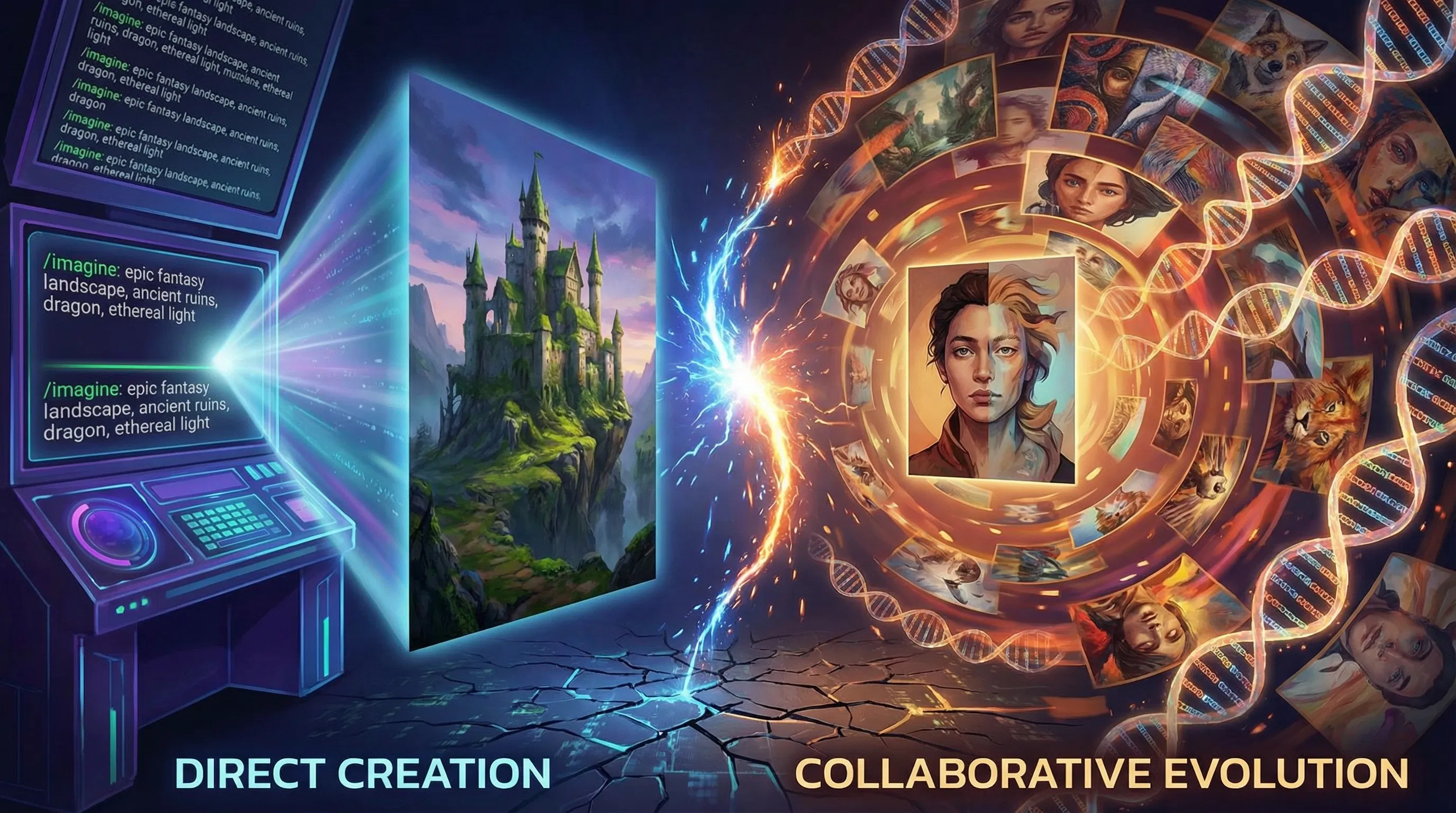
The world of AI image generation is a vast and rapidly evolving landscape, but two platforms stand out for their fundamentally different approaches to creation: Midjourney and Artbreeder. While both tools harness the power of artificial intelligence to produce stunning visuals, they represent two distinct philosophies of art generation—one focused on precise, text-driven creation, and the other on collaborative, evolutionary blending.
For artists, designers, and concept creators, the choice between these two is critical, as it dictates the entire creative workflow. Do you prefer the high-fidelity, cinematic output of a text-to-image powerhouse, or the nuanced, iterative control of a generative evolution tool? This comprehensive 2500-word analysis will serve as your definitive guide, comparing the core mechanics, aesthetic output, control features, and commercial viability of both platforms. By the end, you will understand which tool is best suited for your specific creative needs. The contest of Midjourney vs Artbreeder is a fascinating study in the diverse applications of generative AI.
1. Core Philosophy: Text-to-Image Creation vs. Generative Evolution
The most profound difference between Midjourney and Artbreeder lies in their underlying generative models and the user's primary mode of interaction.
Midjourney: The Text-to-Image Powerhouse
Midjourney operates on a diffusion model, a state-of-the-art AI architecture that generates images from scratch based on a text prompt.
•Diffusion Model: The process begins with random noise, which the model then iteratively "denoises" and refines until it matches the visual concepts described in the user's text prompt. This method excels at creating highly detailed, compositionally sound, and aesthetically polished images that are often described as "cinematic" or "painterly."
•Direct Creation: The user's role is that of a director or a writer. You describe the scene, the style, the lighting, and the mood, and Midjourney attempts to render that vision directly. The output is a finished, high-resolution piece of art, ready for use.
•Prompt-Centric: Mastery of Midjourney is largely about mastering the art of prompt engineering—learning the right keywords, parameters, and syntax to guide the AI to your desired result.
Artbreeder: The Evolutionary Splicer
Artbreeder, in contrast, is built on Generative Adversarial Networks (GANs) and a unique "splicing" mechanism.
•GAN-Based Evolution: Artbreeder’s core function is not to create from text, but to mix, evolve, and manipulate existing images. Users select "parent" images and then use sliders to blend their "genes" (latent space vectors) to create "child" images. This process is akin to genetic breeding or digital collage.
•Iterative Refinement: The user's role is that of a geneticist or an editor. You are constantly refining, blending, and evolving an image over multiple generations. The Artbreeder Splicer tool allows for a high degree of interactive control over the image's features, mood, and style.
•Image-Centric: While Artbreeder has introduced some text-to-image features, its strength remains in image-to-image manipulation and the creation of highly consistent character and world assets.
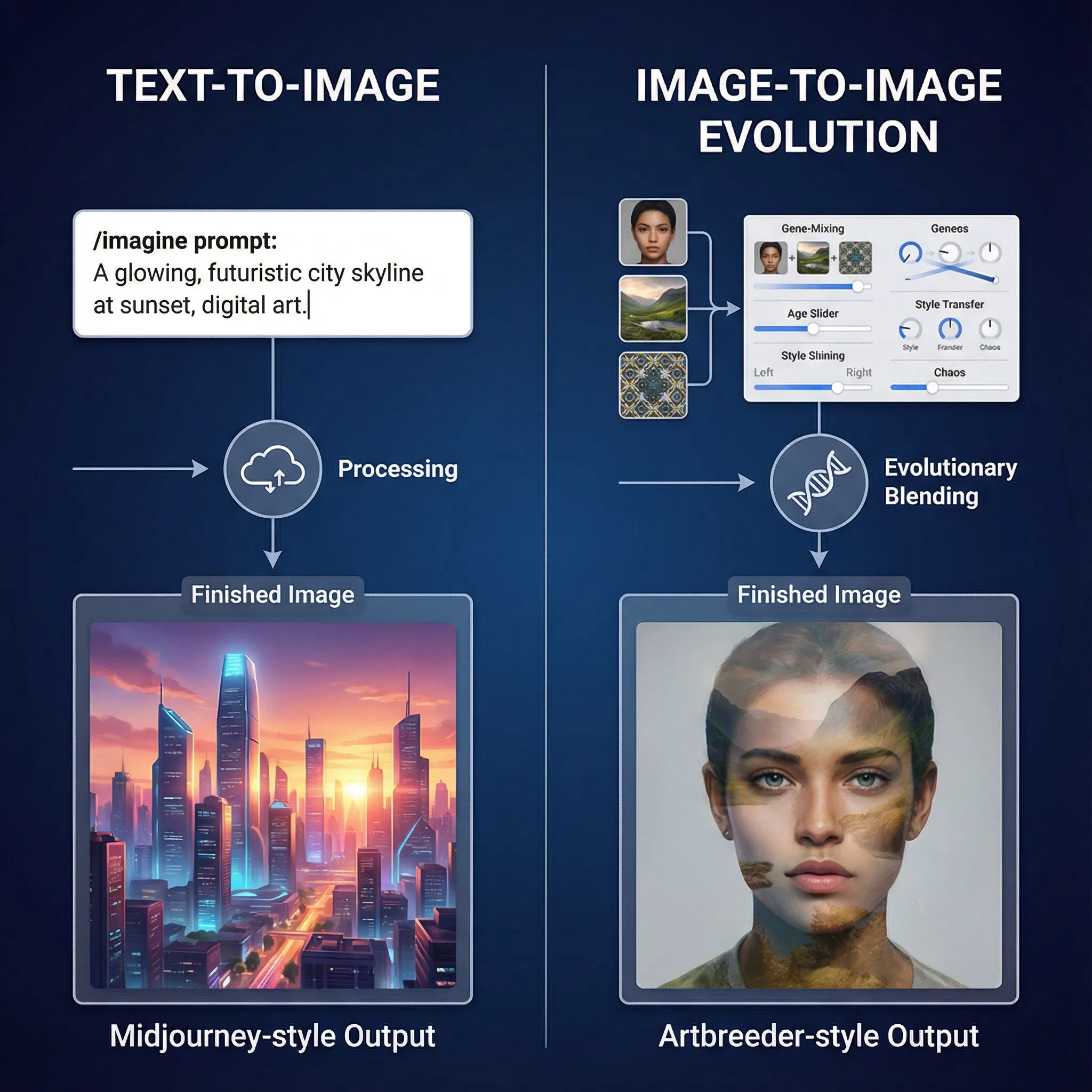
A side-by-side visual comparison of the core generation method. On the left, a single, clean prompt box leading to a finished, high-quality image (Midjourney). On the right, a complex interface with sliders, gene-mixing controls, and multiple image inputs leading to a finished image (Artbreeder). Label the left 'Text-to-Image' and the right 'Image-to-Image Evolution'.
2. Aesthetic and Output Quality: Cinematic Polish vs. Blended Consistency
The visual signature of each tool is immediately recognizable and reflects its core technology.
Midjourney’s Signature Aesthetic
Midjourney is renowned for its distinctive, high-quality aesthetic that often leans toward the epic, the fantastical, and the hyper-detailed.
•Cinematic Quality: Midjourney outputs are characterized by dramatic lighting, deep shadows, rich textures, and a strong sense of composition. It excels at generating landscapes, architectural concepts, and high-fantasy scenes that look like they belong in a AAA video game or a major film production.
•Artistic Versatility: While it has a signature look, Midjourney is highly versatile, capable of generating images in the style of famous painters, photographers, or specific artistic movements, provided the prompt is well-engineered.
•High Resolution: The final outputs are consistently high-resolution and suitable for professional printing or digital display.
Artbreeder’s Signature Aesthetic
Artbreeder’s output is defined by its blended, often painterly, and highly consistent nature, particularly in character and portrait work.
•Blended Consistency: Because Artbreeder works by mixing existing images, its outputs tend to have a smooth, almost airbrushed or painterly quality. This is particularly effective for maintaining the visual consistency of characters across multiple iterations, a key feature for writers and game developers 1
.
•Focus on Features: Artbreeder’s strength lies in manipulating specific features—changing a character's age, gender, expression, or the mood of a landscape—with a high degree of control.
•Specialized Models: Artbreeder offers specialized "Breeder" models (e.g., Portraits, Landscapes, Album Covers) that are fine-tuned for specific tasks, allowing for highly relevant and consistent results within those domains.
%20vs%20paint.webp)
A side-by-side comparison of aesthetic output. On the left, a hyper-detailed, cinematic, high-fantasy scene with dramatic lighting (Midjourney style). On the right, a character portrait with a slightly blurred, painterly, and genetically-mixed look (Artbreeder style). The prompt for both should be 'A warrior with glowing eyes in a misty forest'.
3. Creative Control and Workflow: Parameter-Driven vs. Slider-Based
The way a user exerts control over the final image is perhaps the most significant workflow difference between Midjourney vs Artbreeder.
Midjourney’s Prompt Control
Midjourney’s control system is primarily text-based, relying on a complex array of parameters and modifiers appended to the main prompt.
•Parameter Depth: Users control aspects like aspect ratio (--ar), stylization (--s), chaos (--c), and seed values (--seed) using command-line-style inputs. This offers incredible depth of control, but requires a steep learning curve and memorization of syntax.
•Iterative Prompting: The workflow involves generating an initial set of images, selecting the best one, and then using the "Vary" or "Remix" features with new, refined prompts and parameters to guide the evolution.
•Discord Dependency: Midjourney’s primary interface is the Discord chat application, which can be chaotic and distracting, though it fosters a strong sense of community and real-time feedback.
Artbreeder’s Splicer Control
Artbreeder’s control system is visual and interactive, making it highly intuitive for users who prefer direct manipulation.
•Slider-Based Genes: The core of Artbreeder is the Splicer, which exposes the underlying "genes" of the image as simple sliders (e.g., Age, Gender, Emotion, Color Palette). Users can drag these sliders to instantly see the image evolve in real-time.
•Direct Manipulation: This direct, visual manipulation is ideal for character design, where a user needs to quickly iterate on subtle facial features or blend two different styles together.
•Web-Based Interface: Artbreeder is a dedicated web application, offering a clean, focused interface that is less distracting than a chat application.
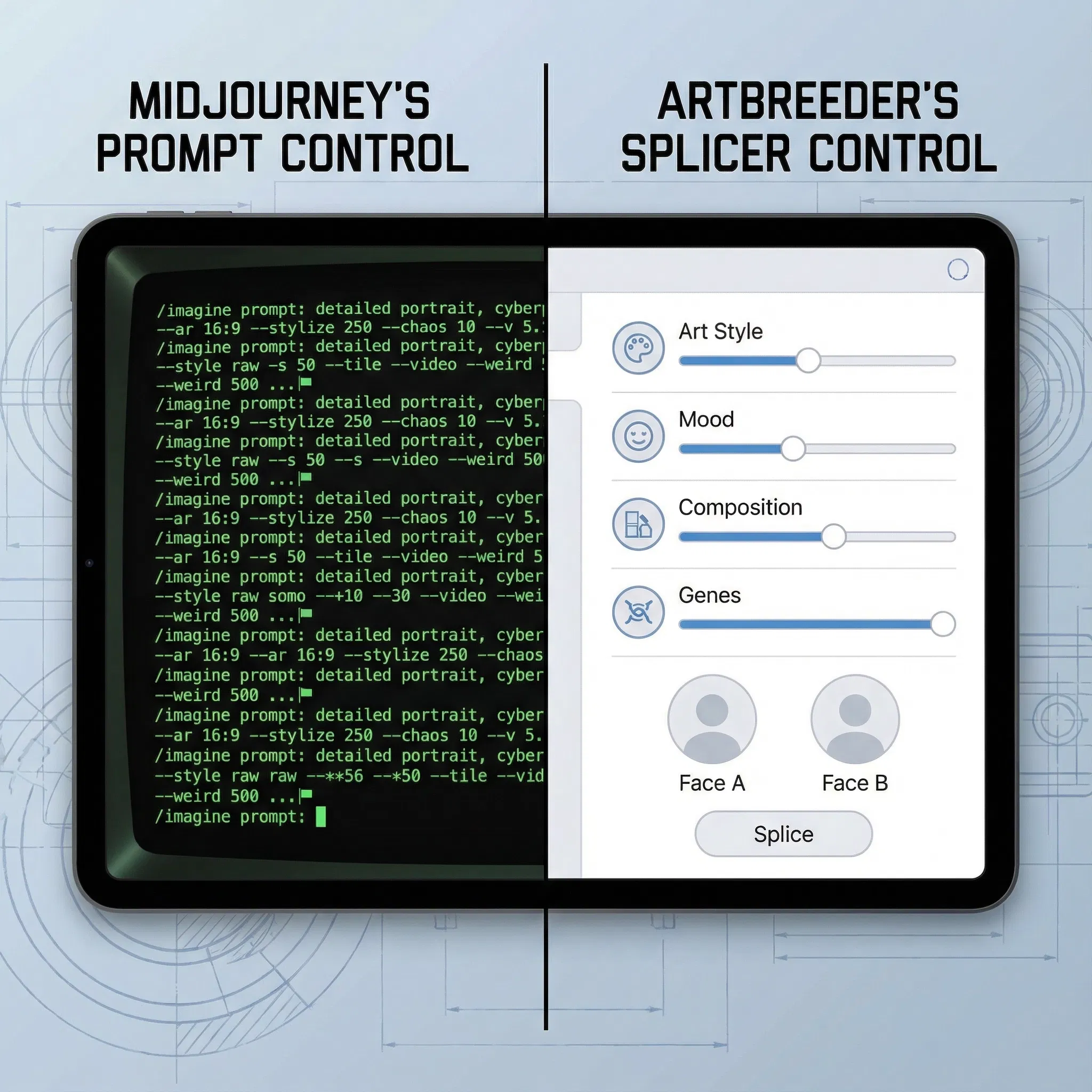
A visual comparison of creative control. On the left, a complex command line interface with many parameters and flags (representing Midjourney's prompt control). On the right, a set of clear, labeled sliders and genetic inputs (representing Artbreeder's Splicer control). The background should be a subtle, technical blueprint.
4. Community and Collaboration: Real-Time Social vs. Curated Evolution
Both platforms have strong community elements, but they manifest in very different ways, reflecting their core mechanics.
Midjourney’s Real-Time Social Generation
Midjourney’s community is centered around the Discord server, creating a highly social and fast-paced environment.
•Live Feed: Users generate images in public channels, creating a constant, real-time feed of new art. This is excellent for inspiration, learning new prompting techniques, and getting immediate feedback.
•Shared Learning: The community is highly active in sharing prompts, tips, and tricks, which accelerates the learning curve for new users.
•Public by Default: By default, all images generated on Midjourney are public, fostering a culture of open sharing and collective inspiration.
Artbreeder’s Curated Evolutionary Gallery
Artbreeder’s community is built around the concept of shared evolution and lineage.
•Image Lineage: Every image created on Artbreeder has a "parent" and "child" lineage, allowing users to trace the evolutionary path of a piece of art back to its original components. This is a powerful tool for understanding how different "genes" affect the final output 2
.
•Collaborative Splicing: Users can take any public image on the platform and use it as a "parent" for their own creations, leading to a truly collaborative and ever-evolving art ecosystem.
•Focused Gallery: The platform is structured as a gallery, making it easy to browse, search, and find inspiration based on specific categories like characters, landscapes, or sci-fi concepts.
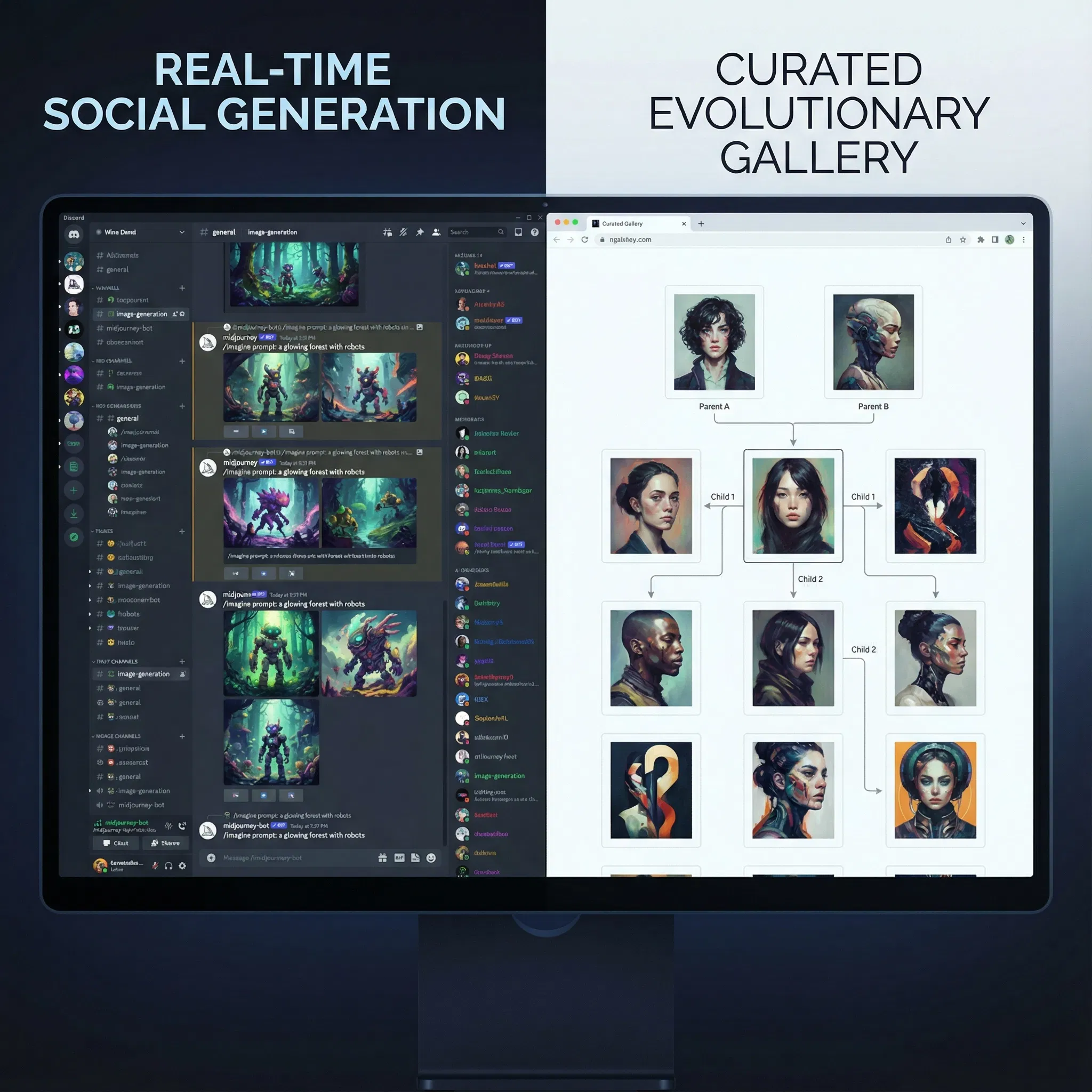
A visual metaphor for community interaction. On the left, a large, bustling Discord server interface with many users generating images (Midjourney). On the right, a clean, organized gallery of evolving images with clear "parent" and "child" lineage connections (Artbreeder). Label the left 'Real-time Social Generation' and the right 'Curated Evolutionary Gallery'.
5. Pricing, Licensing, and Commercial Viability
For professional users, the cost and the legal right to use the generated images are paramount.
Midjourney’s Clear Commercial Path
Midjourney operates on a clear subscription model with straightforward commercial terms.
•Subscription Tiers: Midjourney offers various paid tiers (Basic, Standard, Pro) that grant users a set amount of "Fast GPU Time" and, crucially, full commercial rights to the images they create, provided they are a paying subscriber 3.
•Commercial Clarity: The licensing is relatively clear: if you pay, you own the images. This simplicity makes Midjourney a safe choice for freelancers, agencies, and businesses looking to integrate AI art into their commercial projects.
•Value Proposition: The higher cost is justified by the superior quality, speed, and the clear legal framework for commercial use.
Artbreeder’s Layered Licensing
Artbreeder also offers a free tier and paid subscriptions, but its licensing can be more complex due to its collaborative nature.
•Free Tier: Artbreeder offers a generous free tier that allows for basic creation and evolution, but the images are typically lower resolution and may have restrictions on commercial use.
•Paid Tiers: Paid tiers (Starter, Advanced, Premium) unlock higher resolution outputs, more "genes" to manipulate, and clear commercial rights.
•The Collaboration Caveat: Because Artbreeder is built on the idea of mixing public images, the commercial use of an image that is a "child" of a public "parent" can sometimes be a gray area, requiring users to be mindful of the lineage of their final work. However, images created entirely from scratch or from private uploads on a paid plan are generally safe for commercial use.
The difference in licensing reflects the core difference in creation: Midjourney is a solo creation tool, making ownership simple, while Artbreeder is a collaborative tool, making ownership a matter of lineage.

A visual metaphor for commercial licensing. On the left, a clear, official-looking document with a prominent "Commercial Use Allowed" stamp (Midjourney). On the right, a complex, layered document with small print and a question mark over it (Artbreeder). The background should be a subtle, legal-themed texture.
6. Specific Use Cases: Where Each Tool Shines
The unique strengths of each platform make them ideal for different phases of the creative process.
Midjourney’s Best Use Cases
Midjourney is the superior choice for high-impact, one-off visual assets.
•Concept Art and Illustration: For generating stunning, high-fidelity concept art for games, films, or books, Midjourney’s ability to handle complex prompts and deliver cinematic quality is unmatched.
•Marketing and Advertising: Its speed and aesthetic polish make it perfect for creating eye-catching visuals for social media campaigns, website headers, and digital advertisements.
•High-Quality Textures and Backgrounds: Midjourney excels at generating seamless, detailed textures and complex environmental backgrounds that can be used in 3D modeling or digital painting.
Artbreeder’s Best Use Cases
Artbreeder is the superior choice for iterative design, character development, and world-building consistency.
•Character Design and Iteration: Artbreeder is the industry standard for writers and game developers who need to quickly generate and iterate on consistent character portraits, ensuring the same character can be aged, changed, or stylized while maintaining core features 4.
•World-Building Assets: The ability to blend landscapes, architectural styles, and color palettes makes it excellent for creating a cohesive visual language for an entire fictional world.
•Ideation and Brainstorming: The Splicer’s interactive nature makes it a powerful brainstorming tool, allowing users to rapidly explore thousands of visual possibilities that they might not have thought of with a simple text prompt.
The choice between Midjourney vs Artbreeder often comes down to whether your project requires a single, perfect image (Midjourney) or a series of consistent, evolving assets (Artbreeder).
7. The Future of AI Art: Convergence and Divergence
As AI technology evolves, we are seeing both convergence and divergence in these two models.
•Convergence: Midjourney has introduced image-prompting features, allowing users to use an image as a starting point, blurring the line with Artbreeder’s core function. Similarly, Artbreeder has integrated text-to-image models to allow users to generate initial "parent" images from scratch.
•Divergence: Despite these overlaps, their core strengths remain distinct. Midjourney continues to push the boundaries of text-to-image quality and prompt control, while Artbreeder focuses on deepening the interactive, evolutionary control over image "genes." The former is optimizing for output quality, the latter for process control.
8. Final Verdict: Which Tool is the Right Fit for You?
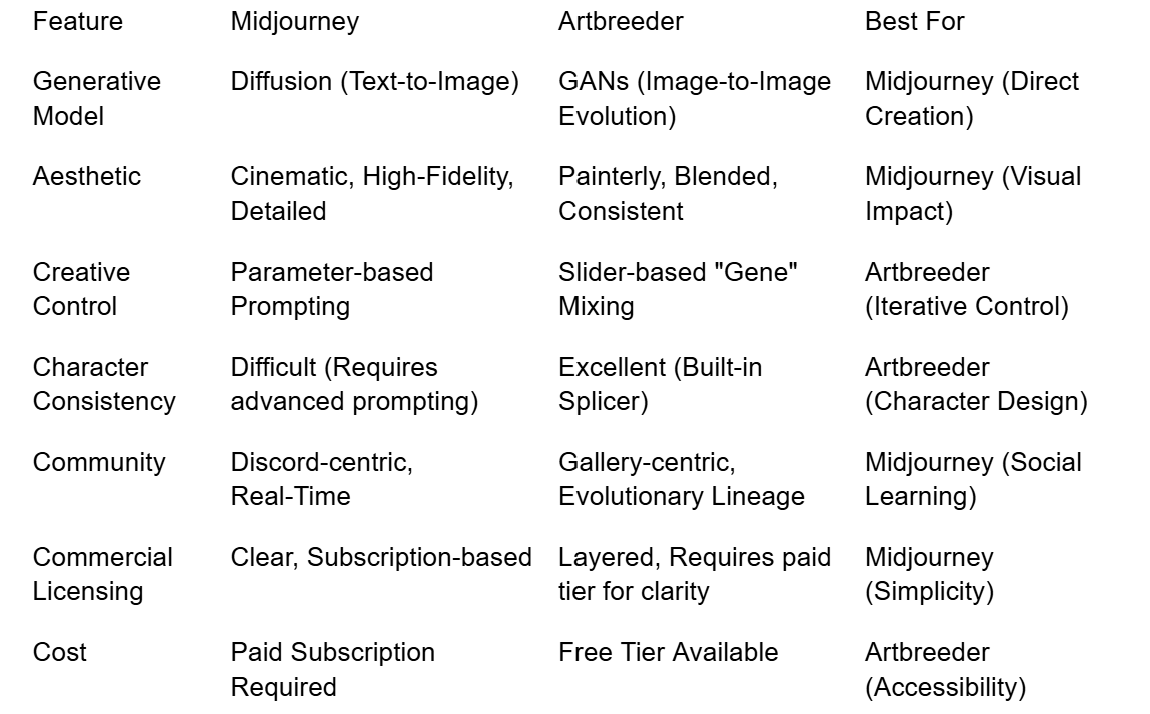
The comparison of Midjourney vs Artbreeder is not about which tool is objectively "better," but which tool is better for your specific creative process. Both are powerful, but they solve different problems.
Choose Artbreeder if:
•Your primary goal is character design, world-building, or creating a series of visually consistent assets that need to evolve over time.
•You prefer a visual, slider-based control system over complex text prompts and parameters.
•You want a free-to-use tool for initial ideation and experimentation.
Choose Midjourney if:
•You need single, high-impact, cinematic, or photorealistic images for professional use.
•You are comfortable with text-based prompt engineering and the Discord-centric workflow.
•You require clear, straightforward commercial licensing for your generated art 5
.
Ultimately, the most powerful workflow may involve using both: Artbreeder to quickly design and iterate on a consistent character or asset, and Midjourney to take that base image and render it into a final, high-fidelity, cinematic scene.
The choice between Runway vs InVideo AI is a microcosm of the larger debate in the AI content creation space: the tension between artistic control and production scale. Runway is the tool for the creator who values the unique, the original, and the visually stunning, even if it means a higher cost per second of video. It is an investment in creative potential. InVideo AI, conversely, is the tool for the content strategist who values consistency, speed, and a predictable return on investment. It is an investment in content velocity. Understanding this fundamental difference is the key to selecting the right platform for your 2025 video strategy. The market is large enough for both to thrive, each serving a critical, yet distinct, need in the evolving digital landscape.