Midjourney vs BlueWillow: The Ultimate AI Art Generator Showdown

The world of generative AI art is a landscape of rapid innovation, where new tools emerge almost daily, each promising to democratize creativity. Among the most prominent contenders are Midjourney vs BlueWillow, two platforms that have captured the attention of millions of users. While both operate primarily through the Discord platform and generate stunning images from text prompts, they represent fundamentally different philosophies in the AI art space: one champions uncompromising, cinematic quality and granular control, while the other prioritizes accessibility, a generous free tier, and ease of use.
For artists, designers, and hobbyists, the choice between these two is a critical one that determines not only the aesthetic of their final output but also their workflow, budget, and learning curve. This comprehensive 2500-word analysis will dissect the core differences, compare their technical outputs, and provide a clear verdict on which platform is the superior tool for various creative workflows.
1. Core Technology and Output Quality: Cinematic Realism vs. Stylized Versatility
The most immediate and striking difference between the two platforms is the quality and aesthetic of the images they produce. This difference stems from the proprietary models they employ.
Midjourney: The Standard for Cinematic Fidelity
Midjourney has established itself as the industry leader in generating images with a distinct, cinematic, and often hyper-realistic aesthetic. Its proprietary models (currently V6, with V7 in development) are trained on massive, curated datasets that result in several key advantages:
- Unmatched Fidelity: Midjourney excels at producing images with incredible detail, superior lighting, and complex textures. Its outputs often look like high-end concept art or professional photography.
- Prompt Adherence: The model is highly effective at interpreting complex, multi-layered prompts, ensuring that the final image accurately reflects the user's vision, including subtle details and compositional requests.
- Anatomical Consistency: While early AI models struggled with hands and complex anatomy, Midjourney’s latest versions have largely overcome these "glitches," delivering a level of consistency that is crucial for professional work.
BlueWillow: Accessible and Stylized
BlueWillow, on the other hand, has historically relied on a blend of open-source models (such as Stable Diffusion) and its own proprietary refinements. This approach makes it more versatile but often less consistent in terms of raw quality.
- Stylistic Range: Because BlueWillow can leverage different underlying models, it offers a wider, more varied range of artistic styles, making it a great tool for experimentation.
- The "Glitches" Factor: As the competitor article noted, BlueWillow, particularly in its earlier iterations, was more prone to the common AI art "glitches," such as distorted hands, unnatural shadows, or illogical compositions. While its quality has improved, it still generally lags behind Midjourney's latest models in terms of photorealistic fidelity.
- Speed vs. Quality: BlueWillow often prioritizes speed and accessibility, allowing users to generate images quickly, though sometimes at the expense of the final polish.
The visual comparison below highlights the difference in output fidelity, particularly in fine details.
.png)
A side-by-side comparison of two close-up images of a human hand holding a detailed object. The left image (Midjourney) shows perfect anatomy and detail. The right image (BlueWillow) shows slight anatomical imperfections or "glitches," clearly illustrating the difference in output fidelity.
2. Workflow and User Experience: Discord Command Line vs. Web App Simplicity
Both platforms started their journey on Discord, but their user experiences have diverged significantly, creating a major point of difference for new users.
Midjourney’s Discord-Centric Workflow
Midjourney’s core experience remains deeply embedded in Discord. While it has introduced a web interface, the most powerful features and the primary community interaction still happen through the chat application.
- Command-Line Feel: Users interact with Midjourney via the /imagine command, followed by a long string of text and technical parameters. This command-line-like interface can be intimidating for beginners but offers maximum control for advanced users.
- Public Gallery as Workflow: The public nature of the Discord channels means that users can see the prompts and results of others in real-time, which is a powerful learning tool but can also feel overwhelming and cluttered.
- Iterative Refinement: Midjourney’s workflow is built around the U (Upscale) and V (Variation) buttons, encouraging users to iteratively refine their images through multiple generations.
BlueWillow’s Hybrid Approach
BlueWillow also uses a Discord bot, but its primary focus has shifted toward a simpler, more streamlined web application, designed to abstract away the complexity of prompt engineering.
- Simplified Interface: BlueWillow’s web app features a clean, single-box interface where users simply type their prompt and hit "Generate." This is a low-friction entry point for those unfamiliar with Discord or command syntax.
- Focus on Output: The platform is designed to get the user to a final, usable image as quickly as possible, often with fewer intermediate steps or complex settings exposed to the user.
- Accessibility: By offering a dedicated web interface, BlueWillow makes its tool accessible to users who do not want to install or manage a separate chat application like Discord.
The image below visually contrasts the two primary workflows.
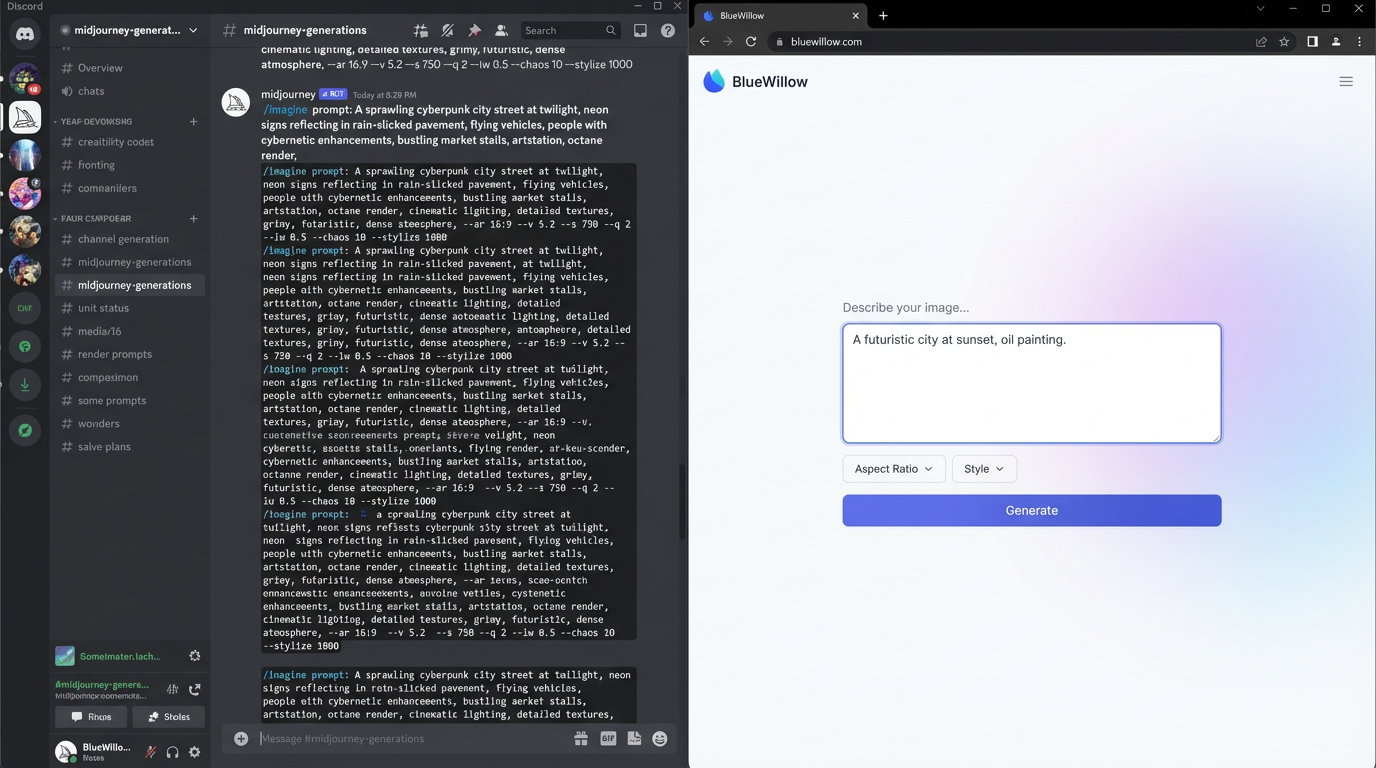
A split screen showing two distinct user interfaces. The left side shows a complex Discord chat window with a long Midjourney prompt and parameter flags. The right side shows a clean, simple BlueWillow web application interface with a single prompt box and minimal settings. The visual should clearly contrast the "command line" feel of Midjourney with the "app" feel of BlueWillow.
3. Creative Control and Customization: Granular Parameters vs. Simplified Settings
For the serious AI artist, the ability to fine-tune the generation process is paramount. This is where the philosophical difference between the two platforms is most apparent.
Midjourney: The Granular Control Panel
Midjourney offers an extensive set of parameters that allow users to exert granular control over every aspect of the image generation process.
- Advanced Parameters: Users can manipulate parameters like --stylize (controls the artistic strength of the model), --chaos (controls the randomness of the results), --seed (ensures reproducibility), and aspect ratios (--ar). This level of control is essential for professional artists who need to maintain consistency across a series of images or achieve a very specific aesthetic.
- Custom Models and Styles: Midjourney allows users to train and utilize custom styles and personal models, further tailoring the output to their unique artistic signature.
- Image-to-Image: The platform’s advanced image-to-image capabilities allow for precise control over the composition and style transfer from a source image.
BlueWillow: The Simplified Dial
BlueWillow’s approach is to simplify the control process, making it easier for beginners to achieve good results without being overwhelmed by technical jargon.
- Pre-set Styles: BlueWillow often relies on a selection of pre-set styles or "modes" that users can select, rather than requiring them to manually input parameters. This is a great feature for casual users who want a specific look (e.g., "Anime," "Photorealistic") without knowing the underlying prompt syntax.
- Focus on Prompt: The primary control mechanism in BlueWillow is the prompt itself. While it supports some basic parameters, the platform encourages users to focus on descriptive language rather than technical settings.
- Ease of Use: This simplified approach means that the learning curve is significantly flatter, but the ceiling for highly customized, professional-grade output is lower than that of Midjourney.
The image below visualizes the difference in the level of creative control offered by each platform.
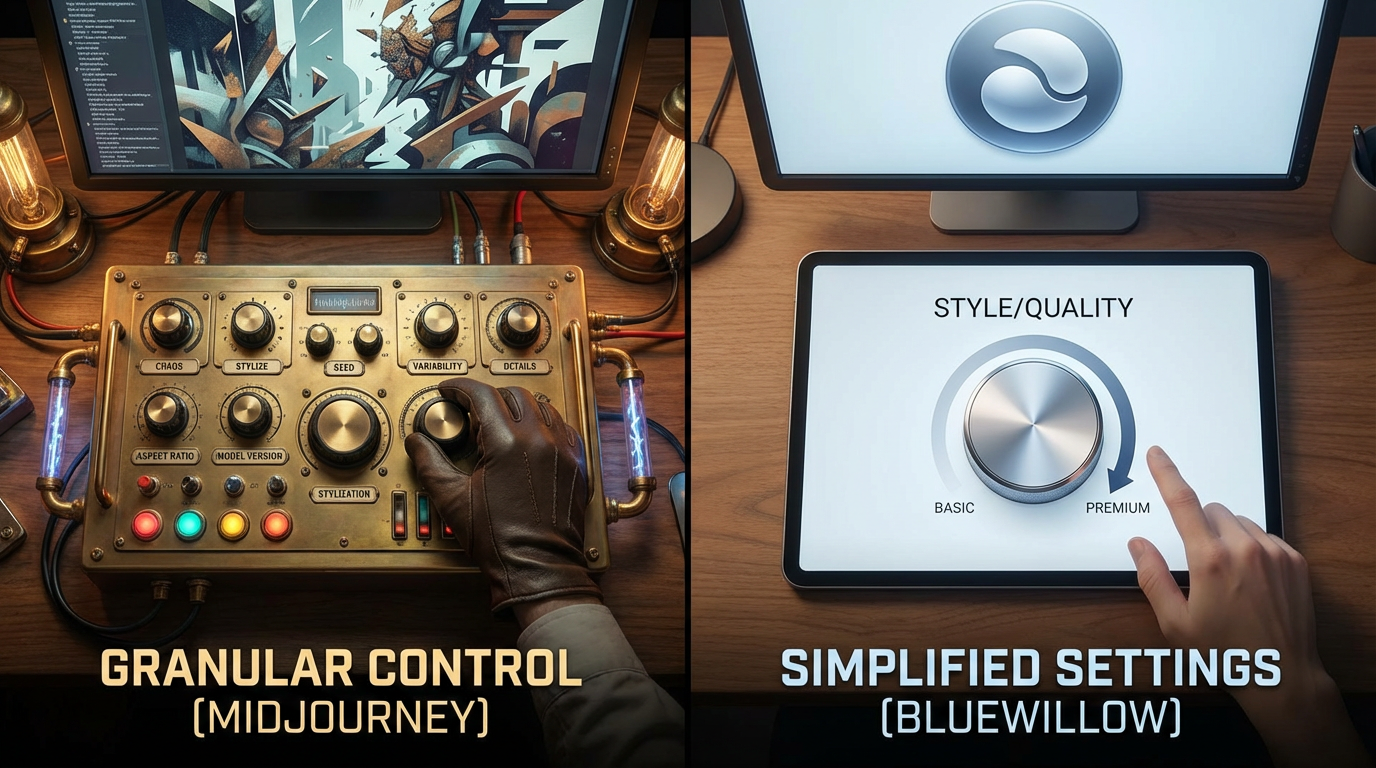
A visual metaphor for creative control. The left side (Midjourney) shows a complex control panel with many dials, sliders, and buttons labeled with technical terms like "Chaos," "Stylize," and "Seed." The right side (BlueWillow) shows a simple, single dial labeled "Style" or "Quality." The visual should convey the difference between granular control and simplified settings.
4. Pricing and Accessibility: Subscription Model vs. Generous Free Tier
The financial model is often the deciding factor for users, and this is perhaps the most significant point of divergence in the Midjourney vs BlueWillow comparison.
Midjourney: The Premium Subscription
Midjourney operates on a paid subscription model, reflecting the high cost of running its proprietary, state-of-the-art models.
- Paid Tiers: Midjourney offers several paid tiers, starting at a relatively low monthly fee for a set number of "Fast Hours" (GPU time). Once these hours are used, the generation speed slows down, or the user must purchase more time.
- Focus on Value: The pricing model is justified by the consistently high quality and the professional-grade output, positioning Midjourney as a necessary business expense for graphic designers, concept artists, and agencies.
- Commercial Rights: Paid subscribers generally receive full commercial rights to the images they generate, which is a non-negotiable requirement for any professional use 1.
BlueWillow: The Free-for-All Approach
BlueWillow’s primary appeal is its accessibility, offering a highly generous free tier that has attracted a massive user base.
- Free Forever: BlueWillow provides a substantial number of free generations daily, making it an excellent tool for beginners, students, and anyone who needs to generate a high volume of images without a financial commitment.
- Optional Paid Tiers: While the free tier is generous, BlueWillow offers paid options for users who require faster generation speeds, higher resolution, or access to more advanced features. These paid tiers are often more budget-friendly than Midjourney’s entry-level subscriptions.
- Democratization of AI Art: By removing the financial barrier to entry, BlueWillow has played a crucial role in democratizing AI art, allowing users to experiment and learn without risk.
The image below visually compares the two pricing models.

A visual comparison of two pricing models. The left side shows a clear, structured subscription model with tiers (Midjourney). The right side shows a "Free Forever" badge with a smaller, less prominent paid option (BlueWillow). Use contrasting colors (e.g., gold for Midjourney, blue/green for BlueWillow) to differentiate the models.
5. Target Audience and Use Cases: Professional Artists vs. Casual Creators
The differences in quality, workflow, and pricing naturally lead to a clear segmentation of the target audience for Midjourney vs BlueWillow.
Midjourney’s Professional Niche
Midjourney is the tool of choice for the professional and the serious enthusiast. Its use cases include:
- Concept Art and Filmmaking: Creating high-fidelity concept art for games, films, and animation, where realism and consistency are paramount.
- High-End Marketing: Generating unique, high-resolution visuals for advertising campaigns and branding, where the cinematic quality justifies the subscription cost.
- Serious Artists: Users who require granular control over every aspect of the image and are willing to invest time in learning the complex command syntax.
BlueWillow’s Casual and Social Niche
BlueWillow is perfectly suited for the casual creator, the student, and the social media enthusiast. Its use cases include:
- Social Media Content: Generating a high volume of stylized, engaging images for platforms like Instagram, TikTok, and Facebook, where speed and variety are more important than hyper-realism.
- Rapid Prototyping: Quickly visualizing ideas, mood boards, or simple graphic concepts without a financial commitment.
- Beginners: Users who are just starting their AI art journey and need a simple, non-intimidating platform to learn the basics of prompt engineering.
6. The Future of AI Art: Convergence and Divergence
The competition between Midjourney vs BlueWillow is not static; both platforms are constantly evolving, leading to both convergence and divergence in their feature sets.
- Convergence on Quality: As open-source models improve, the gap in raw image quality between the two platforms is slowly closing. BlueWillow, by integrating better underlying models, will continue to improve its fidelity, forcing Midjourney to push the boundaries of realism even further.
- Divergence in Ecosystem: Midjourney is increasingly building out its web platform to offer more dedicated editing and organizational tools, moving away from its purely Discord-centric roots. BlueWillow, meanwhile, is likely to double down on its integration with other social and design tools, cementing its place as the accessible, multi-purpose tool.
- The Role of Community: The community aspect remains a key differentiator. Midjourney’s community is focused on technical mastery and artistic excellence, while BlueWillow’s is focused on accessibility and fun. This difference in community culture will continue to shape the user experience 2.
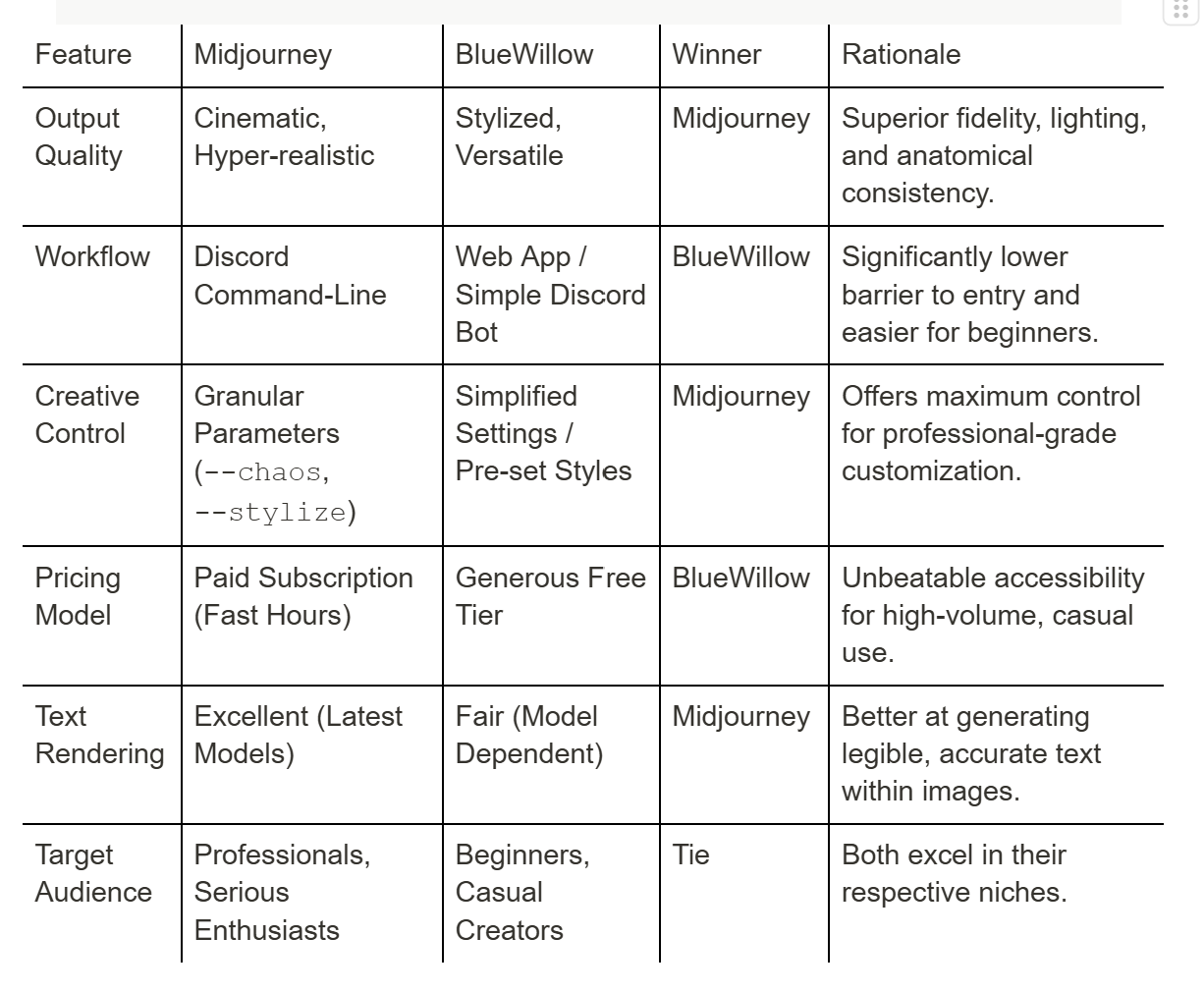
7. Feature Comparison Summary Table
To provide a clear, at-a-glance comparison, the table below summarizes the key differences between the two platforms.
Final Verdict: Which AI Art Generator is Right for You?
The final decision in the Midjourney vs BlueWillow debate comes down to a simple question of priorities.
If your goal is to produce uncompromising, cinematic, and professional-grade concept art where you need granular control over every detail, and you are willing to pay a subscription fee and learn a more complex workflow, Midjourney is the clear winner. It is the tool that sets the industry standard for quality and control.
If your goal is to generate a high volume of fun, stylized, and engaging images for social media, you are on a tight budget, and you prioritize a simple, low-friction user experience, then BlueWillow is the superior choice. It is the ultimate tool for democratizing AI art and making creativity accessible to everyone 3.
Ultimately, the competition between these two platforms ensures that the AI art space remains vibrant and innovative, offering a perfect tool for every type of creator.
The intense competition between Midjourney vs BlueWillow is a net positive for the entire AI art community. Midjourney's relentless pursuit of photorealistic perfection pushes the technical boundaries of what a generative model can achieve, while BlueWillow's focus on accessibility and ease of use ensures that these powerful tools are not confined to a small, technical elite. This dynamic tension guarantees that users at every skill level and budget will continue to receive increasingly powerful and user-friendly tools. The market is large enough for both to thrive, serving their distinct, yet overlapping, user bases with excellence.