Midjourney vs DeepAI: The Ultimate AI Image Generator Showdown
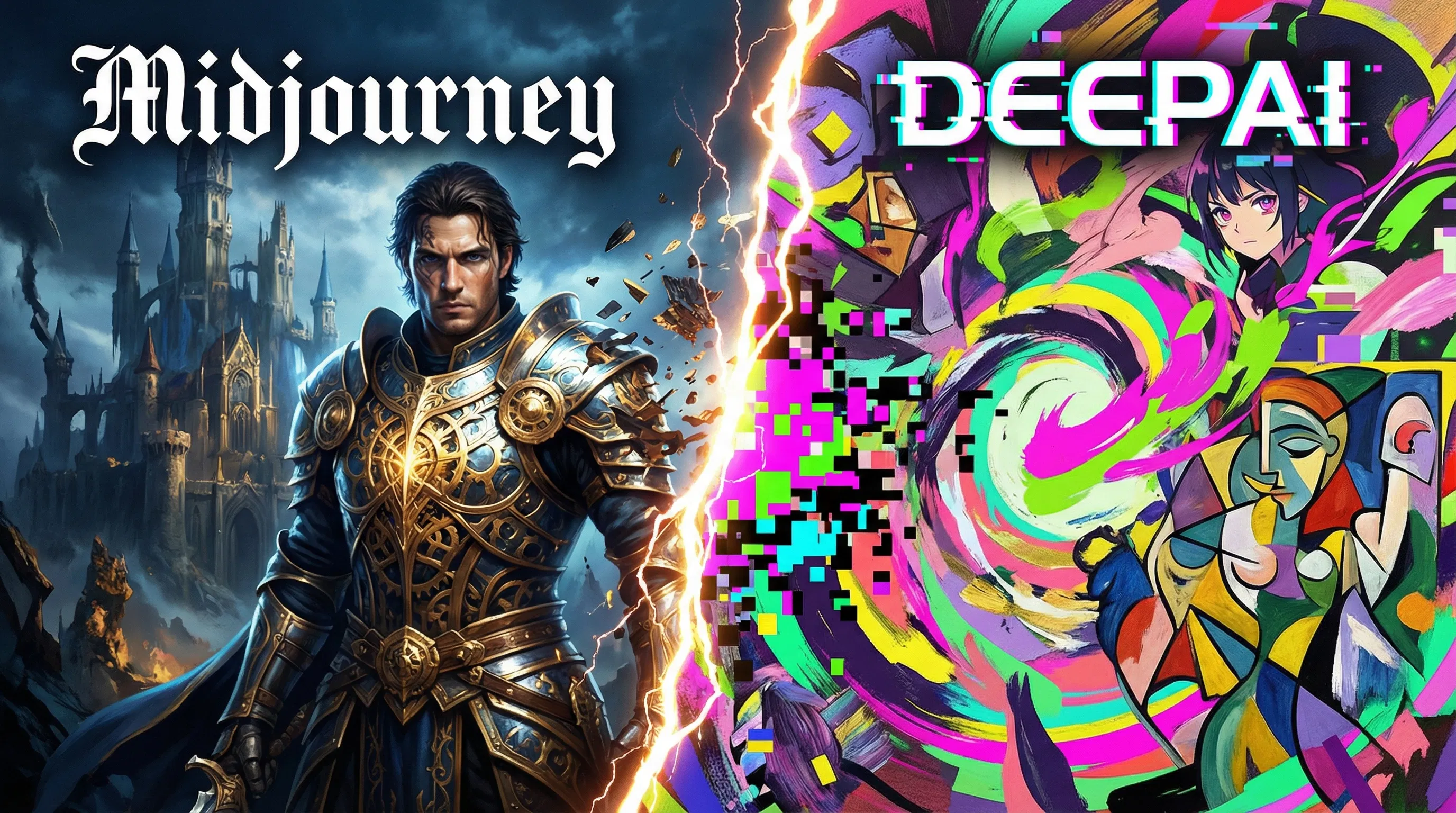
The landscape of AI image generation is dominated by a few key players, each offering a distinct philosophy on how art should be created. On one side stands Midjourney, the undisputed champion of cinematic, high-fidelity aesthetics, built around a powerful, singular model and a unique Discord-native interface. On the other is DeepAI, a platform that champions variety, accessibility, and a broad suite of tools, leveraging multiple underlying models to offer a more diverse, web-based experience.
The choice between these two platforms is not merely a matter of which one is "better," but which one aligns more closely with a user's specific creative goals, technical comfort, and budget. This in-depth comparison of Midjourney vs DeepAI will dissect their core technologies, creative outputs, user experiences, and commercial viability to help you determine the ultimate tool for your artistic journey in 2025.
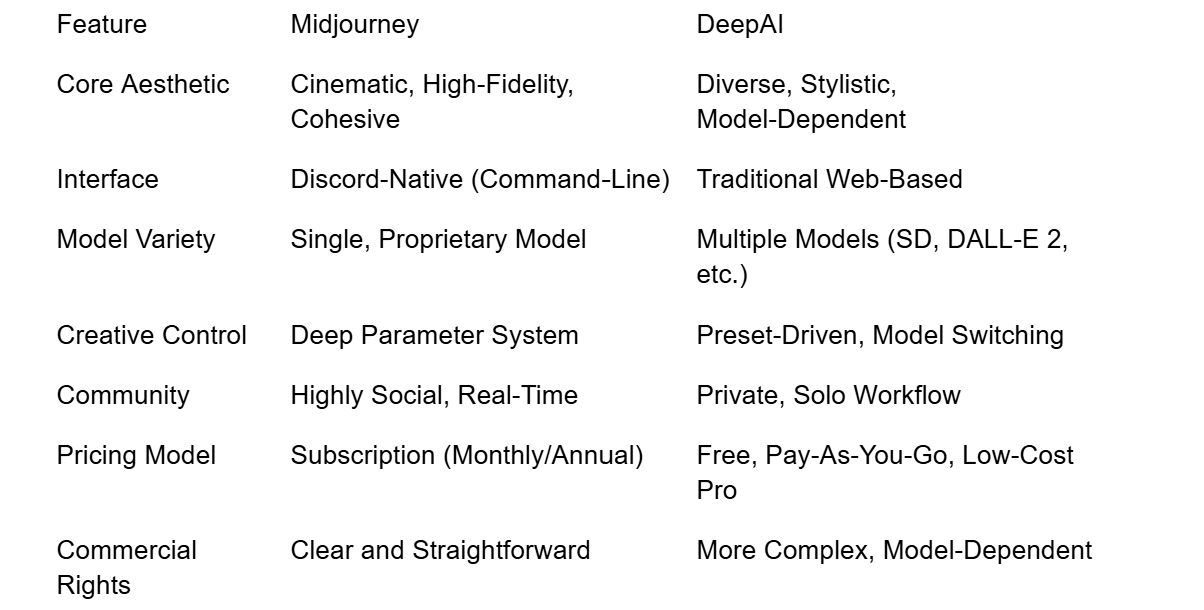
1. Core Philosophy and Aesthetic Output: Cinematic vs. Diverse
The most immediate and striking difference between the two platforms is their artistic output and the underlying philosophy that drives their models.
Midjourney: The Cinematic Visionary
Midjourney has cultivated a reputation for producing images with a distinct, high-quality, and often cinematic aesthetic. Its development has been focused on refining a single, proprietary model (currently V6, with continuous updates) to achieve unparalleled photorealism, dramatic lighting, and a cohesive artistic style.
•Aesthetic Cohesion: Midjourney’s output is instantly recognizable. It excels at generating images with a professional, polished look, making it the go-to choice for concept artists, illustrators, and those seeking a "wow" factor with minimal prompting effort.
•Prompt Interpretation: The model is highly sophisticated at interpreting complex, abstract, and stylistic prompts, often translating vague ideas into stunning visual realities.
•Focus on Quality: The platform prioritizes the quality and aesthetic consistency of its output over sheer model variety. This focus means that Midjourney's training data and model architecture are heavily tuned to produce visually stunning, high-resolution images that often require minimal post-processing. The model's inherent style acts as a powerful artistic filter, ensuring that even simple prompts yield results with professional-grade composition and lighting. This is a key reason why many professional artists and designers are willing to pay a premium for Midjourney's service—it delivers a consistent, high-end look that is difficult to replicate with other models without extensive prompt engineering. The latest versions of Midjourney have also introduced features to allow users to dial back this inherent "style," but the core strength remains its ability to produce a beautiful image right out of the box.
DeepAI: The Model Pluralist
DeepAI takes a fundamentally different approach, acting as a hub for a wide array of generative models, including various versions of Stable Diffusion, custom models, and older proprietary algorithms.
•Model Variety: DeepAI’s strength lies in its diversity. Users can switch between models like Stable Diffusion, Deep Dream, and various specialized artistic styles, offering a much broader range of potential aesthetics, from abstract to anime to photorealistic.
•Tool Suite: Beyond image generation, DeepAI offers a comprehensive suite of related tools, such as an AI Video generator, an AI Music generator, and various image editing plugins, making it a one-stop shop for diverse AI-powered creative tasks.
•Focus on Accessibility: The platform is designed to be a simple, web-based entry point for users to experiment with multiple AI technologies without the need for complex setups or Discord accounts.
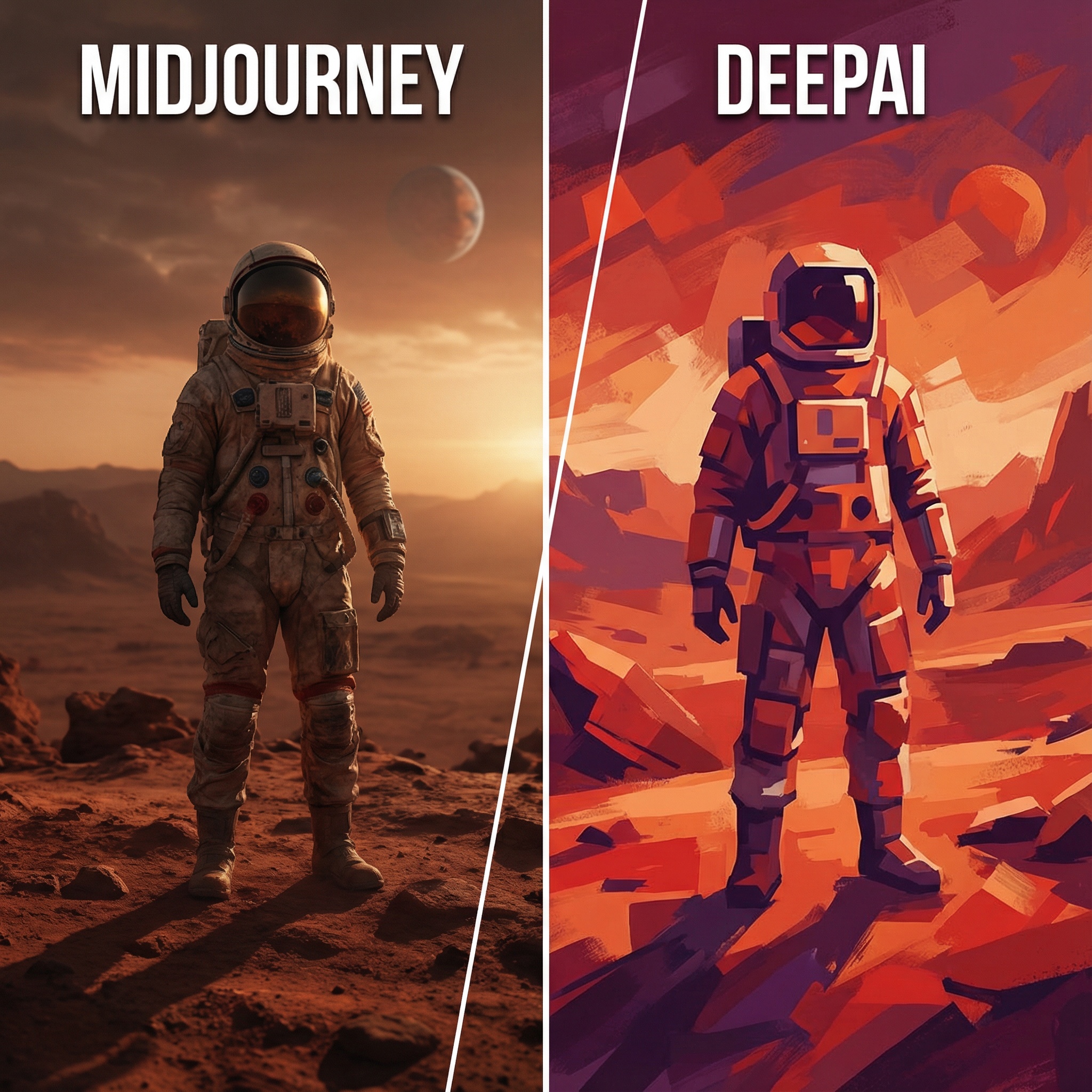
A side-by-side comparison of two generated images from the same prompt. The left image (Midjourney) is highly cinematic, detailed, and moody. The right image (DeepAI) is more stylized, abstract, and less photorealistic, showcasing a different artistic interpretation.
2. User Experience and Interface: Discord vs. Web-Based
The user interface is perhaps the most divisive factor in the Midjourney vs DeepAI debate, directly impacting workflow and accessibility.
Midjourney: The Discord-Native Workflow
Midjourney's primary interface is the Discord chat application. While initially a barrier for some, this unique approach has fostered a powerful community and a highly efficient, command-line-style workflow.
•Community-Driven: The public nature of the Discord server means users can see the prompts and results of others in real-time, creating a powerful learning environment and a constant source of inspiration.
•Command-Line Efficiency: Commands like /imagine, /blend, and /describe allow for rapid generation and iteration, which can be faster than navigating a traditional web interface once the user is familiar with the syntax.
•Learning Curve: The reliance on Discord and specific commands presents a steeper initial learning curve for users unfamiliar with the platform.
DeepAI: The Traditional Web Application
DeepAI offers a clean, traditional web-based interface that is instantly familiar to anyone who has used a standard online tool.
•Instant Accessibility: Users can start generating images immediately after visiting the website, with no need to download a separate application or join a community server.
•Intuitive Navigation: The interface is designed with clear buttons, dropdown menus for model selection, and a simple prompt box, making it highly intuitive for beginners.
•Integrated Tools: All of DeepAI's various tools (image editor, video generator, etc.) are accessible from the same dashboard, streamlining the workflow for users who need more than just image generation.
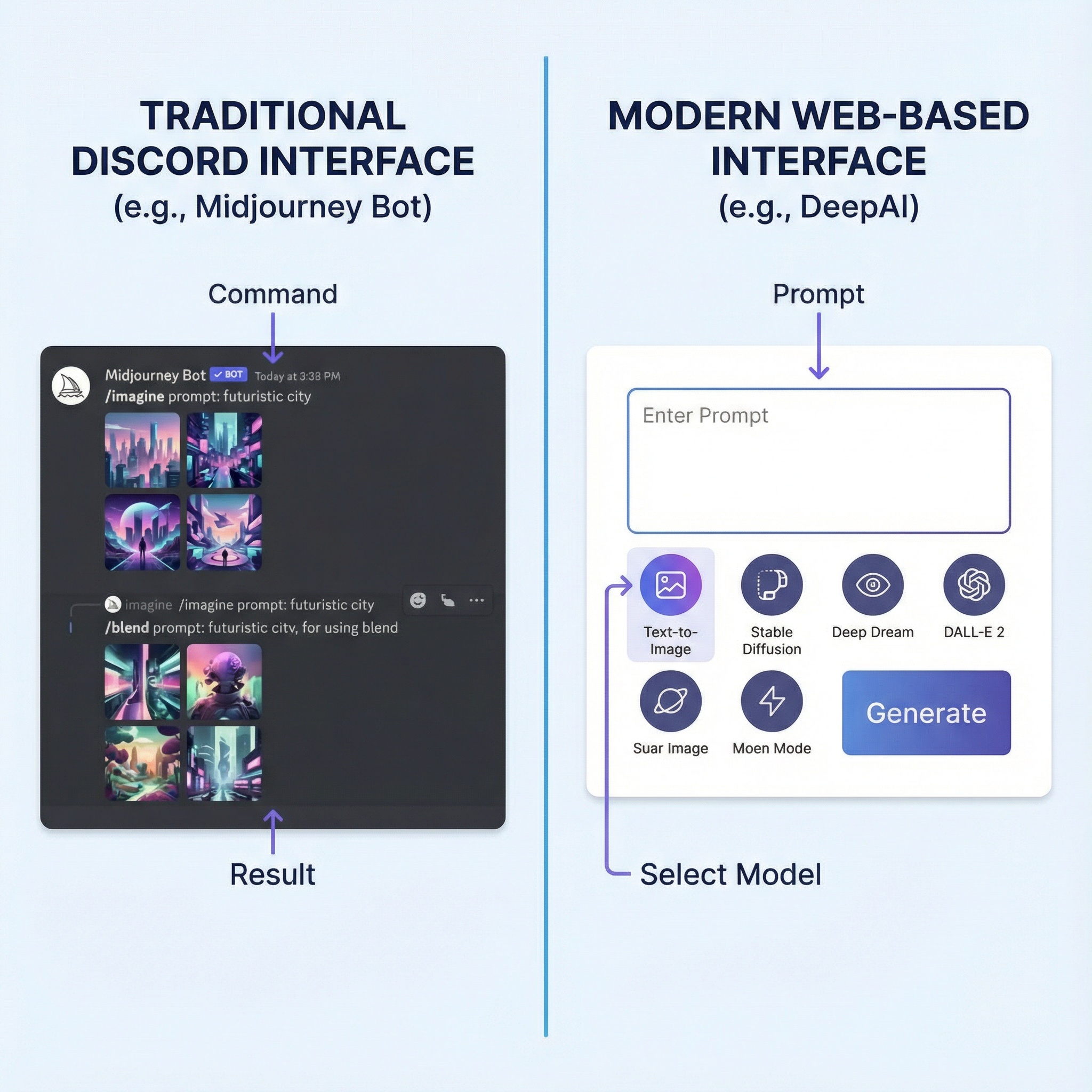
A visual comparison of two user interfaces. The left side shows a Discord chat window with Midjourney commands and image grids. The right side shows a clean, web-based interface with a large prompt box and a gallery of different model options (DeepAI).
3. Creative Control and Customization: Parameters vs. Presets
The depth of control a user has over the generation process is a critical factor for professional artists and designers.
Midjourney: Parameter-Driven Precision
Midjourney offers a deep level of control through its extensive parameter system, allowing users to fine-tune every aspect of the image.
•Advanced Parameters: Users can manipulate aspect ratios (--ar), chaos (--c), stylization (--s), and seed values (--seed) to achieve highly specific and repeatable results.
•Style References: Features like Style Reference (--sref) and Character Reference (--cref) allow for unprecedented control over aesthetic and character consistency across multiple images.
•Vary and Remix: The built-in tools for varying and remixing images allow for precise, iterative refinement, turning a single initial generation into a final, polished piece.
DeepAI: Preset-Driven Simplicity
DeepAI's control is primarily managed through model selection and a simpler set of style presets, prioritizing ease of use over granular control.
•Model Switching: The main form of control is the ability to switch between different underlying models (e.g., Stable Diffusion, DALL-E 2, etc.), each with its own inherent style.
•Style Presets: DeepAI offers a range of pre-defined styles (e.g., "Fantasy Art," "Cyberpunk," "Abstract") that users can select with a single click, simplifying the prompt engineering process.
•Limited Fine-Tuning: DeepAI generally lacks the deep, command-line-style parameter control of Midjourney, making it more challenging to achieve highly specific or repeatable results across different generations. However, DeepAI's strength lies in its API-first approach. For developers, the API offers a different kind of control: the ability to programmatically select from a vast library of models and integrate them into custom workflows. While the web interface is simple, the underlying API provides the flexibility to chain multiple AI functions (e.g., generate an image, then run it through the upscaler, then apply a style transfer) which is a level of programmatic control that Midjourney's Discord interface cannot match. This makes DeepAI a powerful backend tool for applications that require a diverse range of generative functions, rather than a single, highly-tuned aesthetic. The platform is constantly adding new models and tools, reflecting its commitment to being a comprehensive AI utility provider.

A visual metaphor for model variety. The left side shows a single, highly refined, golden statue (Midjourney's focus). The right side shows a shelf filled with many different types of art tools: paintbrushes, clay, digital stylus, and a camera (DeepAI's model variety).
4. Community, Sharing, and the Marketplace
The social and commercial aspects of each platform also present a stark contrast.
Midjourney: The Social Art Hub
Midjourney's Discord integration makes it one of the most social AI art platforms in existence.
•Real-Time Collaboration: The public channels allow for real-time viewing of other users' creations, fostering a sense of community and providing instant inspiration and feedback.
•Gallery and Showcase: The Midjourney website acts as a high-quality gallery where users can view their own and others' best work, often leading to viral sharing and recognition within the community.
•Learning by Observing: The ability to see the prompts used by others (unless they choose to hide them) is an invaluable learning tool for mastering the art of prompt engineering. This open-source-like sharing of knowledge significantly flattens the learning curve for new users, providing a constant stream of high-quality examples and techniques. The community also acts as a rapid-response technical support system, where users can quickly get help with complex commands or troubleshooting issues. This collective intelligence is a massive, intangible asset that Midjourney provides.
DeepAI: The Private Tool Suite
DeepAI is a more private, utility-focused platform, with less emphasis on community interaction. While it does have support channels, the experience is largely solitary. This privacy is a benefit for users working on sensitive or proprietary projects who do not want their work-in-progress to be publicly visible. However, it also means that the user is solely responsible for their own learning and troubleshooting. The lack of a vibrant, real-time feed of prompts and results means the learning curve for advanced prompt engineering is steeper, as users must rely on external tutorials or trial-and-error rather than community observation. This trade-off between privacy and collective learning is a key consideration when choosing between Midjourney vs DeepAI.
•Solo Workflow: The web-based interface is designed for an individual, focused workflow. Users generate images in a private space, making it ideal for those who prefer to work without public scrutiny.
•API Focus: DeepAI is heavily focused on its API, catering to developers who want to integrate AI tools into their own applications, which is a fundamentally different user base than the social art community.
•Limited Sharing: While images can be downloaded and shared, the platform itself does not have the built-in, real-time social sharing features that Midjourney's Discord environment provides.
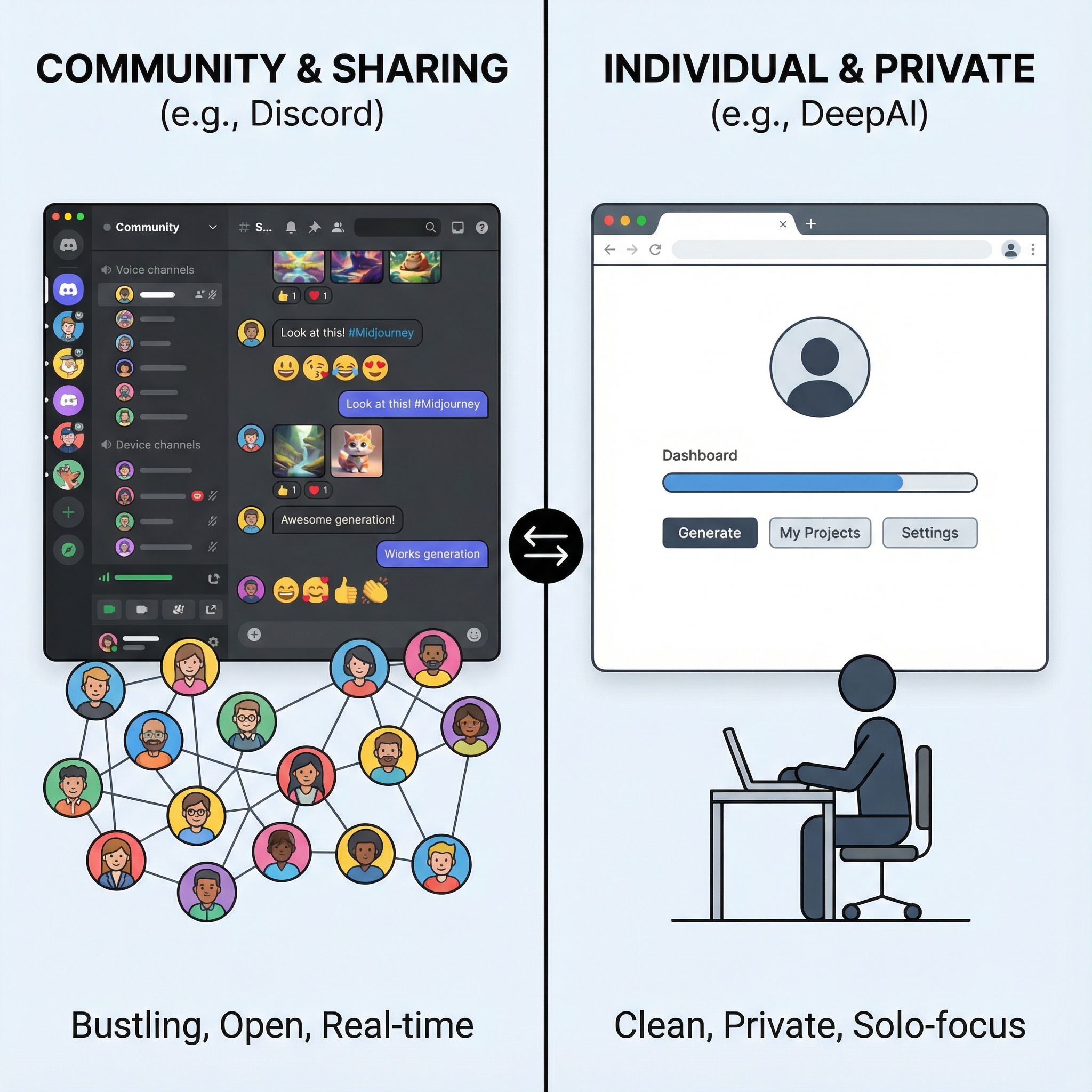
A visual comparison of community and sharing. The left side shows a bustling, open Discord server with many users chatting and sharing images in real-time (Midjourney). The right side shows a clean, private web interface with a single user working alone (DeepAI).
5. Pricing and Commercial Viability: Subscription vs. Pay-As-You-Go
The financial models of the two platforms cater to different user needs and usage patterns.
Midjourney: The Subscription Model
Midjourney operates on a subscription model, offering various tiers that provide a set amount of "Fast GPU Time" per month.
•Predictable Cost: The monthly fee provides a predictable cost for a guaranteed level of service and quality, which is essential for professional users.
•Clear Commercial Rights: Midjourney offers clear, straightforward commercial rights to paying subscribers, making it the safer choice for any work intended for monetization.
•Value for Quality: The higher price point is justified by the consistently superior aesthetic quality and the advanced control features. Furthermore, Midjourney's infrastructure is built for speed and reliability, offering dedicated "Fast GPU Time" that ensures quick turnaround for professional deadlines. The clear, legally sound commercial license is arguably the most valuable feature for any business, providing peace of mind that their generated assets are safe for use in marketing, product design, and sales. The subscription model is an investment in a high-performance, legally compliant, and aesthetically superior creative partner.
DeepAI: Flexible and Accessible
DeepAI offers a more flexible pricing structure, including a free tier, a pay-as-you-go option, and a low-cost Pro subscription.
•Free Tier: The free plan allows users to generate images with basic models, making it highly accessible for beginners and casual users.
•Pay-As-You-Go: The ability to purchase a set number of API calls or generations is ideal for users with intermittent or low-volume needs, avoiding a recurring subscription fee.
•Complex Licensing: While DeepAI's terms allow for commercial use, the licensing can be more complex and model-dependent than Midjourney's, requiring users to carefully review the terms for each specific model they use.
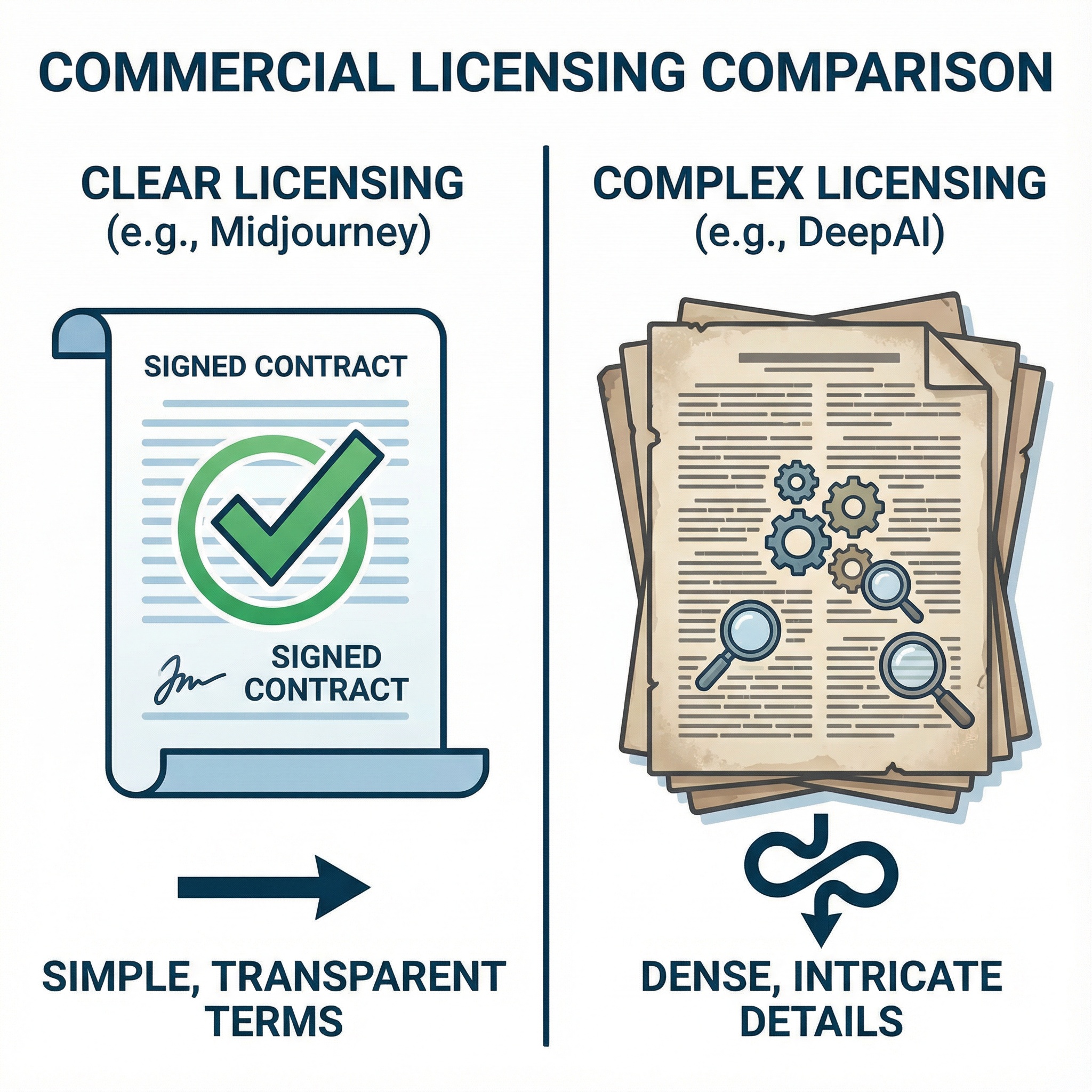
A visual comparison of commercial licensing. The left side shows a clear, signed contract with a large checkmark (Midjourney's clear licensing). The right side shows a complex, slightly faded document with many small print lines (DeepAI's more complex licensing).
6. Final Verdict: Choosing Your Creative Partner
The choice between Midjourney vs DeepAI boils down to a fundamental question: Do you prioritize unparalleled aesthetic quality and community or model variety and accessibility?
For the professional artist, concept designer, or agency that requires consistent, high-end, cinematic visuals and clear commercial rights, Midjourney remains the superior choice. Its focus on a singular, powerful model and its deep parameter control make it the most reliable tool for achieving a specific, polished vision.
For the hobbyist, developer, or user who needs a broad suite of AI tools, a simple web interface, and the flexibility of a pay-as-you-go model, DeepAI is the clear winner. It serves as an excellent entry point into the world of AI art, offering a sandbox to experiment with various models and tools without a significant financial commitment.
The two platforms are not direct competitors in the traditional sense; they are two different solutions to the problem of AI art generation. Midjourney is a specialized, high-performance sports car, while DeepAI is a versatile, accessible utility vehicle. Your ultimate choice depends entirely on the destination of your creative journey. The ongoing evolution of Midjourney vs DeepAI will likely see Midjourney continue to push the boundaries of aesthetic realism and control, while DeepAI will continue to expand its library of models and tools, solidifying its position as the go-to platform for AI utility and model diversity. For the user, this competition is a win-win, offering a clear choice between a premium, curated experience and a flexible, broad-spectrum toolkit. The final decision rests on whether your priority is the highest possible artistic quality or the greatest possible functional variety.