Midjourney vs Leonardo AI: The Best AI Image Generator for Gaming and Assets

Midjourney vs Leonardo AI: The Best AI Image Generator for Gaming and Assets
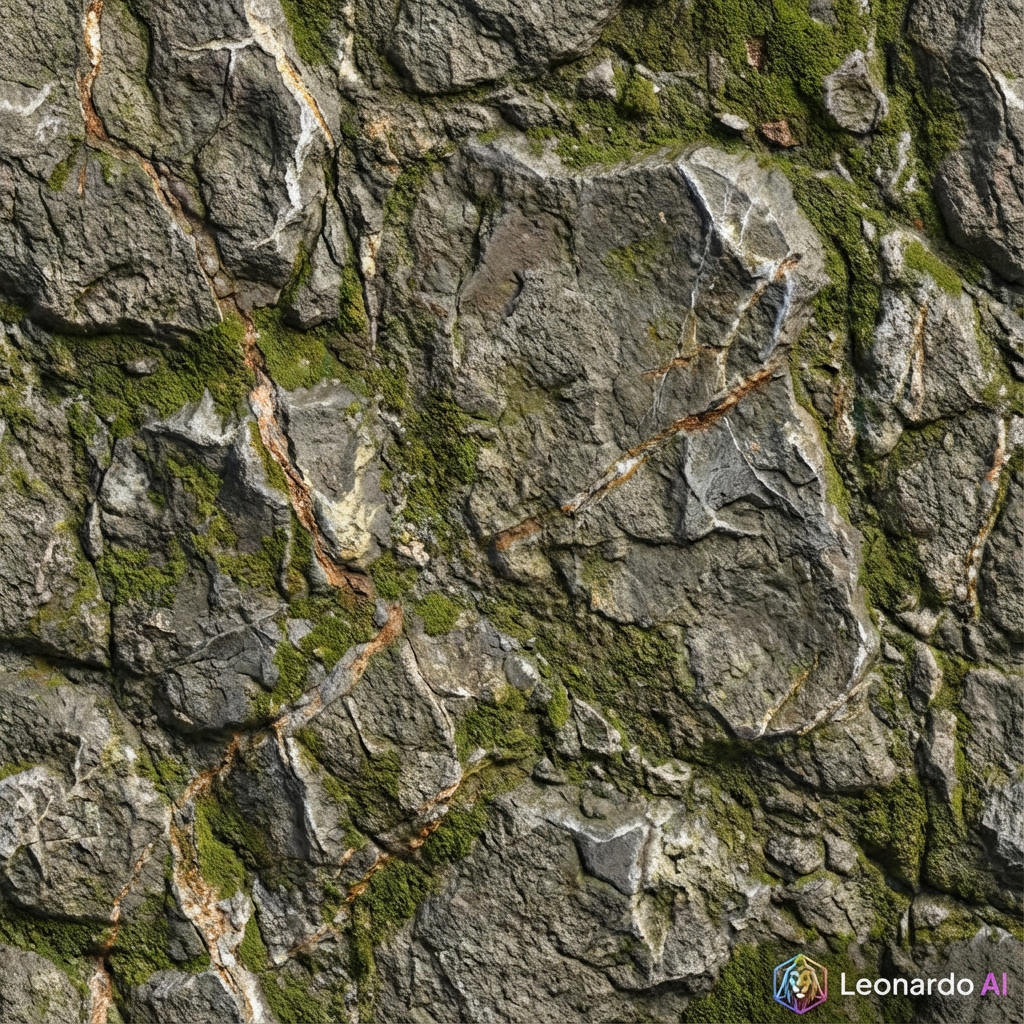
The rise of generative AI has presented game developers, concept artists, and asset creators with a powerful new toolkit. At the forefront of this revolution are two distinct platforms: Midjourney and Leonardo AI. While Midjourney is renowned for its artistic prowess and stunning visual quality, Leonardo AI has carved out a specialized niche, positioning itself as the go-to tool for game development and asset creation.
The choice between Midjourney vs Leonardo AI is a critical one for anyone looking to streamline their creative pipeline. It’s a decision that weighs artistic excellence against technical utility, and a premium experience against a free, feature-rich platform. This 2600-word analysis will provide a comprehensive comparison, focusing specifically on the needs of the gaming and asset creation community. We will explore which platform offers the best features for generating sprites, textures, 3D assets, and concept art, ultimately determining which reigns supreme for the professional game developer.
1. Core Philosophy and Target Audience
The fundamental difference between Midjourney vs Leonardo AI lies in their core mission and the audience they prioritize.
Midjourney: The Artistic Visionary
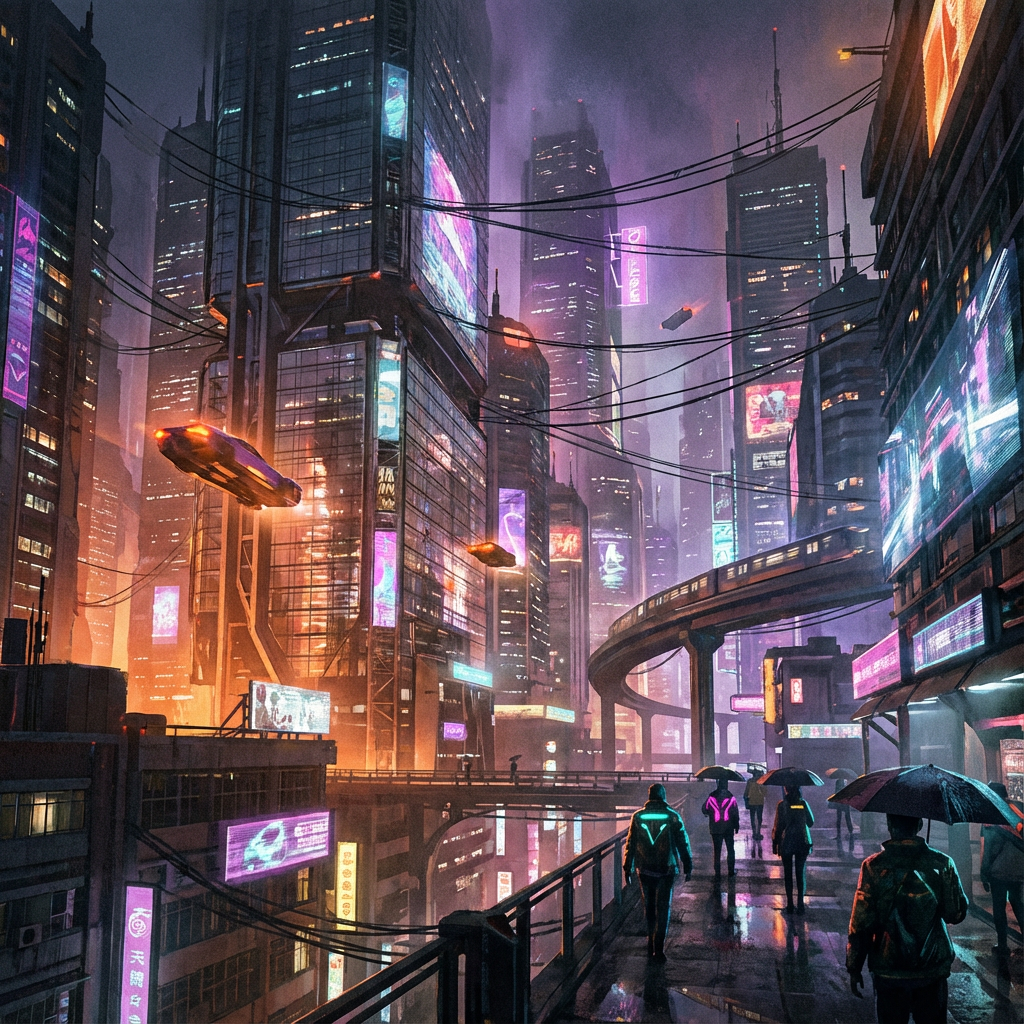
Midjourney’s primary focus is on generating high-quality, aesthetically pleasing, and often surreal or cinematic images. Its development is driven by a pursuit of artistic excellence, making it the favorite of fine artists, illustrators, and those seeking unique, stylized visuals.
•Focus: Artistic quality, photorealism, and unique style.
•Workflow: Primarily prompt-driven, with refinement through variations and remixing.
•Community: Discord-centric, fostering a community of artists and enthusiasts.
Leonardo AI: The Game Developer’s Utility Belt
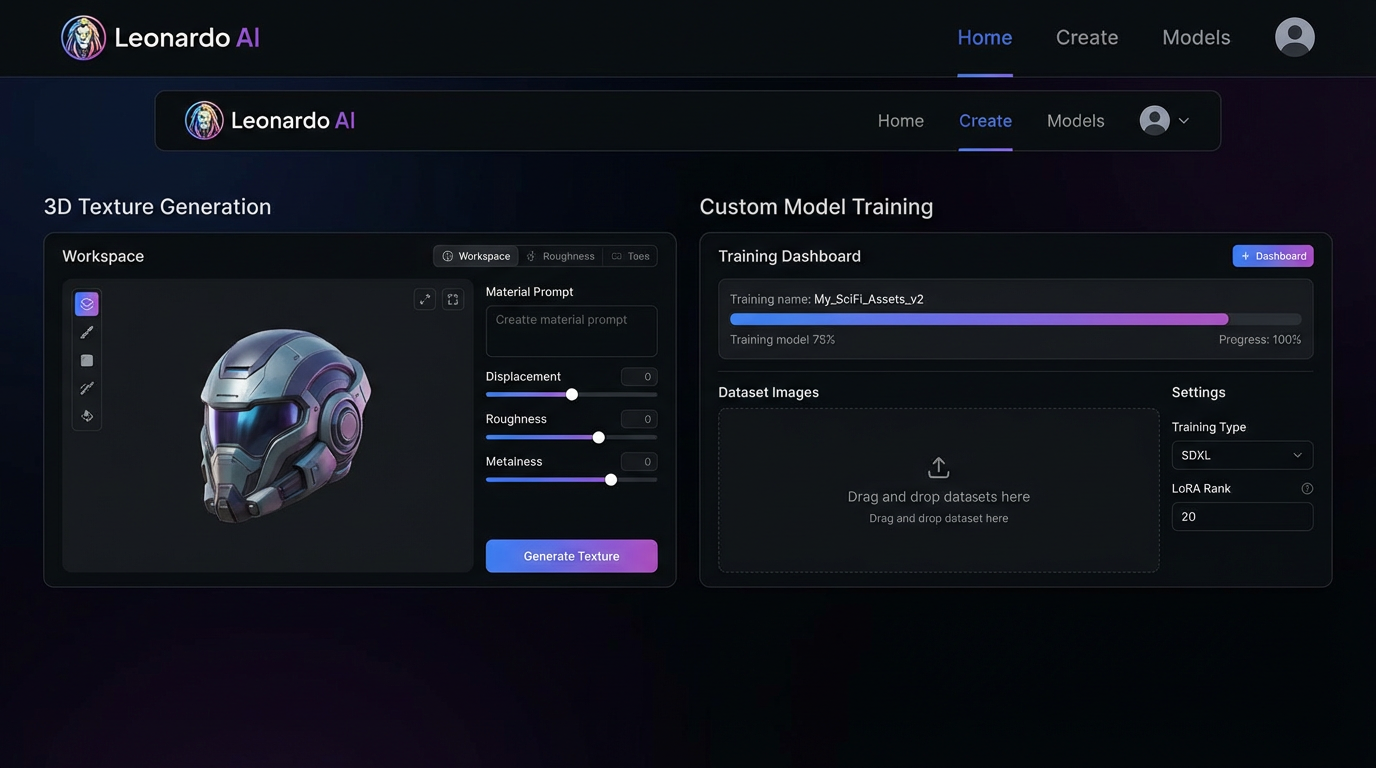
Leonardo AI was explicitly designed with game developers and creative professionals in mind. Its platform is built around tools that facilitate the creation of production-ready assets, offering a level of control and customization that Midjourney lacks.
•Focus: Utility, control, and production-ready assets (sprites, textures, concept art).
•Workflow: Feature-driven, with dedicated tools for image-to-image, prompt-to-3D, and custom model training.
•Community: Web-based, with a focus on sharing custom models and resources relevant to game development.
2. Specialized Tools for Gaming and Assets
The fan-out query Midjourney vs Leonardo AI for game assets and textures is where Leonardo AI truly shines, offering a suite of tools tailored for the gaming industry.
Leonardo AI’s Specialized Toolkit
Leonardo AI provides several features that are indispensable for game development:
•Image-to-Image and Prompt-to-Prompt: These features allow artists to upload a sketch or a low-resolution asset and use a text prompt to generate a high-quality, stylized version, maintaining the original composition.
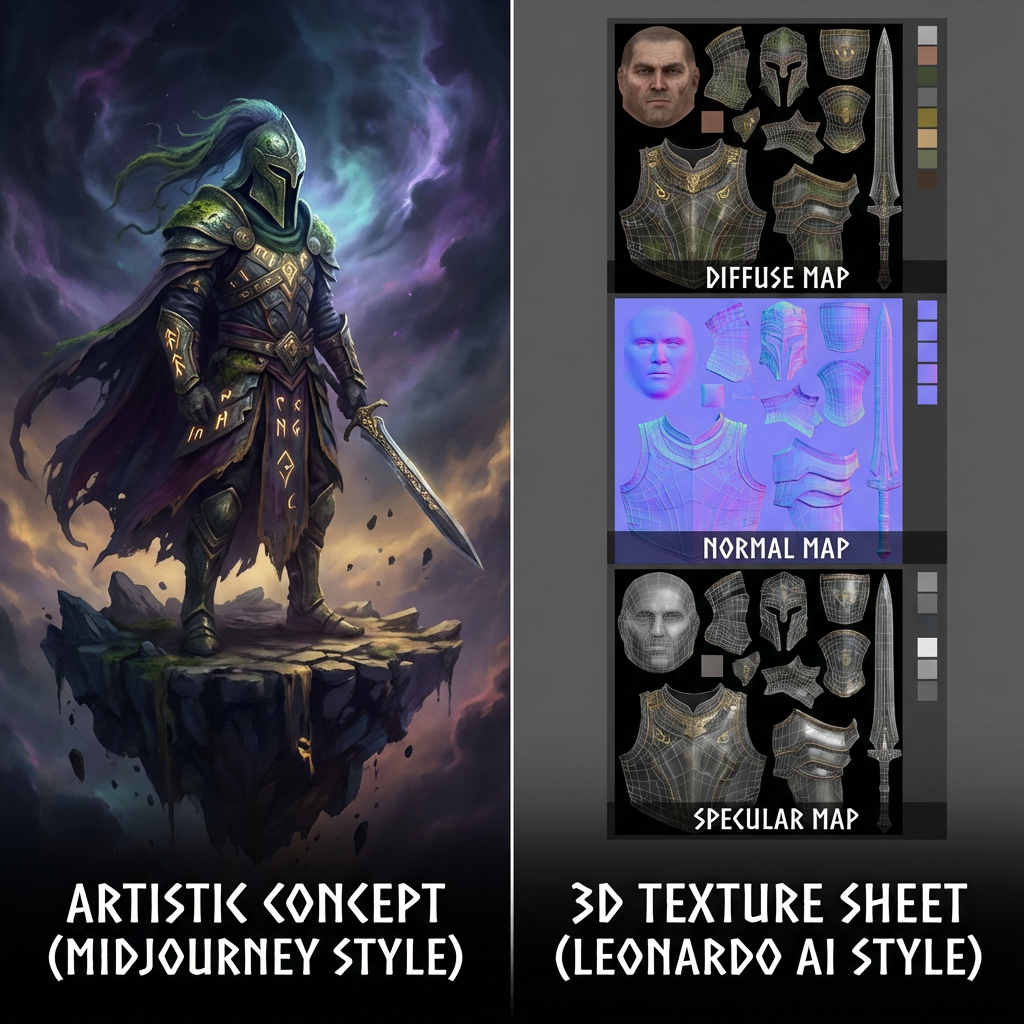
•3D Texture Generation: Leonardo AI offers tools specifically designed to generate seamless, tileable textures for 3D models, a critical and time-consuming task in game development. This includes normal maps, depth maps, and albedo maps, which are essential for rendering realistic 3D environments.
•Custom Model Training (Finetuning): Game studios can train a custom model on their existing art style, ensuring that all newly generated assets—from character portraits to environmental props—maintain a consistent, branded look. This is a massive advantage for maintaining visual cohesion across a large game world.
Midjourney’s Approach to Assets
While Midjourney can generate stunning concept art, its utility for creating production-ready assets is limited by its lack of specialized tools.
•Concept Art Excellence: Midjourney excels at generating high-level concept art for characters, environments, and mood boards, often surpassing Leonardo AI in raw artistic flair.
•Lack of Utility: Midjourney lacks native tools for generating seamless textures, 3D assets, or the fine-grained control needed for sprite sheet creation. While users can achieve some results through clever prompting, it is a less efficient and more manual process.
3. Control and Customization: The Workflow Decider
The fan-out query Midjourney vs Leonardo AI control and customization for game developers addresses the need for precise, repeatable results—a necessity in game development.
Leonardo AI: Granular Control
Leonardo AI offers a range of sliders, toggles, and dedicated features that give the user granular control over the generation process.
•Prompt Weighting: Users can easily adjust the influence of the text prompt versus the influence of the base image or model.
•Tiling and Seamless Textures: A dedicated "Tiling" option ensures that generated images can be seamlessly tiled, which is crucial for creating large, repeating textures for game environments.
•Negative Prompts and Elements: The platform makes it easy to exclude unwanted elements and use "Elements" (pre-trained style modules) to quickly apply a specific aesthetic.
Midjourney: Artistic Direction
Midjourney’s control is primarily exercised through advanced prompting and parameters (e.g., --style, --sref). While powerful for artistic direction, it is less suited for technical precision.
•Vast Parameter Space: Midjourney’s parameters allow for deep exploration of artistic styles and moods.
•Less Technical Control: It lacks the dedicated sliders and toggles for technical aspects like tiling, depth map generation, or specific asset formats, making it less predictable for production work.
4. Pricing and Accessibility
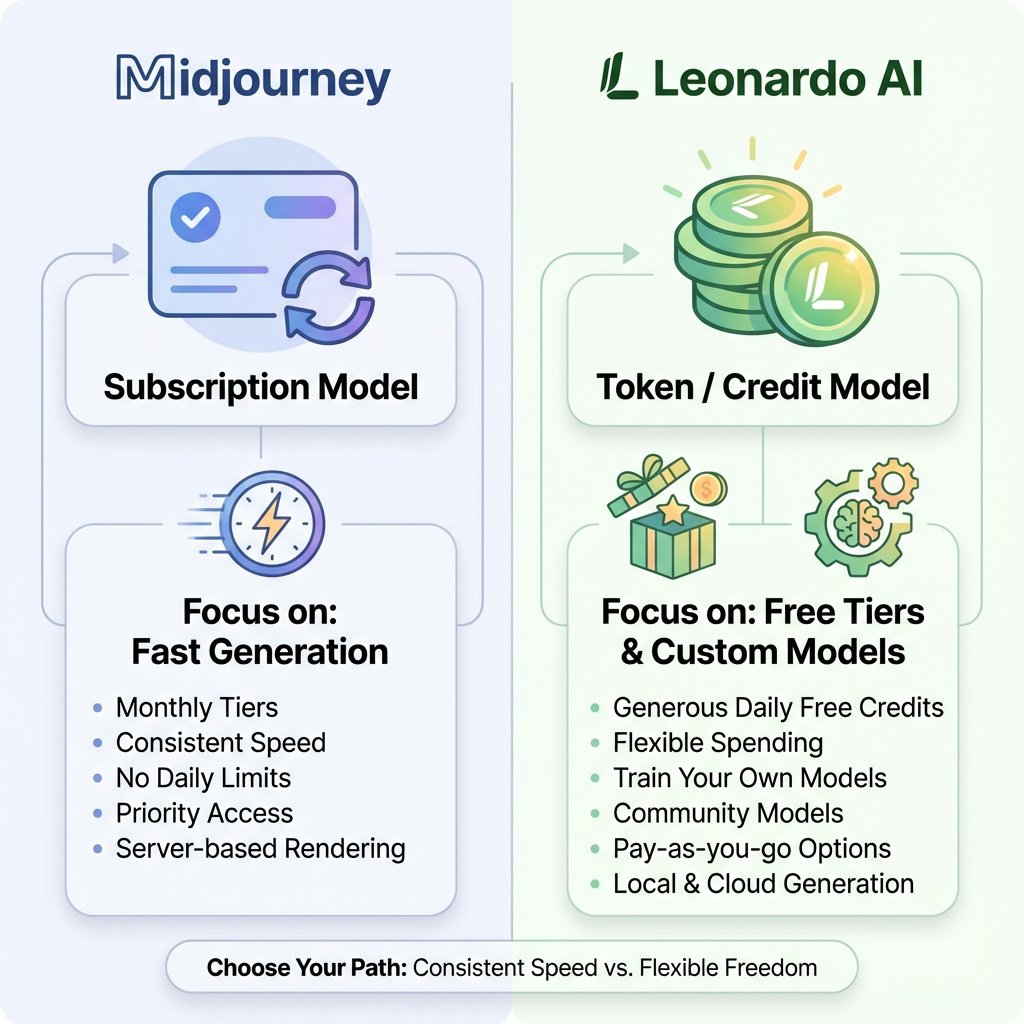
The fan-out query Midjourney vs Leonardo AI pricing and free tiers is a major consideration for indie developers and small studios.
Leonardo AI: Accessibility Champion
Leonardo AI is highly accessible, offering a generous free tier that allows users to test its capabilities without any financial commitment.
•Free Tier: Leonardo AI provides a daily allotment of free tokens (typically 150 tokens per day), allowing users to generate a significant number of images for free. This is a huge advantage for hobbyists and students.
•Token System: Paid plans are token-based, offering a flexible, pay-as-you-go model that scales with usage. The cost per image is generally lower than Midjourney.
Midjourney: Subscription-Only
Midjourney has moved away from its free trial and now operates on a subscription-only model.
•Subscription Required: Users must subscribe to a paid plan to generate any images.
•Higher Cost: While the quality is exceptional, the cost per image is generally higher, and the focus is on "fast" GPU time rather than a simple token count. This can be a barrier to entry for new users or those with limited budgets.
5. Community and Learning Resources
Both platforms have strong communities, but their focus differs significantly.
Midjourney’s Discord-Centric Community
Midjourney’s community is primarily hosted on Discord, which fosters a vibrant, real-time, and highly visual environment.
•Artistic Inspiration: The public nature of the generation channels means users are constantly exposed to new prompts, styles, and artistic ideas, which is excellent for inspiration.
•Less Structured Learning: While helpful, the Discord format is less structured for learning specific technical skills like asset creation.
Leonardo AI’s Web-Based Community
Leonardo AI’s community is integrated into its web platform, making it more structured and focused on utility.
•Model Sharing: The community gallery is a hub for sharing custom-trained models and LoRAs, which is invaluable for game developers looking for specific art styles.
•Tutorials and Documentation: The platform often features tutorials and documentation geared towards technical applications, such as creating seamless textures or training models for character consistency.
6. The Verdict: Artistic Vision vs. Production Utility
The choice between Midjourney vs Leonardo AI is a clear trade-off between raw artistic quality and production-ready utility.
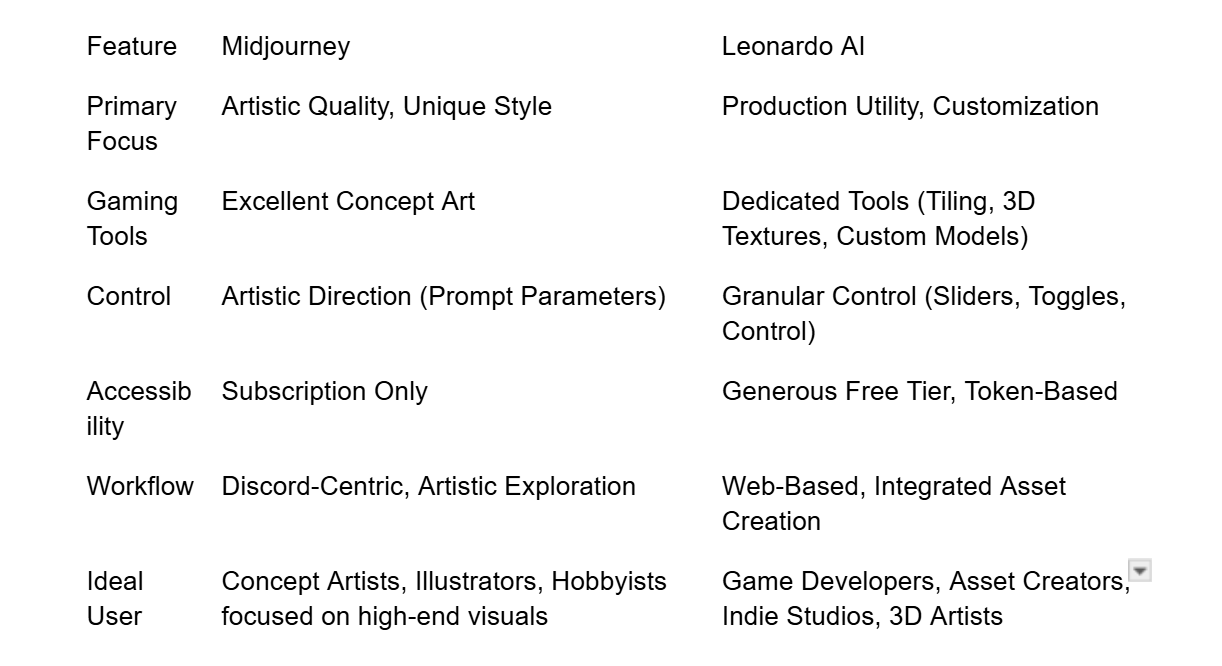
Leonardo AI is the clear winner for game development and asset creation. Its specialized tools for tiling, 3D texture generation, and custom model training make it a far more efficient and practical choice for a production pipeline.
Midjourney remains the champion for raw artistic vision and high-end concept art. If the goal is to create a single, stunning image for a marketing campaign or a portfolio piece, Midjourney’s artistic quality is often unmatched.
Ultimately, the best strategy for a professional studio is often to use both: Midjourney for initial, high-level concept art, and Leonardo AI for the bulk of the production-ready assets and textures.
8. The Technical Deep Dive: 3D Asset Generation and Textures
The fan-out query Midjourney vs Leonardo AI for 3D texture generation is a critical differentiator for game developers and 3D artists.
Leonardo AI's 3D Focus
Leonardo AI has made significant strides in integrating 3D workflows directly into its platform.
•Dedicated 3D Tools: Leonardo AI offers features like 3D Texture Generation and Depth Map Generation. These tools allow users to generate not just a flat image, but the necessary maps (Albedo, Normal, Roughness, etc. ) that a 3D rendering engine (like Unity or Unreal Engine) needs to apply a realistic texture to a model. This is a massive time-saver for creating environmental assets, props, and terrain.
•Prompt-to-3D: While still in its early stages, Leonardo AI is actively developing Prompt-to-3D features, allowing users to generate a low-poly 3D mesh directly from a text prompt, which can then be refined and textured.
Midjourney's 3D Limitations
Midjourney's focus on 2D artistic output means it lacks native 3D tools.
•Concept Only: Midjourney can generate stunning 3D concept art (images that look like 3D renders), but it does not output the necessary texture maps or 3D geometry files (like OBJ or FBX) required for a game engine.
•Manual Workflow: To use a Midjourney image as a texture, a 3D artist must manually process the image in external software (like Substance Painter or Blender) to create the required PBR (Physically Based Rendering) maps, adding significant time and complexity to the workflow.
9. Community and Ecosystem: Discord vs. Dedicated Platform
The community structure of each platform influences the learning curve and the type of support available.
Leonardo AI: The Collaborative Workshop
Leonardo AI's web-based platform is designed as a collaborative workshop, with a strong emphasis on sharing and utility.
•Model Marketplace: The platform features a marketplace where users can share and download custom-trained models and LoRAs. This allows a game developer to quickly find a model trained specifically for "cyberpunk cityscapes" or "medieval armor," accelerating their asset creation process.
•Structured Learning: Tutorials and documentation are integrated into the platform, making it easier for users to learn the technical aspects of asset generation, such as how to use the Tiling feature or how to train a custom model effectively.
Midjourney: The Artistic Gallery
Midjourney's Discord-centric model is excellent for artistic inspiration but less efficient for technical collaboration.
•Real-Time Inspiration: The public generation channels are a constant source of new ideas and artistic styles, which is invaluable for concept artists.
•Scattered Knowledge: Finding specific technical information, such as the best prompt for a seamless texture or a specific parameter setting, often requires sifting through thousands of Discord messages, making the learning process less structured and more time-consuming.
10. The Final Verdict for Game Developers
The choice between Midjourney vs Leonardo AI is clear when the goal is game development and asset creation.
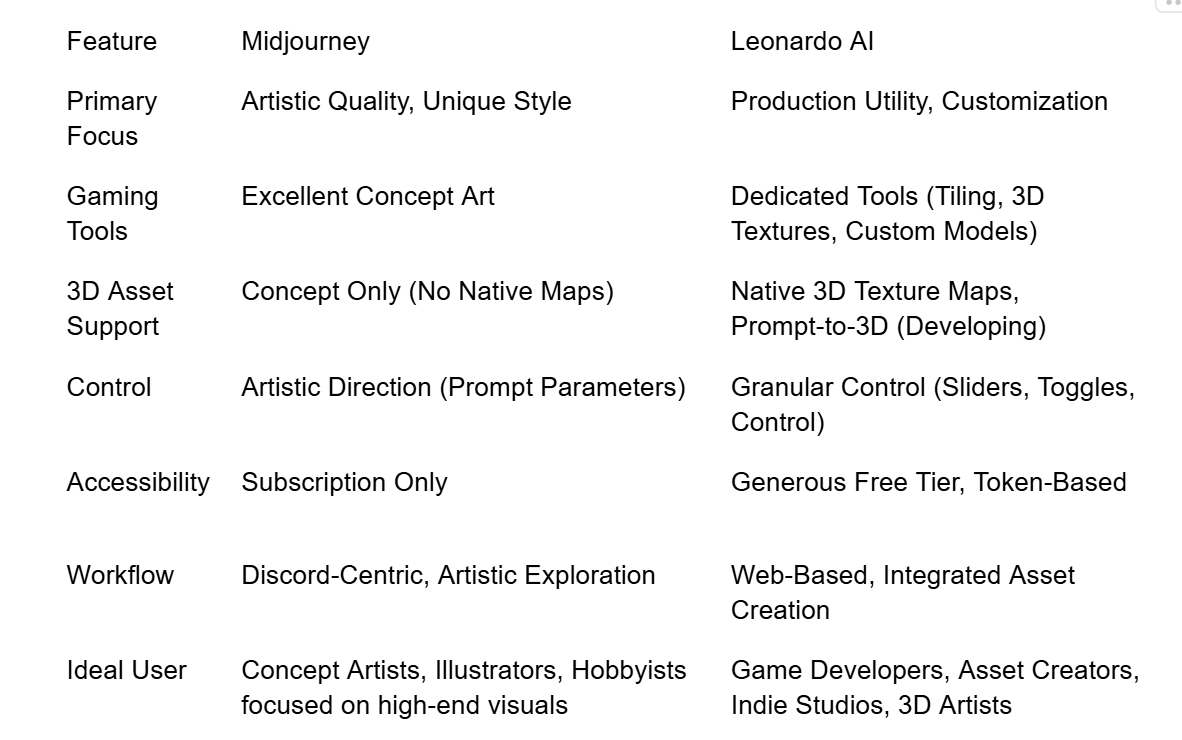
Leonardo AI is the clear winner for game development and asset creation. Its specialized tools for tiling, 3D texture generation, and custom model training make it a far more efficient and practical choice for a production pipeline. The generous free tier and token-based pricing also make it highly accessible to indie developers and small studios.
Midjourney remains the champion for raw artistic vision and high-end concept art. If the goal is to create a single, stunning image for a marketing campaign or a portfolio piece, Midjourney’s artistic quality is often unmatched.
The most effective strategy for a professional studio is to leverage the strengths of both: Midjourney for initial, high-level concept art and Leonardo AI for the bulk of the production-ready assets and textures. This dual-tool approach maximizes both artistic quality and production efficiency, setting the standard for the next generation of game development.
11. The Future of AI Asset Creation: Convergence and Specialization
The competition between Midjourney vs Leonardo AI is driving rapid innovation, with both platforms beginning to converge on certain features while simultaneously specializing in their core strengths.
Midjourney is increasingly focused on providing more control through advanced prompting and parameters, hinting at a future where its artistic quality can be guided with greater precision. However, its proprietary nature and lack of native 3D tools will likely keep it focused on 2D concept art.
Leonardo AI, conversely, is rapidly expanding its utility features, with a clear roadmap toward becoming the all-in-one asset creation suite for game developers. The integration of 3D tools, the focus on custom models, and the user-friendly interface all point to a platform that prioritizes production efficiency.
For the game developer, the current state of the Midjourney vs Leonardo AI debate is a win-win. They have access to the best artistic concept generator (Midjourney ) and the most feature-rich asset production tool (Leonardo AI). The key is understanding when to use each tool to maximize the efficiency and quality of their creative pipeline. The future will belong to the tool that can most effectively bridge the gap between stunning artistic vision and seamless, production-ready utility.