Midjourney vs NightCafe: The Ultimate AI Image Generator Showdown
The landscape of AI image generation is dominated by a few key players, each offering a unique philosophy on how art should be created. At the forefront of this revolution are two platforms that represent fundamentally different approaches: Midjourney and NightCafe. This comprehensive 2500-word analysis pits Midjourney vs NightCafe, dissecting their core models, user experiences, creative controls, and commercial viability to provide a definitive guide for creators in 2025.
Midjourney has established itself as the gold standard for high-quality, cinematic, and often surreal imagery, operating primarily through a Discord interface that fosters a unique, real-time community. NightCafe, on the other hand, is a versatile, web-based platform that offers users access to a wide array of underlying models, including Stable Diffusion, DALL-E 2, and its own proprietary algorithms, making it a hub for experimentation and accessibility.
For any artist, designer, or content creator, the choice between Midjourney vs NightCafe is a crucial one, determining not just the aesthetic of their work but the entire creative workflow. We will explore every facet of this comparison, from the signature look of each platform to the subtle differences in their pricing structures, to help you decide which tool is the right fit for your artistic journey.
1. Aesthetic and Output Quality: Cinematic Vision vs. Model Diversity
The most immediate and striking difference between the two platforms is the aesthetic quality of their output. Each has a distinct signature that is instantly recognizable.
Midjourney: The Cinematic Master
Midjourney is renowned for its highly stylized, often cinematic, and hyper-detailed aesthetic. The model is fine-tuned to produce images that look like they belong in a high-budget fantasy film or a glossy art book.
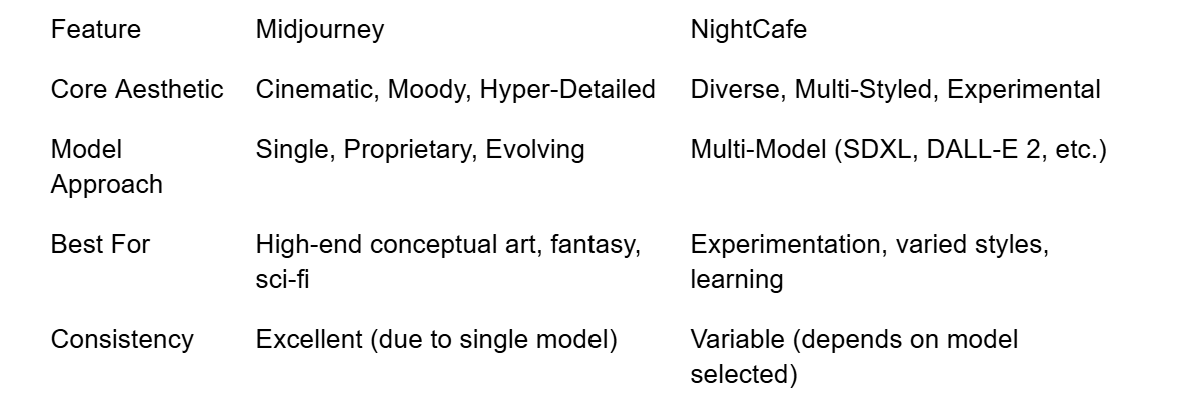
•Signature Look: Midjourney images typically feature dramatic lighting, rich textures, and a strong sense of composition. They excel at fantasy, sci-fi, and conceptual art, often requiring minimal prompting to achieve stunning results.
•Consistency: The single, proprietary model (currently V6, with V7 in development) ensures a high degree of aesthetic consistency. This is a massive advantage for creators who need a unified look across a series of images or a brand campaign .
•Prompt Interpretation: Midjourney is highly sensitive to artistic terms, camera angles, and lighting descriptions, allowing power users to achieve precise visual outcomes through complex prompting.
NightCafe: The Multi-Model Experimenter
NightCafe is not a single model but a platform that hosts several of the world's leading AI art engines. This multi-model approach is its greatest strength, offering unparalleled diversity.
•Aesthetic Range: Users can choose from a vast library of styles by selecting different underlying models, such as Stable Diffusion XL for photorealism, DALL-E 2 for unique compositions, or CLIP-Guided Diffusion for abstract, painterly results.
•Model Management: While this diversity is powerful, it requires the user to understand the strengths and weaknesses of each model. The quality and aesthetic can vary wildly depending on the engine selected.
•Accessibility: NightCafe's approach makes it an excellent starting point for beginners who want to experiment with different AI art styles without the need to learn complex parameters for a single model.
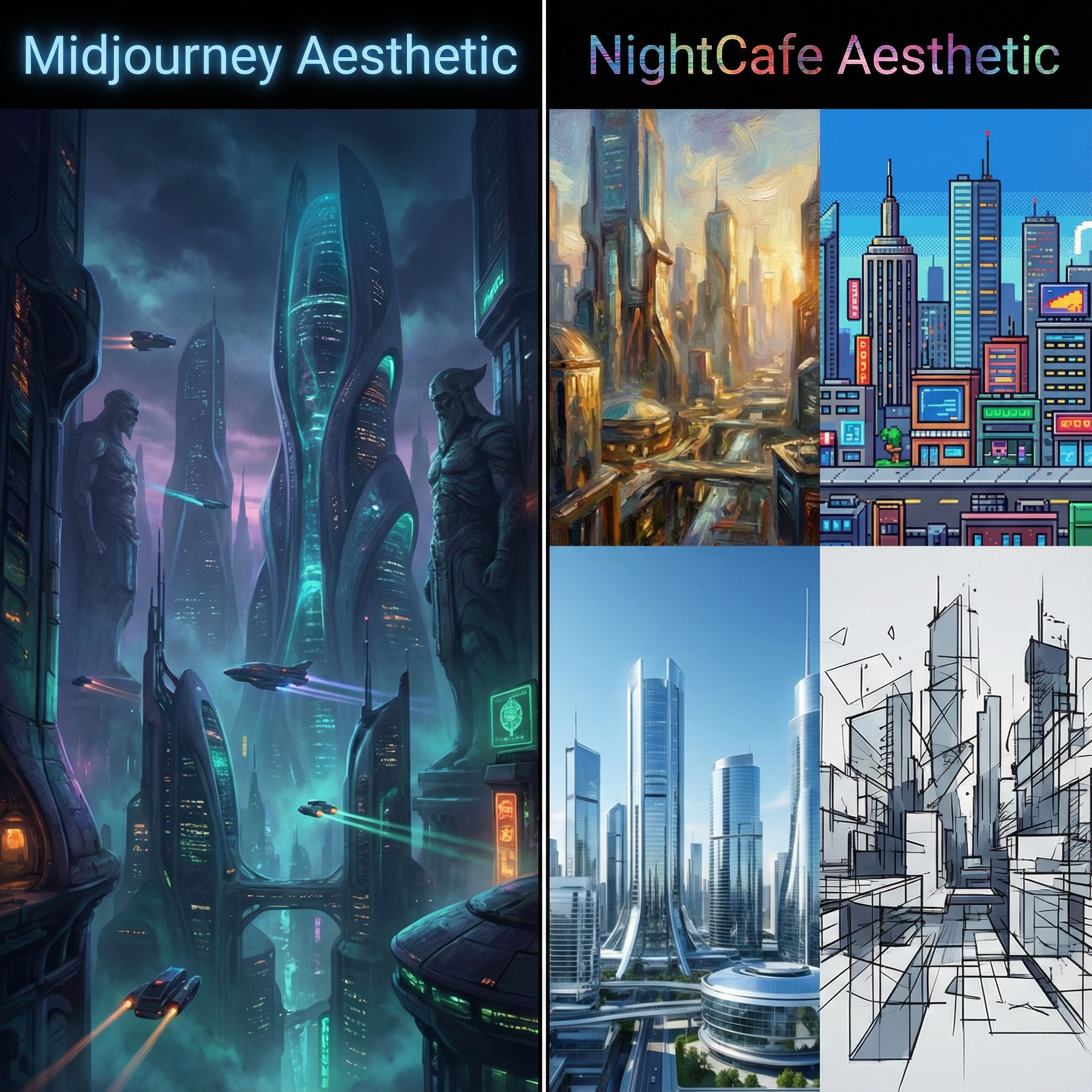
A side-by-side comparison of two generated images of a futuristic city. The left image (Midjourney) should be highly cinematic, moody, and detailed with a strong fantasy/sci-fi aesthetic. The right image (NightCafe) should be more varied in style, perhaps a collage of different artistic styles (e.g., oil painting, pixel art, photorealism) to represent its multi-model approach. Label the sections 'Midjourney Aesthetic' and 'NightCafe Aesthetic'.
2. User Experience and Interface: Discord-Native vs. Web-Based Platform
The way users interact with these tools is perhaps the most significant practical difference, defining the entire workflow.
Midjourney: The Discord Ecosystem
Midjourney is famously a Discord-native tool. Users interact with the AI bot directly within a Discord server, typing commands to generate images.
•Real-Time Generation: The generation process happens in real-time within the public or private Discord channels, allowing for instant feedback and iteration.
•Learning by Observation: A major benefit is the ability to see the prompts and results of thousands of other users in the public channels. This "learning by observation" is a powerful way for new users to quickly grasp advanced prompting techniques.
•Workflow: The workflow is command-line based (/imagine prompt: ...), which can be intimidating for non-Discord users but is incredibly fast and efficient once mastered. The primary tools for upscaling and variation are simple reaction buttons.
NightCafe: The Accessible Web App
NightCafe is a traditional, web-based application that is instantly familiar to anyone who has used a standard online creative tool.
•Intuitive Interface: The user interface is clean, intuitive, and designed for maximum accessibility. All controls, settings, and galleries are laid out clearly on the website.
•No External App Required: There is no need to download or use a third-party application like Discord, making the barrier to entry extremely low.
•Workflow: The workflow is form-based. Users enter a prompt, select a model, adjust settings via sliders and dropdowns, and click a "Create" button. This is often preferred by users who want a private, focused workspace without the distraction of a public feed.
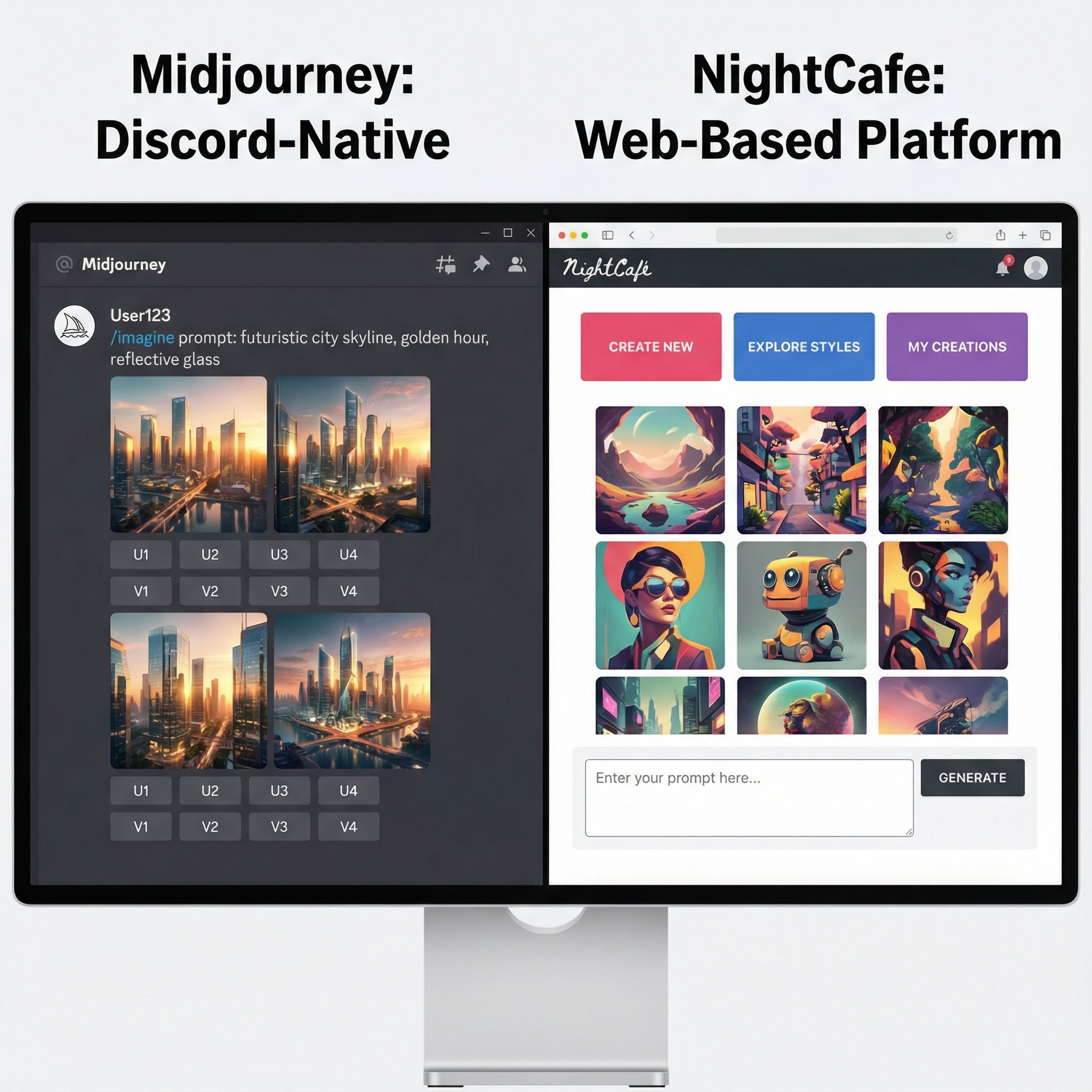
A visual comparison of two user interfaces. The left side shows a minimalist, text-heavy Discord chat window with a prompt and four generated images (Midjourney). The right side shows a clean, web-based interface with large buttons, a gallery view, and a simple text box (NightCafe). Label the sections 'Midjourney: Discord-Native' and 'NightCafe: Web-Based Platform'.
3. Creative Control and Parameter Depth
The level of control a user has over the final image is a key factor for professional artists. Both platforms offer control, but they approach it from different directions.
Midjourney: Parameter-Driven Control
Midjourney offers deep, granular control through a vast array of parameters that are appended to the main prompt.
•Advanced Parameters: Users can fine-tune aspects like aspect ratio (--ar), stylization (--s), chaos (--c), and seed (--seed) to achieve highly specific and repeatable results. The complexity of these parameters allows for incredible creative depth.
•Image Prompts: Midjourney excels at using image prompts, allowing users to upload a reference image and use its aesthetic or composition as a guide for a new generation.
•Learning Curve: Mastering Midjourney's parameters requires dedication and experimentation, leading to a steeper learning curve than NightCafe. However, the payoff is a level of artistic control that is hard to match.
NightCafe: Preset-Driven Simplicity
NightCafe focuses on simplifying the control process by offering pre-configured styles and templates.
•Style Presets: Instead of complex parameters, NightCafe offers a large library of one-click style presets (e.g., "Vibrant Fantasy," "Oil Painting," "Cyberpunk"). This allows users to instantly apply a professional look without needing to know the underlying model settings.
•Template Customization: The platform also offers templates that can be customized, guiding the user through the process of creating specific types of art, such as logos or character portraits.
•Model-Specific Controls: While generally simpler, NightCafe does expose some model-specific controls (like the number of steps or CFG scale) when using models like Stable Diffusion, offering a middle ground between simplicity and power.
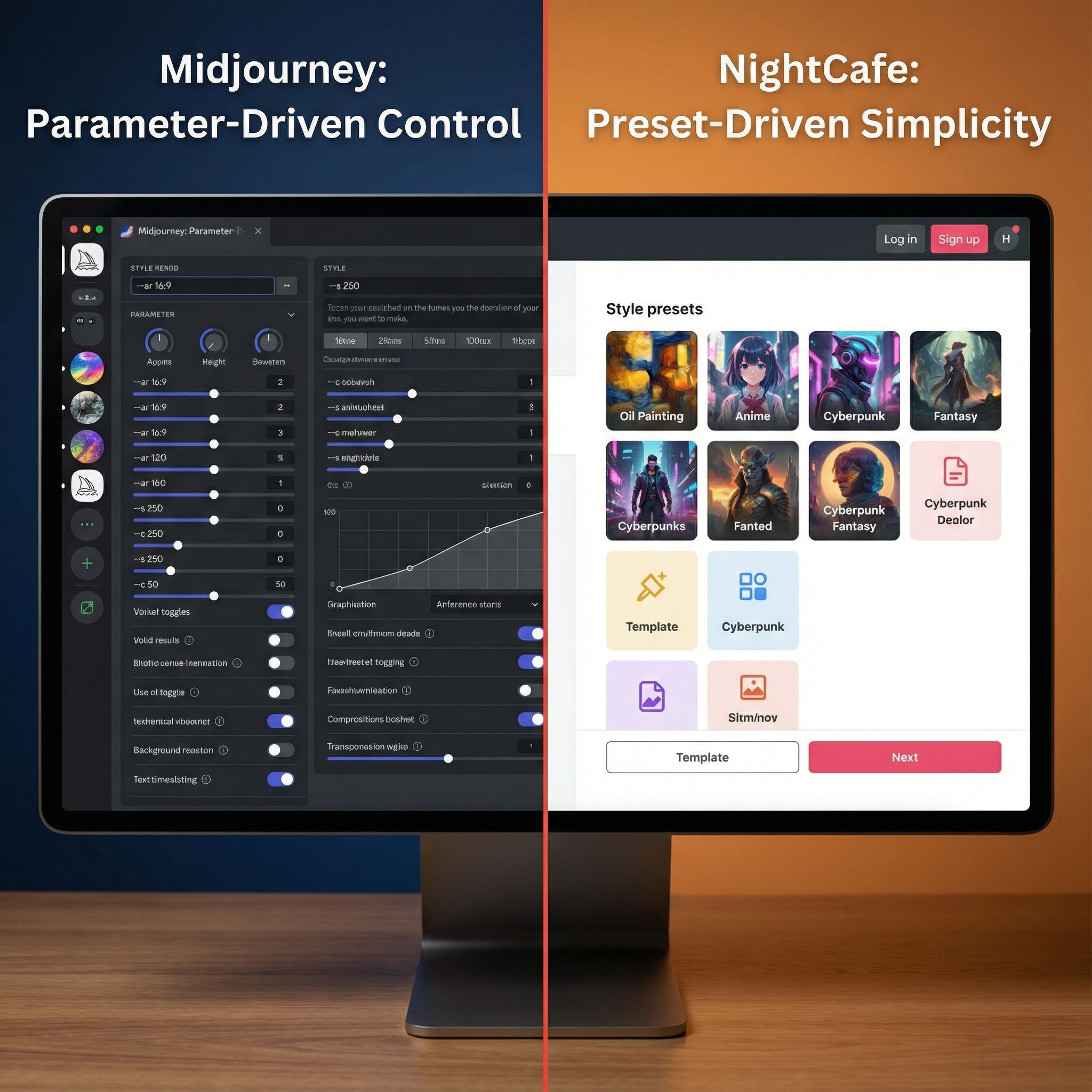
A visual comparison of creative control. The left side shows a complex control panel with many fine-tuning sliders and text parameters (Midjourney). The right side shows a simpler control panel with large, easy-to-select style presets and templates (NightCafe). Label the sections 'Midjourney: Parameter-Driven Control' and 'NightCafe: Preset-Driven Simplicity'.
4. Community, Sharing, and the Marketplace
The social and commercial aspects of these platforms are fundamentally different, catering to distinct user goals.
Midjourney: The Real-Time Social Hub
Midjourney's Discord environment is a vibrant, real-time social hub where creation is inherently public. This unique setup has profound implications for the user experience and the speed of learning.
•Public Creation and Transparency: By default, all generations happen in public channels, creating a dynamic, collaborative, and highly transparent atmosphere. This is excellent for inspiration, as users can instantly see what others are creating and the exact prompts they used. However, this transparency is a significant concern for users prioritizing privacy or working on proprietary commercial projects. The constant stream of new art also creates a sense of urgency and rapid iteration that is unique to the platform.
•Community Learning and Prompt Engineering: The community is a massive, self-teaching resource. Users constantly share tips, advanced prompt structures, and parameter combinations. The sheer volume of visible generations allows new users to quickly reverse-engineer successful prompts, accelerating the learning curve for those willing to engage with the Discord environment. The community also acts as a real-time support system, with experienced users often helping newcomers.
•Private Mode and Commercial Privacy: Midjourney offers a "Stealth Mode" for Pro subscribers, allowing for private generations, which is essential for commercial work. However, the core, free experience remains public, reinforcing its identity as a social art experiment.
NightCafe: The Gallery and Marketplace
NightCafe is built around a traditional web gallery and a robust community system that feels more like a dedicated social media platform for artists. It emphasizes curation, competition, and commercialization.
•Daily Challenges and Gamification: NightCafe hosts daily and weekly art challenges, encouraging users to create art based on a specific theme. This gamification is a powerful tool for engagement and skill development, providing clear goals and a competitive structure that appeals to many artists. The voting system further reinforces community interaction and helps surface high-quality work.
•Selling Art and Direct Monetization: NightCafe features a built-in marketplace where users can sell their creations as prints or digital assets, providing a direct, integrated path to monetization that is a key differentiator from Midjourney's core offering . This makes NightCafe a more attractive option for artists looking to immediately turn their AI creations into a source of income.
•Curated Social Features: The platform includes features like following, liking, and commenting, similar to a standard social media platform, making it feel more like an art gallery than a chat room. The focus is on the final, curated piece of art rather than the raw, iterative process of generation, offering a calmer, more focused social experience. This web-based approach also allows for better organization and searchability of user galleries.
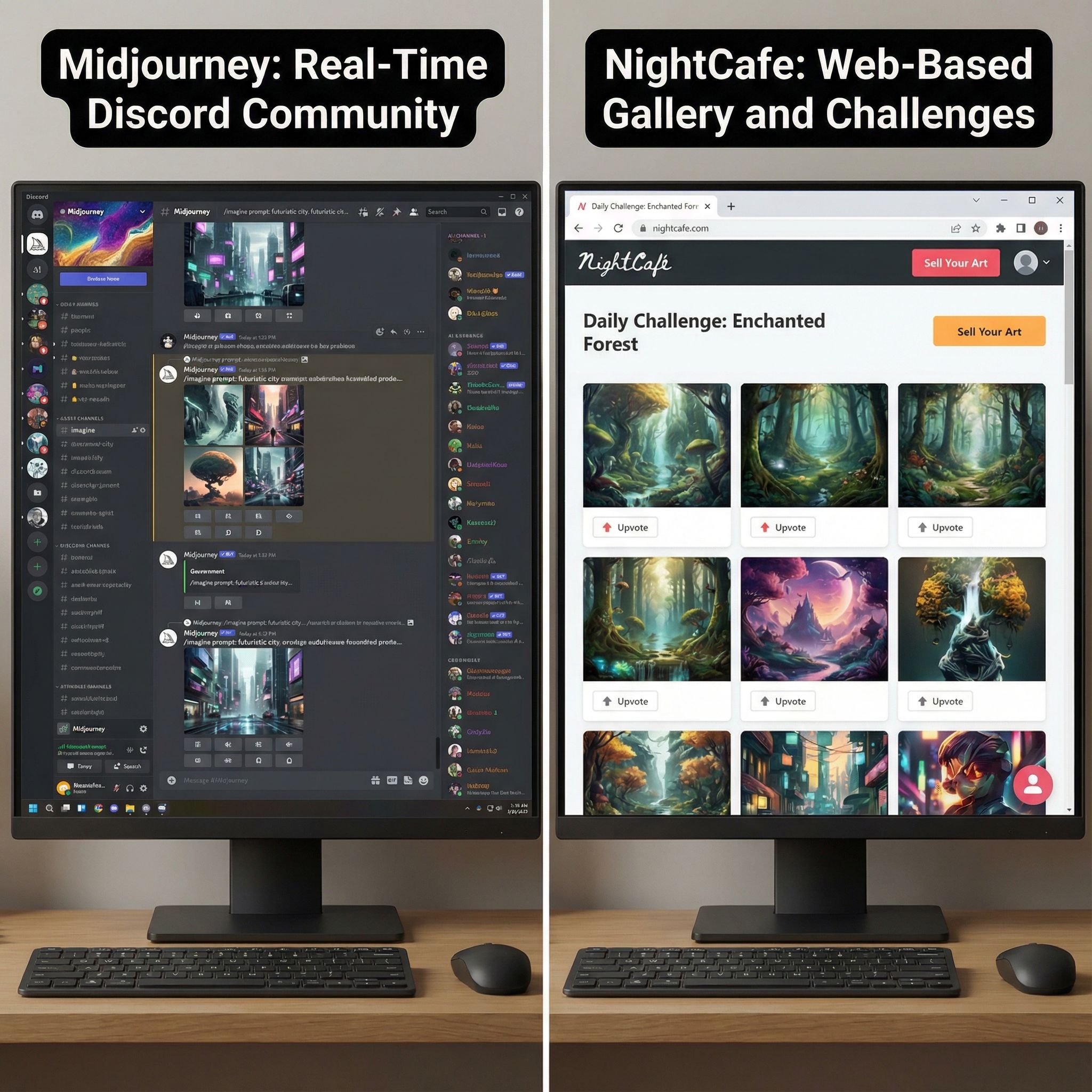
A visual comparison of community and sharing. The left side shows a busy Discord server with many users generating images in a public feed (Midjourney). The right side shows a clean, web-based gallery with daily challenges, voting buttons, and a clear "Sell Your Art" button (NightCafe). Label the sections 'Midjourney: Real-Time Discord Community' and 'NightCafe: Web-Based Gallery and Challenges'.
5. Pricing, Credits, and Commercial Viability
The cost of using these tools is a major consideration, and their models are entirely different.
Midjourney’s Pricing: Time-Based Subscription
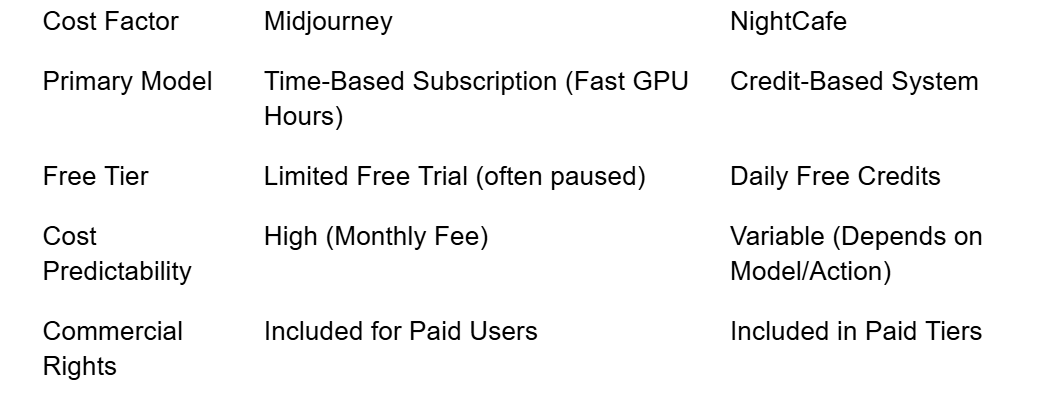
Midjourney uses a subscription model based on the amount of "Fast GPU Time" a user consumes.
•Fast GPU Time: Users pay for a monthly allocation of GPU time (e.g., 15 hours for the Standard Plan). This time is consumed rapidly when generating images. Once the fast time is used up, generations switch to "Relax Mode," which is free but significantly slower.
•Cost Predictability: The cost is relatively predictable, but the speed of generation is not. High-volume users may find themselves constantly running out of Fast Time.
•Commercial Rights: Paid subscribers generally have full commercial rights to the images they create, a critical factor for professional use .
NightCafe’s Pricing: Credit-Based System
NightCafe uses a credit system, where different actions consume different amounts of credits.
•Credit Consumption: A simple generation might cost 1-2 credits, while using a high-end model like SDXL or DALL-E 2, or performing an advanced action like upscaling, will cost more.
•Flexibility: This system is highly flexible, allowing users to pay only for the complexity they require. NightCafe also offers daily free credits, making it the more accessible option for casual users.
•Subscription Tiers: NightCafe offers subscription tiers that provide a monthly bundle of credits at a discounted rate, offering a balance between the flexibility of credits and the predictability of a subscription.
6. The Final Showdown: Midjourney vs NightCafe
The ultimate choice between Midjourney vs NightCafe is a reflection of the creator's needs, skill level, and desired workflow. Both platforms are leaders in the field, but they serve different masters.
Choose Midjourney if:
•Your priority is a consistent, high-end, cinematic aesthetic. Midjourney's unique model is unmatched for creating stunning, professional-grade conceptual art with a unified look.
•You thrive in a real-time, community-driven environment. The Discord workflow and the ability to learn from thousands of other users are invaluable for rapid skill development.
•You are comfortable with complex parameters and want the deepest possible control over composition and style.
Choose NightCafe if:
•You need access to a wide variety of models (Stable Diffusion, DALL-E 2, etc.) for maximum stylistic flexibility.
•You prefer a simple, web-based interface and a private workspace without the distraction of Discord.
•You want to monetize your art through a built-in marketplace or benefit from daily art challenges.
•You are a beginner looking for a free, accessible way to experiment with different AI art styles.
The comparison of Midjourney vs NightCafe is not about finding a single "best" tool, but about identifying the best tool for you. Midjourney offers a singular, powerful vision, while NightCafe offers a diverse, accessible toolkit. By understanding the core differences in their aesthetic, interface, and pricing, creators can make an informed decision that aligns with their artistic and commercial goals. The continued evolution of both platforms ensures that the ultimate winner is the creator, who now has an unprecedented choice of powerful AI tools at their disposal. For the professional studio or the artist focused on a specific, high-end look, Midjourney’s consistent quality and parameter control make it indispensable. For the hobbyist, the educator, or the artist who needs to quickly prototype in multiple styles and potentially sell their work, NightCafe’s flexibility and web-based community are the clear advantages. Ultimately, the choice between Midjourney vs NightCafe is a choice between a highly specialized, top-tier aesthetic and a broad, accessible ecosystem of creative tools.