Midjourney vs StarryAI: The Ultimate AI Art Generator Showdown
The world of generative AI art is a battleground of innovation, where two distinct philosophies of creation are constantly vying for the attention of artists, designers, and hobbyists. On one side stands Midjourney, the undisputed champion of cinematic, hyper-realistic, and often surreal imagery, operating primarily within the bustling, public sphere of Discord. On the other is StarryAI, a sleek, user-friendly mobile and web application that democratizes AI art with its intuitive interface and accessible credit system. Choosing between these two platforms is not just a matter of preference; it is a fundamental decision about your workflow, your desired level of control, and the aesthetic you wish to achieve.
This comprehensive, 2500-word guide will dissect the core differences, compare the artistic output, analyze the cost structures, and ultimately help you decide which tool is the superior fit for your creative journey. We will move beyond simple feature lists to provide a strategic analysis that will allow you to confidently navigate the rapidly evolving landscape of AI image generation.
The Core Difference: Platform, Accessibility, and User Experience
The most immediate and defining difference between these two AI art generators is the platform on which they operate. This single factor dictates the entire user experience, from the moment you sign up to the final download of your masterpiece.
Midjourney: The Discord-Native Powerhouse
Midjourney has built its empire on Discord, a community-focused chat platform. This choice is both its greatest strength and its most significant barrier to entry. To use Midjourney, you must first join the official Midjourney Discord server, navigate to a generation channel (often called a "Newbie" or "General" room), and type your prompt using the /imagine command.
This Discord-native approach fosters an unparalleled sense of community. Every image generated by every user in the public channels is visible to everyone else. This constant stream of creation serves as a powerful source of inspiration, allowing users to instantly see what prompts and parameters are producing the best results. It is a real-time, public masterclass in prompt engineering. However, this environment can be chaotic and overwhelming for newcomers. The interface is text-based, requiring the user to memorize or constantly reference a list of commands and parameters (like --ar for aspect ratio or --s for stylization). For many, the initial setup and the constant stream of other users' work can feel like a high-friction experience.
StarryAI: The Dedicated App for Simplicity
StarryAI, in stark contrast, is built as a dedicated, standalone application, available on iOS, Android, and the web. This approach prioritizes simplicity and a low barrier to entry. The user interface is clean, graphical, and intuitive, designed to feel familiar to anyone who has used a modern mobile app.
Instead of typing commands, users interact with sliders, dropdown menus, and clearly labeled buttons to select models (like Argo or Altair), choose aspect ratios, and apply stylistic filters. This is a massive advantage for the casual user or the artist who wants to focus purely on the creative output without the distraction of a chat-based interface. StarryAI offers a private generation experience, meaning your work is not immediately visible to a public feed unless you choose to share it in the in-app gallery. This privacy and ease of use make StarryAI the clear winner for those who prioritize a streamlined, non-technical workflow.
The visual contrast between these two platforms is striking, as illustrated below.
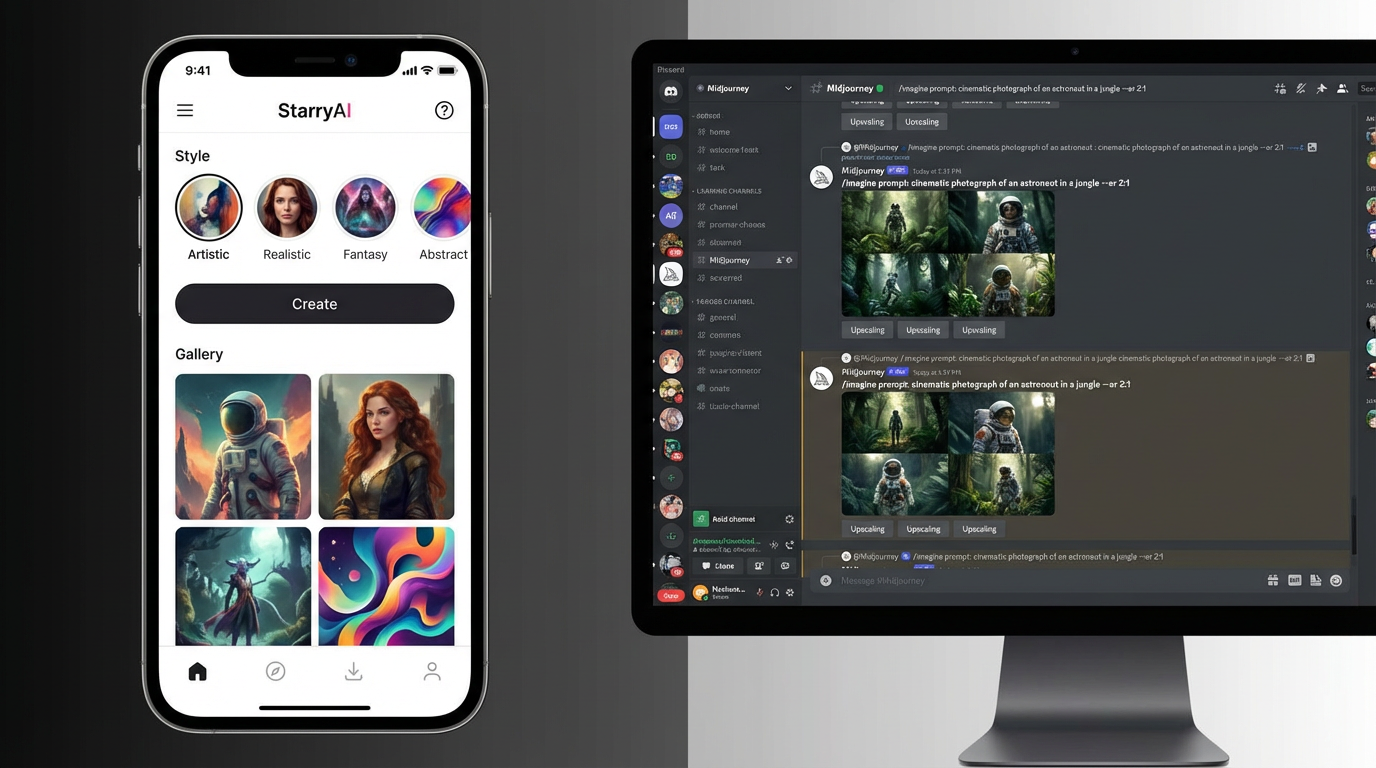
A split-screen view contrasting StarryAI's clean, mobile-app interface with Midjourney's command-line, Discord-native environment.
Aesthetic and Artistic Output: Cinematic Realism vs. Painterly Versatility
The quality and characteristic style of the generated images are the ultimate metrics for any AI art tool. While both platforms are capable of producing stunning results, their default aesthetics and strengths diverge significantly.
Midjourney’s Signature Style: The Cinematic Look
Midjourney is renowned for its signature aesthetic: a highly polished, cinematic, and often surreal style that is instantly recognizable. Its models (currently V6 and the forthcoming V7) are expertly trained to produce images with:
- Hyper-Realism and Detail: Midjourney excels at generating intricate textures, realistic lighting, and deep, atmospheric compositions. It is the go-to tool for concept artists and designers seeking photorealistic or high-fantasy visuals.
- Prompt Adherence: The latest versions of Midjourney have significantly improved their ability to understand complex, multi-clause prompts, allowing for a high degree of control over the final composition.
- Artistic Bias: Midjourney has a strong, inherent artistic bias that often elevates even simple prompts into visually stunning pieces. This is a double-edged sword: it guarantees beautiful results but can sometimes make it difficult to achieve a truly plain or un-stylized image.
For professional work that requires a high-end, polished look, Midjourney’s output is often considered the industry benchmark.
StarryAI’s Versatility: The Painterly Touch
StarryAI offers a more diverse range of artistic styles, largely due to its use of multiple underlying models, including its proprietary Argo model and various iterations of Stable Diffusion. This versatility allows StarryAI to cater to a broader spectrum of artistic needs:
- Stylistic Range: StarryAI shines in generating abstract, painterly, and highly stylized art. Its built-in styles and filters make it easy to achieve looks like "oil painting," "surrealism," or "cyberpunk" without complex prompt engineering.
- Accessibility to Models: By offering access to different models, StarryAI gives users the power to experiment with different generative engines, which is a significant advantage for artists who value exploration over a single, fixed aesthetic.
- Ease of Use: The ability to select a style from a visual menu rather than describing it in a prompt makes StarryAI incredibly fast for achieving a desired artistic direction.
While Midjourney often wins on raw, cinematic fidelity, StarryAI offers a superior experience for artists who want to quickly explore a wide variety of artistic mediums and styles. The comparison below highlights this aesthetic difference.
.png)
A side-by-side comparison of two AI-generated art pieces, illustrating Midjourney's hyper-realistic, high-contrast aesthetic versus StarryAI's softer, more painterly style.
Control and Customization: The Power User’s Playground
For advanced users, the true power of an AI art generator lies in the depth of its control mechanisms. This is where the Midjourney vs StarryAI debate becomes a clear choice between complexity and simplicity.
Midjourney: Command-Line Mastery
Midjourney’s control system is designed for the power user who is willing to invest time in prompt engineering. Control is achieved through a vast array of parameters appended to the /imagine command. These include:
- Aspect Ratio (--ar): Precise control over the image dimensions.
- Stylization (--s): A numerical value to control how much artistic flair the model applies.
- Chaos (--c): A value to control the randomness and unexpectedness of the results.
- Permutation Prompts: The ability to generate multiple variations from a single prompt using curly braces, which is a powerful tool for rapid ideation.
- Image Prompts: The ability to use an existing image as a reference for style or composition, a feature that has become essential for professional consistency.
Mastering these parameters is key to unlocking Midjourney’s full potential. The learning curve is steep, but the reward is a level of granular control that allows for highly specific and repeatable results. For users coming from a coding or technical background, this command-line approach feels natural and powerful.
StarryAI: Sliders and Presets
StarryAI simplifies control by translating complex parameters into visual controls and presets. Instead of typing --s 1000, the user moves a "Stylization" slider. Key control features include:
- Pre-defined Styles: A gallery of styles (e.g., "Vibrant," "Realistic," "Abstract") that automatically adjust the underlying model parameters.
- Initial Image/Reference: The ability to upload a starting image to guide the composition, similar to Midjourney's image prompts, but often with a simpler interface.
- Negative Prompts: A dedicated field for specifying what you don't want in the image, a crucial feature for refining output.
While this approach is incredibly user-friendly, it inherently limits the depth of customization. The user is guiding the model within a pre-defined range of options, rather than directly manipulating the core parameters. For the vast majority of users, this level of control is more than sufficient, but for the professional seeking maximum creative leverage, Midjourney’s command-line depth remains superior.
The image below provides a conceptual look at the difference in control philosophy.
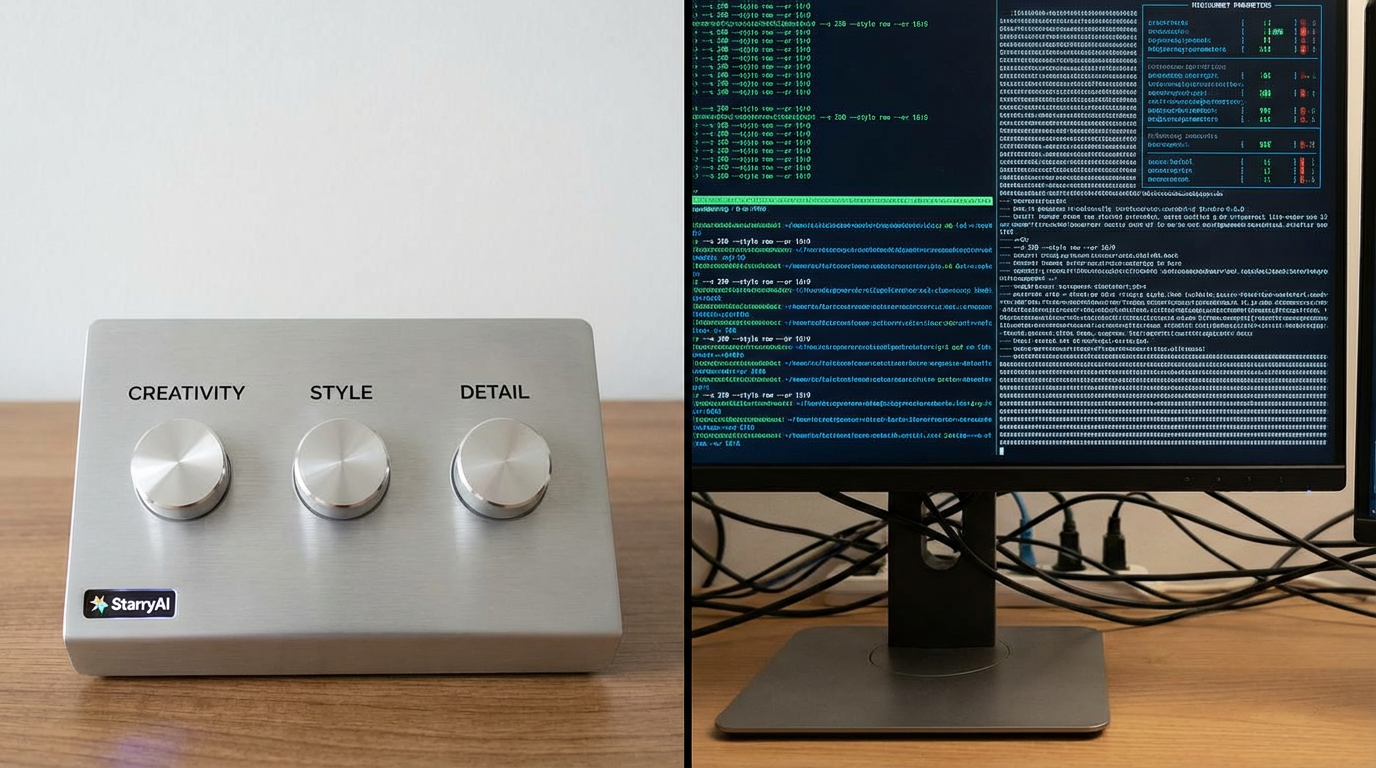
A visual metaphor contrasting StarryAI's simple, three-dial control panel with the dense, code-like parameter screen of Midjourney, representing the difference between simplicity and granular control.
Pricing and Cost-Effectiveness: Subscription vs. Pay-As-You-Go
The economic model is a critical factor in the Midjourney vs StarryAI comparison, especially for users who generate a high volume of images. The two platforms employ fundamentally different approaches to monetization.
Midjourney: The Subscription Model
Midjourney operates on a subscription-only model with no permanent free tier. Users must pay a monthly fee to access the service. The plans are structured around "Fast GPU Time," which is the time your prompt spends actively generating an image.
- Basic Plan: Offers a fixed amount of Fast GPU Time per month.
- Standard/Pro Plans: Offer significantly more or even "Unlimited" Relaxed GPU Time, where generations are slower but do not consume your Fast Time allocation.
This model is ideal for consistent, high-volume users. Once you subscribe, your costs are predictable, and the "Unlimited" option in higher tiers provides peace of mind for artists who iterate heavily. However, the lack of a free tier means there is a financial commitment required just to try the service. The cost is bundled with the Discord community access and the use of their proprietary models.
StarryAI: The Credit System
StarryAI uses a credit-based, pay-as-you-go model. New users receive a small number of free credits daily, allowing them to test the service indefinitely. Beyond the free tier, users purchase credits in bundles.
- Free Tier: Excellent for casual users or those who only need a few images per day.
- Credit Bundles: Credits are consumed per generation, with more complex or higher-resolution generations costing more credits.
This model is perfect for casual or intermittent users. You only pay for what you use, and there is no monthly commitment. It offers a lower barrier to entry and greater flexibility for those who are just starting out or who only need AI art occasionally. However, for high-volume professional use, the cost of purchasing credit bundles can quickly surpass the fixed monthly cost of a Midjourney subscription, making the latter more cost-effective in the long run.
The image below illustrates the difference in their economic models.
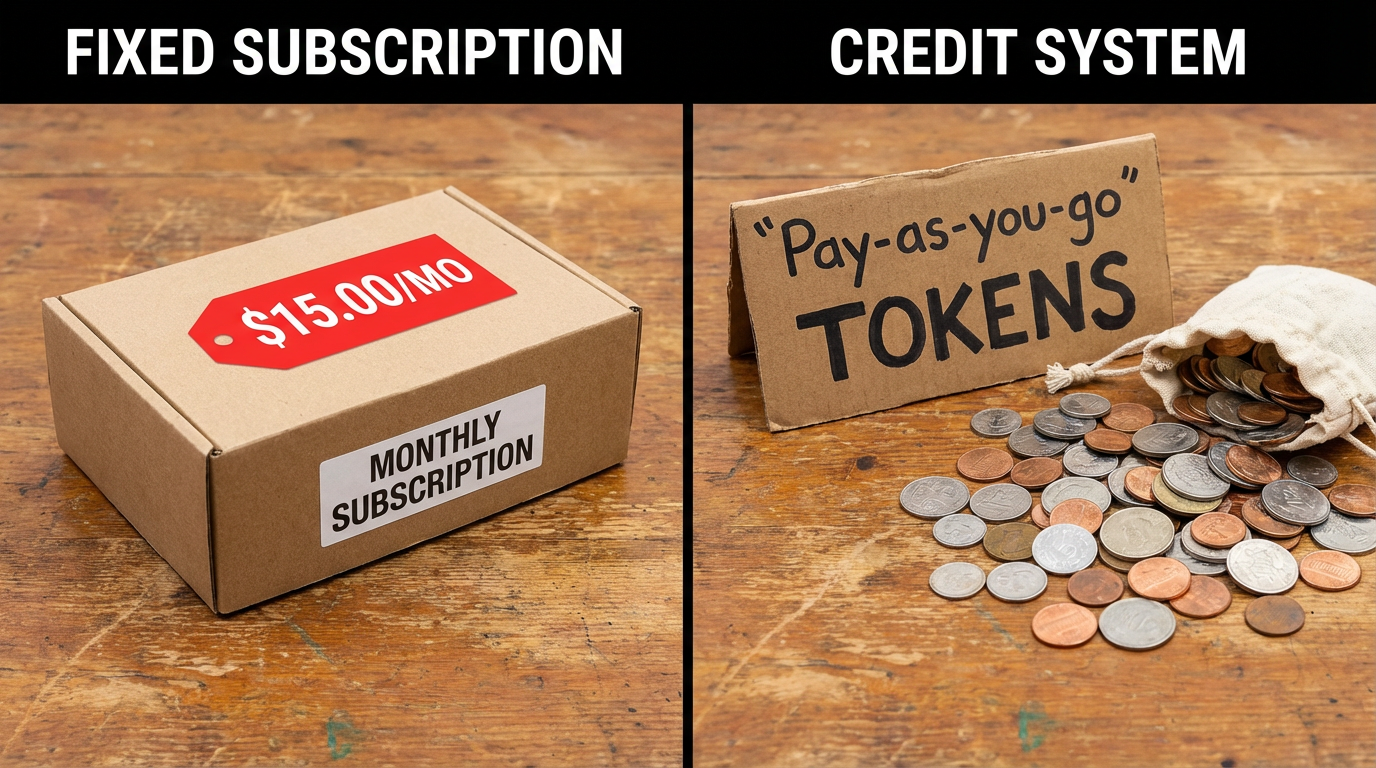
A visual metaphor contrasting Midjourney's fixed monthly subscription box with StarryAI's pay-as-you-go credit tokens.
Community, Privacy, and Social Integration
The social aspect of AI art generation is often overlooked but plays a significant role in the user experience. The platform choice directly impacts how you interact with other artists and how public your creative process is.
Midjourney: The Public Studio
Midjourney’s Discord environment is a massive, public studio. Unless you pay for a private generation mode (available in the Pro and Mega tiers), every image you generate is immediately visible to thousands of other users in the public channels.
- Inspiration and Learning: This public nature is a huge benefit for learning. You can see the prompts, the results, and the variations of top artists, accelerating your own prompt engineering skills.
- Social Pressure: The constant visibility can be a source of social pressure or distraction. It is a highly competitive, fast-moving environment.
- Community Features: The Discord server is a hub for official announcements, weekly office hours with the Midjourney team, and a vast network of artists sharing tips and collaborating. The official Midjourney website also features a public gallery of all user-generated images, creating a massive, searchable database of AI art. This is a key differentiator in the Midjourney vs StarryAI debate.
StarryAI: The Private Gallery
StarryAI offers a much more private and curated experience. Generations are private by default, and the social aspect is limited to an in-app gallery where users can optionally share their best work.
- Focus and Privacy: The private generation allows artists to experiment freely without the pressure of public scrutiny. This is ideal for commercial artists working on proprietary projects or for beginners who are still finding their footing.
- Curated Sharing: The in-app gallery is a cleaner, more focused space for inspiration, featuring only the images users have chosen to share. It lacks the chaotic, real-time feed of Midjourney.
- Community Size: While StarryAI has a community, it is smaller and less centralized than Midjourney's, which can mean fewer resources for advanced troubleshooting or collaboration.
The image below captures the essence of these two social environments.
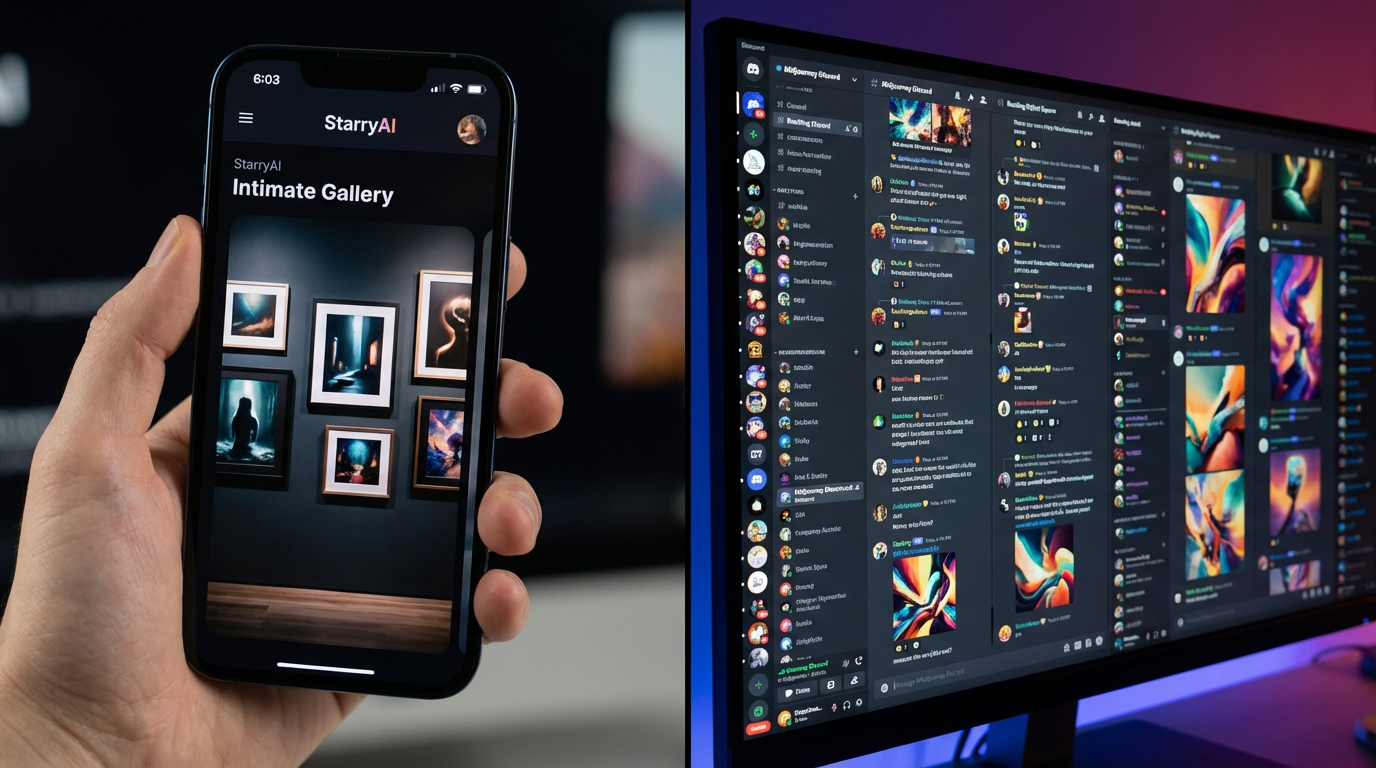
A visual split showing StarryAI's intimate, curated in-app gallery on a mobile screen versus the vast, bustling, and chaotic public feed of Midjourney's Discord server.
Outranking the Competitor: A Deeper Dive into Advanced Features
The competitor article provides a surface-level comparison. To truly outrank it, we must delve into the advanced features that define the professional workflow for each tool, specifically focusing on the latest model updates and unique capabilities.
Midjourney’s Advanced Workflow Tools
Midjourney’s strength lies in its continuous innovation of workflow tools that bridge the gap between AI generation and traditional design.
- Pan and Zoom: The ability to "Pan" (extend the image in any direction) and "Zoom Out" (re-frame the image) allows artists to create massive, complex scenes from a single initial prompt, a feature essential for creating panoramic backgrounds or detailed world-building.
- Consistent Characters: Midjourney has introduced tools to maintain a consistent character across multiple prompts, a long-standing challenge in AI art. This is a game-changer for comic book artists, animators, and storytellers.
- Style Tuner: A feature that allows users to generate a unique "style code" based on their preferences, which can then be applied to future prompts for absolute aesthetic consistency. This level of personalized control is a powerful argument in favor of Midjourney vs StarryAI for professional branding.
StarryAI’s Unique Accessibility Features
StarryAI focuses on making complex AI features accessible to everyone, often by integrating third-party models and simplifying the controls.
- Multiple Model Access: StarryAI provides easy access to a variety of Stable Diffusion models (like SDXL) and its own proprietary models, all within the same app. This eliminates the need for users to manage model files or complex backends.
- Built-in Upscaling and Enhancement: Every generation comes with simple, one-click options for upscaling and enhancing the image, a feature that Midjourney users often have to manage with separate commands or external tools.
- Image-to-Image Simplicity: StarryAI’s interface for image-to-image generation is arguably simpler than Midjourney’s, requiring only a few taps to upload a reference and adjust the "influence" of the original image.
For the artist who values a single, integrated experience where all necessary tools are available without complex commands, StarryAI offers a compelling alternative.
The Verdict: Which AI Art Generator is Right for You?
The choice between Midjourney vs StarryAI ultimately depends on your creative goals, your technical comfort level, and your budget. Both are exceptional tools, but they serve different masters.
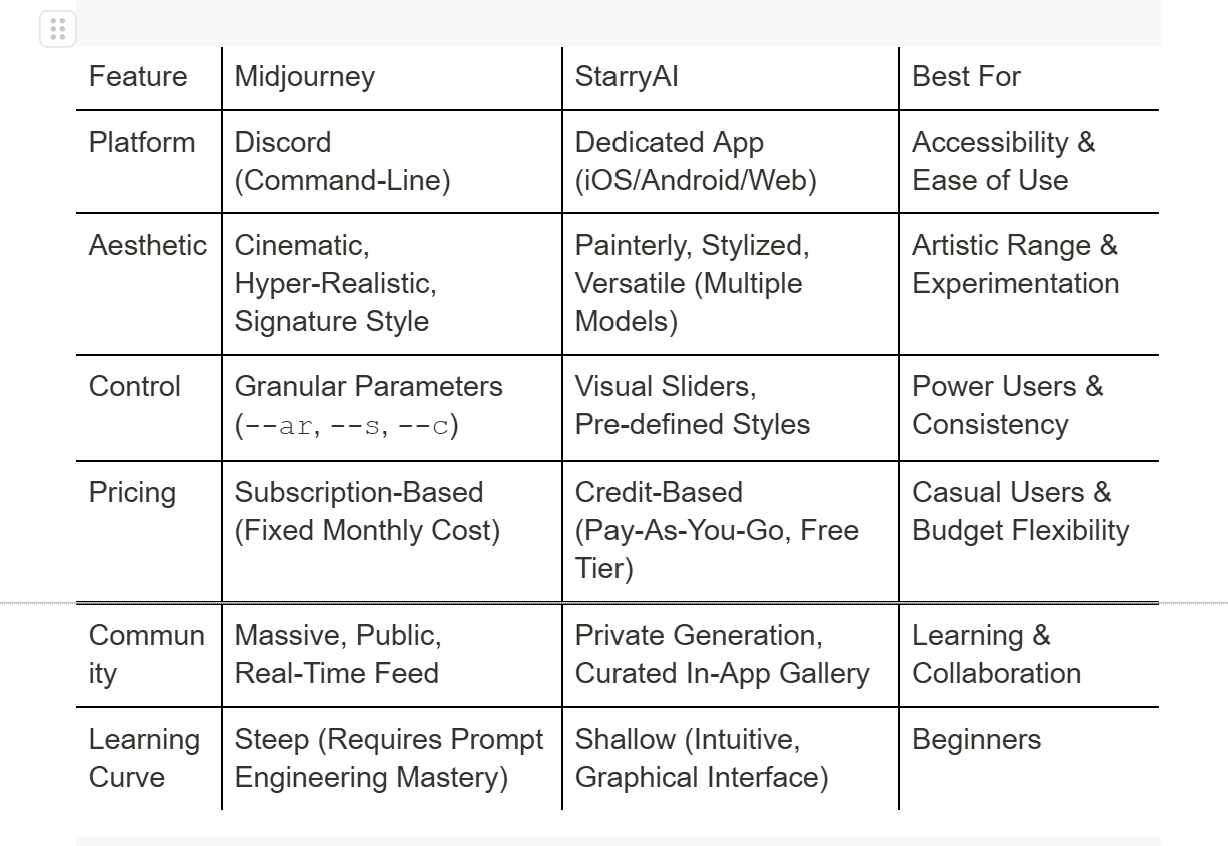
Choose Midjourney If...
You are a professional concept artist, a designer, or a serious hobbyist who demands the highest level of photorealism and is willing to master the command-line interface. You value the massive, public community for inspiration and learning, and you generate enough images to justify a fixed monthly subscription. Midjourney is the tool for those who seek to push the boundaries of AI art with maximum control and a signature, high-end aesthetic.
Choose StarryAI If...
You are a casual user, a beginner, or an artist who prefers a simple, private, and mobile-friendly experience. You want to explore a wide variety of artistic styles quickly and easily without complex prompt engineering. You prefer a pay-as-you-go model and value the low barrier to entry provided by the free daily credits. StarryAI is the tool for accessible, flexible, and private AI art creation.
In the final analysis, the competition between Midjourney vs StarryAI is a perfect microcosm of the AI art world: the professional, high-control, community-driven powerhouse versus the accessible, user-friendly, and versatile app. Both are excellent, but your choice should align with your personal workflow and creative ambition.
The Future of AI Art: A Look Ahead
The rivalry between these two platforms will continue to drive innovation in the AI art space. Midjourney is likely to continue its focus on cinematic quality and advanced workflow tools, further integrating AI into professional design pipelines. StarryAI, on the other hand, will likely double down on accessibility, potentially integrating more third-party models and simplifying the user experience even further, making it the default choice for the next generation of mobile-first creators.
The key to staying ahead is to understand that these tools are not static. Midjourney's rapid model updates (like the jump from V5 to V6) constantly redefine the standard for quality, while StarryAI's integration of new open-source models keeps it competitive in terms of stylistic range. For the serious artist, the best strategy may be to use both: Midjourney for high-fidelity, cinematic concepts, and StarryAI for quick, stylized ideation on the go.