Midjourney vs Wombo Dream: The Ultimate AI Art Generator Showdown
The landscape of generative AI art is a vibrant, rapidly evolving ecosystem, characterized by a fundamental tension between uncompromising quality and unparalleled accessibility. At the heart of this dynamic are two platforms that have captured the attention of millions: Midjourney and Wombo Dream. While both promise to transform text prompts into stunning visual art, they represent vastly different philosophies, workflows, and target audiences.
Midjourney, the undisputed champion of cinematic, hyper-realistic, and often surreal imagery, has set the industry standard for aesthetic quality. Wombo Dream, on the other hand, has democratized AI art with its user-friendly mobile application, generous free tier, and focus on vibrant, abstract, and stylized outputs. For artists, designers, and hobbyists, the choice between Midjourney vs Wombo Dream is not merely a matter of preference; it is a decision that defines the entire creative process, from the initial prompt to the final output.
This comprehensive 2500-word analysis will dissect the core differences between these two platforms, examining their technology, workflow, pricing, and artistic output to help you determine which tool is the ultimate fit for your creative journey.
1. The Core Philosophy: Cinematic Realism vs. Accessible Abstraction
The most significant difference between the two platforms lies in their core design philosophy, which directly influences the aesthetic of the final image.
Midjourney: The Pursuit of Cinematic Perfection
Midjourney’s development has been singularly focused on achieving the highest possible aesthetic quality, often described as cinematic, hyper-realistic, and highly detailed. With each new model iteration (currently V6), Midjourney pushes the boundaries of photorealism, lighting, and composition. Its strength lies in its ability to create images that look like they were captured by a professional photographer or rendered by a high-end CGI studio.
The platform excels at:
- Complex Composition: Handling intricate scenes with multiple subjects, accurate perspective, and deep depth of field.
- Lighting and Texture: Mastering subtle details like rim lighting, subsurface scattering, and realistic material textures.
- Artistic Coherence: Maintaining a consistent, high-end artistic vision across all generations, making it the go-to tool for professional concept artists and illustrators 1.
Wombo Dream: The Champion of Stylized Accessibility
Wombo Dream, developed by Wombo AI, has prioritized speed, ease of use, and a distinct, stylized aesthetic. Its primary goal is to make AI art generation instantaneous and fun for the casual user. The platform is known for its vibrant, abstract, and often painterly outputs, which lean heavily into digital art styles.
Wombo Dream excels at:
- Rapid Generation: Producing results in seconds, making it ideal for quick ideation and social media content.
- Style Selection: Offering a wide array of predefined artistic styles (e.g., Dark Fantasy, Vibrant, Ghibli, Realistic) that users can select with a single tap.
- Mobile-First Design: Its dedicated mobile application makes it the most accessible AI art tool for on-the-go creation.
.png)
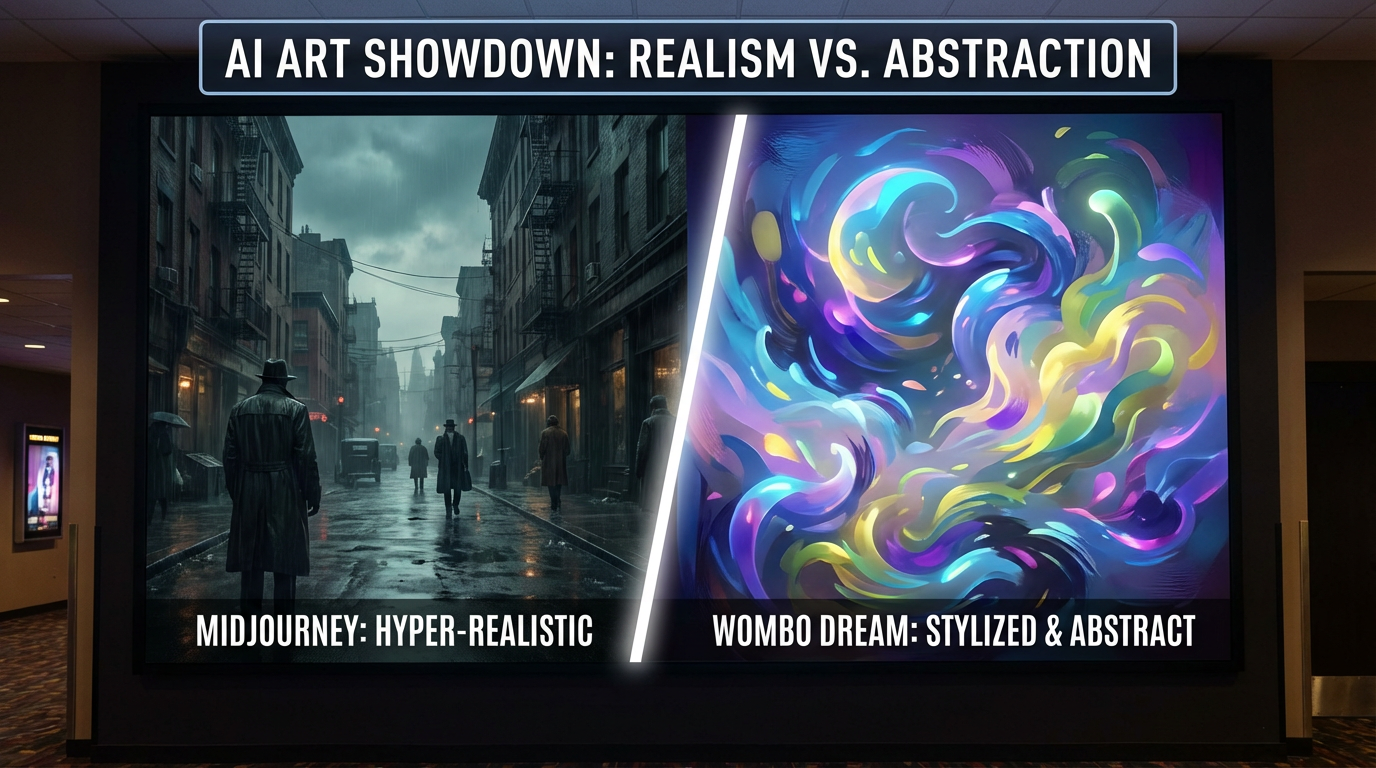
A side-by-side comparison of two generated images. Left: A photorealistic, detailed portrait with perfect lighting (Midjourney style). Right: A vibrant, abstract, stylized landscape with visible brushstrokes (Wombo Dream style), illustrating the aesthetic difference.
2. Workflow and User Interface: Discord vs. Dedicated App
The user interface is arguably the most polarizing difference between the two platforms, fundamentally shaping the user experience.
Midjourney’s Discord-Centric Workflow
Midjourney operates almost exclusively within the Discord chat application. Users interact with the AI bot by typing commands, primarily the /imagine command, followed by their text prompt. This workflow is highly efficient for power users who are comfortable with command-line interfaces and text-based iteration.
Pros of the Discord Workflow:
- Community Integration: Generations happen in public channels (unless using private mode), fostering a strong, inspiring community where users can see and learn from each other's prompts.
- Efficiency: Advanced users can quickly append complex parameters (e.g., --ar 16:9 --style raw --s 750) to their prompts, allowing for granular control without a graphical interface.
- Iteration: The chat history makes it easy to quickly re-run, vary, or upscale previous generations.
Cons of the Discord Workflow:
- Steep Learning Curve: New users often find the command-line interface intimidating and the sheer volume of public generations overwhelming.
- Lack of Visual Tools: The workflow lacks dedicated visual editing tools, requiring users to export images to external software for further refinement.
Wombo Dream’s Mobile-First Application
Wombo Dream is built as a dedicated mobile and web application, offering a clean, intuitive, and highly visual interface. The process is simple: enter a prompt, select a style from a visual gallery, and tap "Create."
Pros of the Dedicated App:
- Zero Learning Curve: The interface is designed for immediate use, making it the perfect entry point for beginners.
- Visual Style Selection: Users can browse and select styles visually, which is much more intuitive than learning text-based style prompts.
- Accessibility: The mobile app allows for creation anytime, anywhere, appealing to the casual, on-the-go creator.
Cons of the Dedicated App:
- Limited Control: The simplicity comes at the cost of granular control; advanced users cannot easily tweak technical parameters like aspect ratio, seed, or sampler settings.
- In-App Ads/Paywalls: The free experience is often interrupted by advertisements, and advanced features are locked behind a paywall.
.png)
A split screen showing two user interfaces. Left: A Discord chat window with a complex /imagine command and parameters (Midjourney). Right: A clean, simple mobile app screen with a large 'Generate' button and a style selector (Wombo Dream).
3. Pricing and Commercial Viability: Premium vs. Freemium
The financial model is a critical factor, especially for users planning to use the generated art commercially. The comparison between Midjourney vs Wombo Dream highlights the difference between a premium subscription service and a freemium model.
Midjourney’s Premium Subscription
Midjourney operates on a paid subscription model with no permanent free tier (though limited trials are occasionally offered). The pricing is tiered, offering different levels of GPU time, which is the core resource consumed during generation.
- Cost: Midjourney's plans range from Basic to Mega, with costs tied directly to the amount of "Fast GPU Time" provided. This model ensures a high-quality, uninterrupted experience.
- Commercial Rights: All images generated on a paid subscription are granted full commercial rights to the user, making it a safe choice for professional work 2.
- Value Proposition: The cost is justified by the consistently high quality, the advanced features, and the commercial license.
Wombo Dream’s Freemium Model
Wombo Dream operates on a freemium, credit-based model.
- Free Tier: Users receive a set number of free credits daily, allowing them to generate images without paying. This is a massive advantage for hobbyists and students.
- Paid Tier: The paid tier, often called "Dream Premium," removes ads, unlocks all styles, and provides unlimited or faster generation. The cost is generally lower than Midjourney's entry-level plan.
- Commercial Rights: Wombo Dream also grants commercial rights to images generated on its platform, though users should always verify the terms for images generated on the free tier.
.png)
A visual metaphor comparing two financial models. Left: A complex, tiered subscription chart with 'Basic,' 'Standard,' and 'Pro' labels (Midjourney). Right: A simple credit counter with a 'Free Daily Credits' label and a small 'Buy Credits' button (Wombo Dream).
4. Control and Customization: Granular Parameters vs. Style Presets
The ability to fine-tune the generation process is what separates a casual tool from a professional one.
Midjourney’s Granular Control
Midjourney offers an extensive array of granular parameters that allow users to control nearly every aspect of the image:
- Aspect Ratio (--ar): Precise control over the image dimensions.
- Stylization (--s): Adjusting the degree of artistic flair applied by the model.
- Chaos (--c): Controlling the randomness and unexpectedness of the results.
- Seed (--seed): Essential for reproducing a specific image or maintaining character consistency.
- Image Prompts: Using existing images to influence the style or composition of a new generation.
This level of control is what allows Midjourney to achieve its signature cinematic quality and is a key reason why professionals choose it over simpler alternatives.
Wombo Dream’s Preset Control
Wombo Dream’s control is primarily managed through style presets. The user selects a style (e.g., "Gothic," "Vibrant," "Realistic"), and the app handles the underlying technical parameters.
While this is excellent for simplicity, it means the user cannot fine-tune the output beyond the available presets. If a user wants a "Vibrant" style but with a slightly more muted color palette, they have no direct way to achieve this within the app. The control is focused on what style to use, not how that style is applied.
.png)
A visual showing two different control panels. Left: A complex set of sliders and text fields for advanced parameters (CFG, steps, seeds) symbolizing Midjourney's control. Right: A simple, large selection of artistic style buttons (e.g., 'Fantasy,' 'Dark Fantasy,' 'Realistic') symbolizing Wombo Dream's control.
5. Community and Learning: Shared Prompts vs. Private Creation
The community surrounding an AI tool is a powerful, often overlooked, feature that impacts the learning curve and creative inspiration.
Midjourney’s Public Learning Environment
Midjourney’s Discord-centric model fosters a highly active, public learning environment. Users can scroll through the public channels and instantly see the prompts and parameters used to create thousands of stunning images. This "prompt hacking" is the primary way new users learn the intricacies of the system.
The community is also a source of immediate feedback and support, making the learning process collaborative. The sheer volume of high-quality art generated daily serves as a constant source of inspiration and a benchmark for quality.
Wombo Dream’s Private, Individual Experience
Wombo Dream is designed for a more private, individual experience. While it has social features, the primary interaction is between the user and the app. The focus is on personal creation and enjoyment, rather than a shared, collaborative learning space.
This is ideal for users who prefer privacy or who are easily overwhelmed by the constant stream of content in a public forum. However, it means the learning process is more isolated, relying on in-app tutorials and external guides rather than the real-time observation of other users' successful prompts.
6. Technical Deep Dive: The Models Under the Hood
While Midjourney’s model is proprietary and closed-source, Wombo Dream is built on a foundation of open-source technology, which affects everything from performance to feature rollout.
Midjourney’s model is a single, unified architecture that has been trained on a massive, highly curated dataset. This unified approach is what allows for its consistent, high-quality aesthetic. The model is not just generating an image; it is generating an image that adheres to the Midjourney "look," which is a key part of its brand identity.
Wombo Dream, while also having proprietary elements, is built on a foundation of Stable Diffusion and other open-source models. This allows Wombo to rapidly integrate new advancements from the open-source community, such as new samplers or control mechanisms, without having to develop the core technology from scratch. This flexibility is a major advantage for Wombo, allowing it to remain competitive in terms of features and speed.
6. Output Quality and Aesthetic Differences: The Uncanny Valley vs. The Abstract Canvas
The final output quality is the most subjective, yet most important, factor in the Midjourney vs Wombo Dream comparison. While Midjourney is often lauded for its photorealism, Wombo Dream is celebrated for its immediate, stylized impact.
Midjourney: Mastering the Uncanny Valley
Midjourney's relentless pursuit of photorealism means it often ventures into the Uncanny Valley—the unsettling zone where an image is almost, but not quite, perfectly human or real. While its latest models (V6 and beyond) have largely conquered common issues like distorted hands and bizarre anatomy, the sheer detail can sometimes make the image feel too perfect, too synthetic.
However, when Midjourney succeeds, the results are breathtaking. Its ability to render complex scenes with accurate physics, depth of field, and subtle atmospheric effects is unmatched. This makes it the preferred tool for high-fidelity concept art, architectural visualization, and product mockups where realism is paramount. The quality is not just in the pixels, but in the coherence of the simulated world it creates.
Wombo Dream: The Power of Stylistic Escape
Wombo Dream, by leaning into abstract and stylized aesthetics, largely avoids the Uncanny Valley altogether. Its output is not trying to fool the viewer into believing it is a photograph; it is clearly a work of digital art. This stylistic escape is a major advantage for casual users who prioritize a beautiful, immediate result over technical perfection.
The platform's strength lies in its ability to generate images with a strong sense of color, texture, and emotional tone. The predefined styles act as powerful artistic filters, instantly transforming a simple prompt into a vibrant, abstract painting or a moody, dark fantasy scene. This makes Wombo Dream an excellent tool for generating unique backgrounds, social media graphics, or artistic profile pictures where a strong, immediate visual identity is more important than photorealistic accuracy. The difference in aesthetic output is a key consideration for artists choosing between the two platforms.
7. The Final Verdict: Which Tool is Right for You?
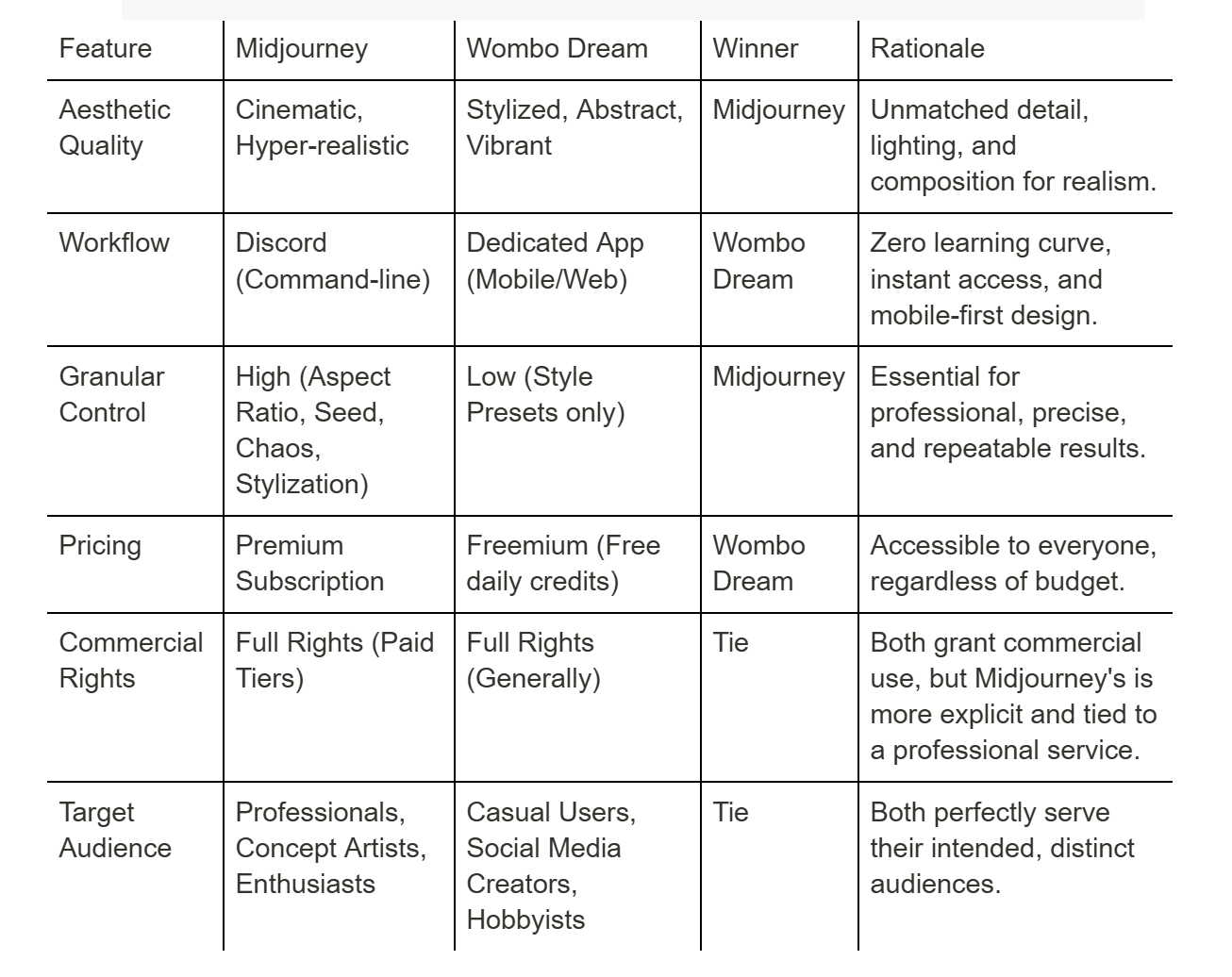
The choice between Midjourney vs Wombo Dream ultimately boils down to a trade-off between Quality/Control and Accessibility/Style.
8. Conclusion: The Future of AI Art
The competition between Midjourney vs Wombo Dream is a powerful force driving innovation in the AI art space. Midjourney will continue to push the boundaries of photorealism and control, solidifying its position as the industry standard for high-end, professional concept art. Wombo Dream will continue to democratize the technology, making AI art creation a fun, accessible, and instant experience for the masses.
The ultimate winner is the creator, who now has a perfect tool for every need: Midjourney for the professional project that demands the best quality and control, and Wombo Dream for the quick, fun, and stylized creation on the go.