NetSuite Review: Best Accounting Software in 2025?
In today’s hyper-competitive business landscape, managing finances is no longer just about balancing the books. It’s about achieving operational efficiency, driving digital transformation, and gaining a competitive edge through insightful data analytics. For growing businesses, the patchwork of disparate software for accounting, inventory, and customer management quickly becomes a liability, creating data silos and hindering growth. This is where a unified cloud ERP system like Oracle NetSuite enters the conversation.
NetSuite isn’t just an accounting tool; it’s a comprehensive business management suite designed to be the single source of truth for your entire organization. From intricate financial management and supply chain management to CRM and e-commerce, it promises a holistic view of your business in real-time. But with its reputation for being a powerhouse platform comes questions about complexity and cost. Is NetSuite the ultimate solution for scaling businesses, or is it an expensive overkill?
This 4000-word review will dissect the NetSuite platform, exploring its core modules, pricing structure, and ideal use cases. We will delve into how its features like revenue recognition, financial consolidation, and workflow automation empower businesses to achieve greater ROI optimization and navigate the complexities of the modern market, helping you decide if this SaaS platform is the right investment for your company in 2025.
What is NetSuite? A Unified Platform for Growth
At its core, NetSuite is a true cloud ERP system, meaning it integrates all key business processes into a single, unified platform. Unlike basic accounting software that only handles bookkeeping, NetSuite provides a full suite of applications that manage nearly every aspect of a business. This integration is crucial for achieving scalability and real-time visibility. When your sales, inventory, and financial data all live in the same system, you eliminate manual data entry, reduce errors, and empower decision-makers with a complete, up-to-the-minute picture of business health.
The platform is built on the principle of a single data source. A sales order automatically updates inventory levels, triggers procurement if necessary, and posts to the general ledger without any manual intervention. This level of business process automation is what allows companies to scale efficiently without hiring armies of administrative staff. For any organization focused on long-term growth and operational efficiency, this unified approach is a game-changer.
A Deep Dive into NetSuite’s Core Modules
NetSuite’s power lies in its modular yet integrated architecture. Businesses can start with the modules they need and add more as they grow. Let’s explore the key components.
Financial Management: The Heart of the System
This is the foundation of NetSuite. It goes far beyond basic bookkeeping, offering a robust suite of tools for complex financial operations. Key features include a flexible general ledger, streamlined accounts payable/receivable, and powerful financial reporting capabilities. For companies operating globally, its multi-currency accounting and tax management features are indispensable.
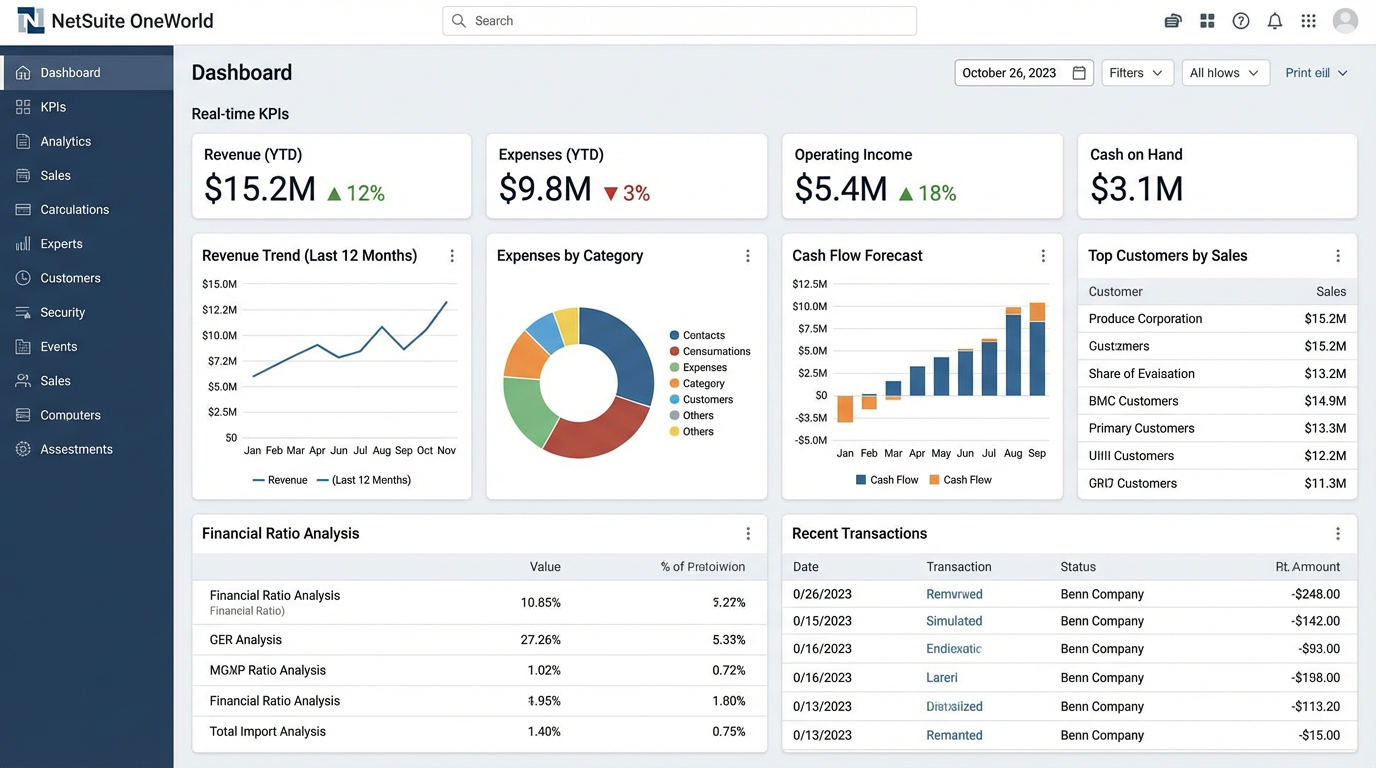
Caption: NetSuite’s customizable dashboard provides real-time KPIs for a complete financial overview. Source: Image generated by Manus AI.
The platform excels at automating complex processes like revenue recognition, ensuring compliance with standards like ASC 606. With the 2025.2 release, NetSuite has further enhanced its AI-powered planning and close capabilities, making the month-end close process faster and more accurate. This focus on compliance management and providing a clear audit trail is critical for public or venture-backed companies.
Enterprise Resource Planning (ERP): Unifying Operations
NetSuite’s ERP capabilities are what truly set it apart from simple accounting software. This module is the central nervous system of your operations, connecting everything from order fulfillment to supply chain management. The inventory management system provides real-time visibility across all locations, preventing stockouts and overstock situations. This is essential for any business, whether in e-commerce, manufacturing, or distribution, as it directly impacts cash flow management.
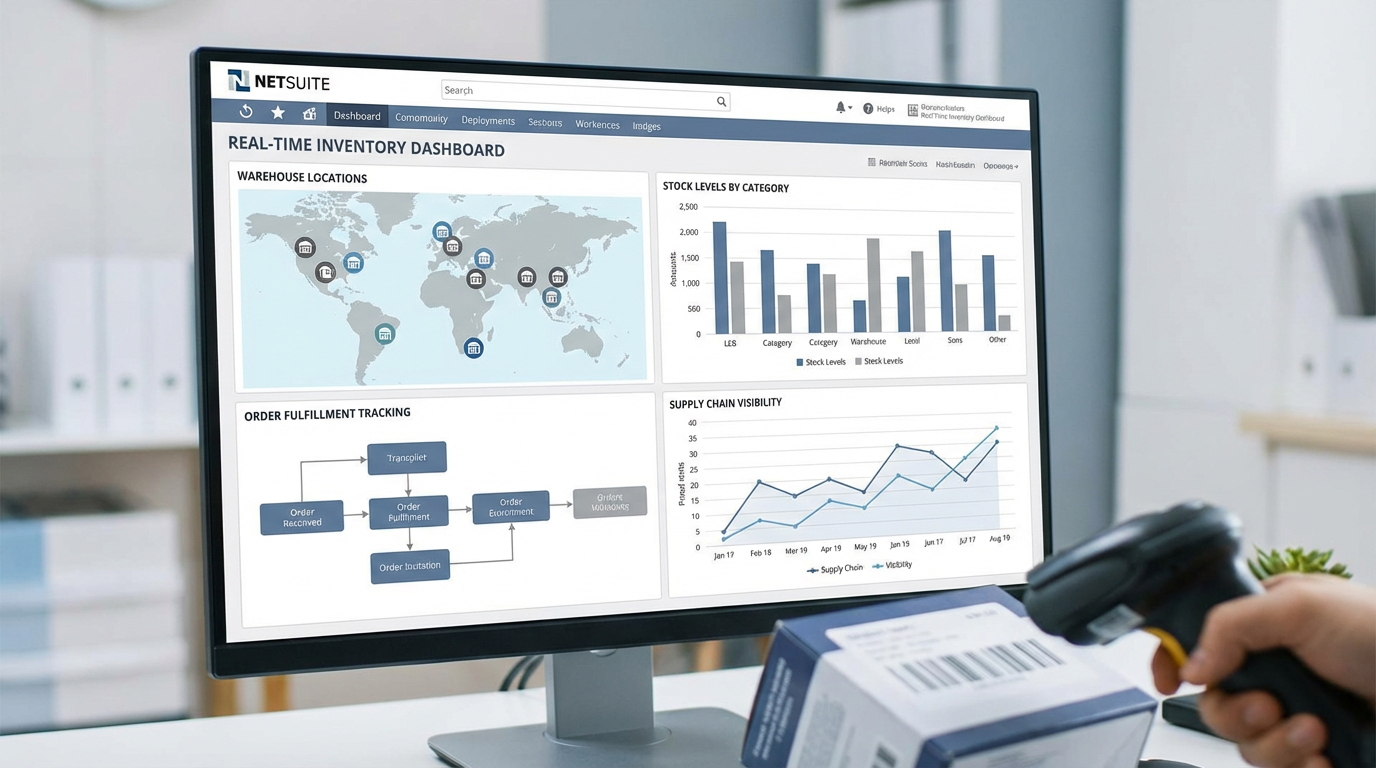
Caption: Real-time inventory and supply chain visibility in NetSuite. Source: Image generated by Manus AI.
Furthermore, the system’s workflow automation capabilities allow businesses to design custom processes that match their unique operational needs. From procurement and vendor management to production planning, the ERP module ensures that every step of the value chain is optimized for efficiency and cost-effectiveness, contributing to a higher ROI optimization.
Customer Relationship Management (CRM): A 360-Degree Customer View
NetSuite’s built-in CRM is seamlessly integrated with its financial and ERP modules, providing a true 360-degree view of the customer. When a sales representative views a customer record, they don’t just see contact information and communication history; they see past orders, payment status, and support tickets. This deep integration is a powerful tool for improving customer service and identifying upselling opportunities.

Caption: NetSuite CRM provides a complete view of the sales pipeline and customer interactions. Source: Image generated by Manus AI.
The CRM module supports the entire customer lifecycle, from marketing automation and sales force automation to customer support and partner relationship management. This unified approach ensures that every customer touchpoint is consistent and informed by a complete history of their relationship with your company, a cornerstone of modern business intelligence.
Business Intelligence (BI) and Reporting: Data-Driven Decisions
In today’s data-driven world, the ability to analyze information and act on it quickly is paramount. NetSuite’s business intelligence tools provide real-time dashboards and customizable reports that give stakeholders the insights they need, when they need them. Because all the data resides in a single database, you can run reports that cross-reference information from different departments—for example, analyzing the profitability of marketing campaigns by tracking leads through to sales and final revenue.

Caption: NetSuite enables deep financial reporting and multi-entity consolidation. Source: Image generated by Manus AI.
For businesses with multiple subsidiaries, the financial consolidation feature is a lifesaver, allowing for a unified view of the entire enterprise’s financial health. This ability to transform raw data into actionable insights is a key component of effective data analytics and strategic planning, making it a core pillar of any successful digital transformation initiative.
NetSuite vs. Competitors: A Comparative Look
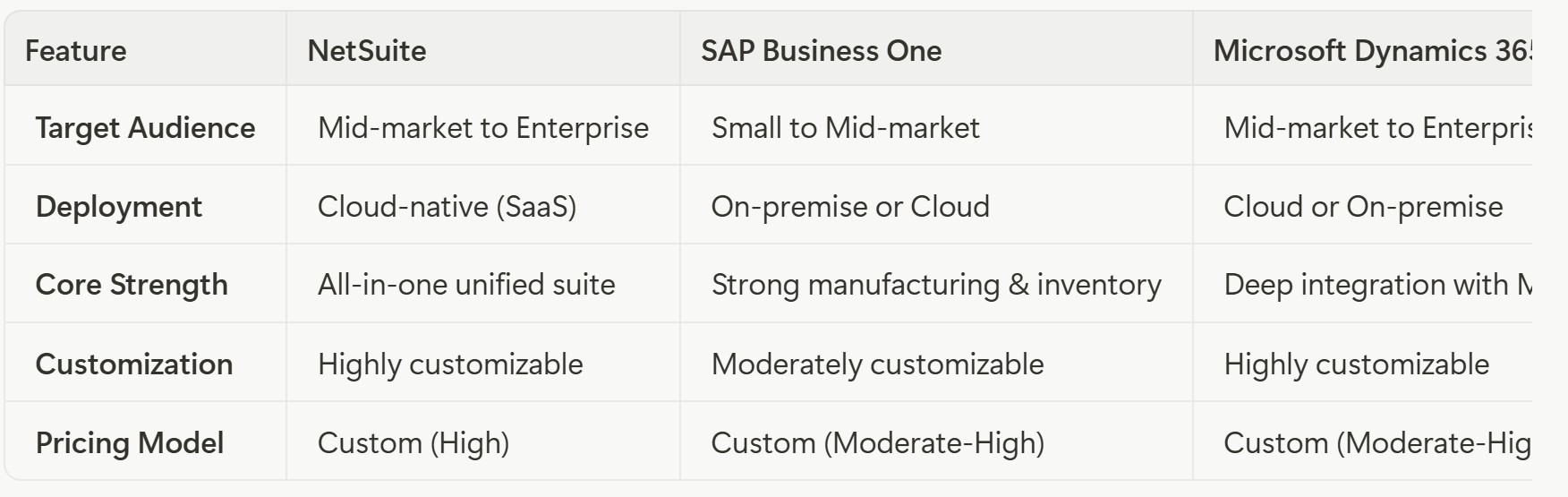
While NetSuite is a leader in the cloud ERP space, it’s important to understand how it stacks up against its main competitors. Each platform has its strengths and is suited for different types of businesses.
The Elephant in the Room: NetSuite Pricing
There’s no sugarcoating it: NetSuite is a significant investment. Its pricing is notoriously complex and opaque, as it’s tailored to each customer’s specific needs. The total cost is a combination of a one-time implementation fee and recurring annual license costs.
•Implementation Costs: This can range from $10,000 to well over $100,000, depending on the complexity of your business processes, data migration needs, and the level of customization required.
•License Costs: This is an annual recurring fee based on the specific modules you choose, the number of users, and the level of access each user needs.
While the price tag is high, it’s crucial to view it through the lens of ROI optimization. For a rapidly growing company, the cost of not having a unified system—in terms of inefficiencies, errors, and missed opportunities—can be far greater. The investment in a robust SaaS platform like NetSuite is an investment in scalability and long-term operational efficiency.
Pros and Cons: A Balanced Perspective
Pros:
•Truly Unified Platform: The all-in-one nature eliminates data silos and provides a single source of truth.
•Unmatched Scalability: The system is designed to grow with your business, from a mid-sized company to a global enterprise.
•Deep Customization: NetSuite can be tailored to fit even the most unique business processes and workflows.
•Powerful Reporting & BI: Real-time data and analytics provide unparalleled business insight.
•Robust Financial Controls: Strong features for compliance management, audit trail, and multi-entity financial consolidation.
Cons:
•High Total Cost of Ownership: The implementation and licensing fees are substantial and can be prohibitive for smaller businesses.
•Steep Learning Curve: The platform’s complexity means that user training and adoption can be a significant challenge.
•Implementation Time: A full implementation can take several months and requires significant internal resources.
•Potential for Overkill: For businesses with simple needs, NetSuite’s vast capabilities can be overwhelming and unnecessary.
Final Verdict: Is NetSuite the Right Choice for You in 2025?
NetSuite is not a one-size-fits-all solution. It is a powerful, complex, and expensive piece of enterprise software. For a small business with straightforward accounting needs, it is almost certainly overkill. However, for a mid-sized or rapidly growing company that is feeling the pain of disconnected systems, NetSuite is arguably the best cloud ERP system on the market.
You should seriously consider NetSuite if:
•You are a mid-sized business on a high-growth trajectory.
•You operate multiple legal entities or do business in multiple currencies.
•Your operational complexity is increasing, and you need to invest in business process automation.
•You are committed to a long-term digital transformation strategy and need a platform that can scale with your ambitions.
If you are ready to make a significant investment in a platform that can serve as the backbone of your business for years to come, and you have the resources to manage its implementation, then NetSuite is an unparalleled choice. It provides the tools for deep data analytics, robust compliance management, and superior operational efficiency that are essential for thriving in 2025 and beyond.
Frequently Asked Questions (FAQ)
1. What is the typical implementation time for NetSuite? A standard implementation can take anywhere from 3 to 9 months, depending on the complexity of your business and the number of modules being deployed.
2. Is NetSuite suitable for small businesses? Generally, NetSuite is too complex and expensive for most small businesses. Smaller companies are often better served by platforms like QuickBooks Online or Xero.
3. How customizable is NetSuite? NetSuite is extremely customizable. Its SuiteCloud platform allows developers to build custom applications and workflows directly within NetSuite, but this can add significantly to the cost.
4. Does NetSuite have good customer support? This is a point of contention. While Oracle offers premium support packages, some users have reported that the standard support can be slow and unhelpful. It’s often recommended to work with a certified NetSuite implementation partner.
5. Can NetSuite handle manufacturing and inventory? Yes, NetSuite has strong modules for both manufacturing (including work orders, assembly management, and bill of materials) and advanced inventory management (including multi-location warehousing and demand planning).
6. How does NetSuite’s CRM compare to Salesforce? While NetSuite’s CRM is very capable, Salesforce is generally considered the market leader in pure-play CRM. The main advantage of NetSuite’s CRM is its seamless, out-of-the-box integration with the ERP and financial data.
7. Is NetSuite secure? As an Oracle product, NetSuite has robust, enterprise-grade security features, including role-based access controls, a detailed audit trail, and regular security audits.
8. What is a NetSuite implementation partner? These are third-party consulting firms that specialize in implementing and customizing NetSuite. They often provide better training and support than NetSuite direct.
9. How does NetSuite handle multi-currency and international operations? This is one of NetSuite’s greatest strengths. Its OneWorld module is designed specifically for global businesses, handling multi-currency accounting, international tax compliance, and financial consolidation across different legal entities with ease.
10. What is the long-term cost of owning NetSuite? Beyond the initial implementation and annual license fees, you should budget for ongoing costs related to user training, customization, and potentially hiring a NetSuite administrator as your business grows. It is a significant long-term commitment.