Pika Labs vs Artlist: The Ultimate AI Video Generation Showdown
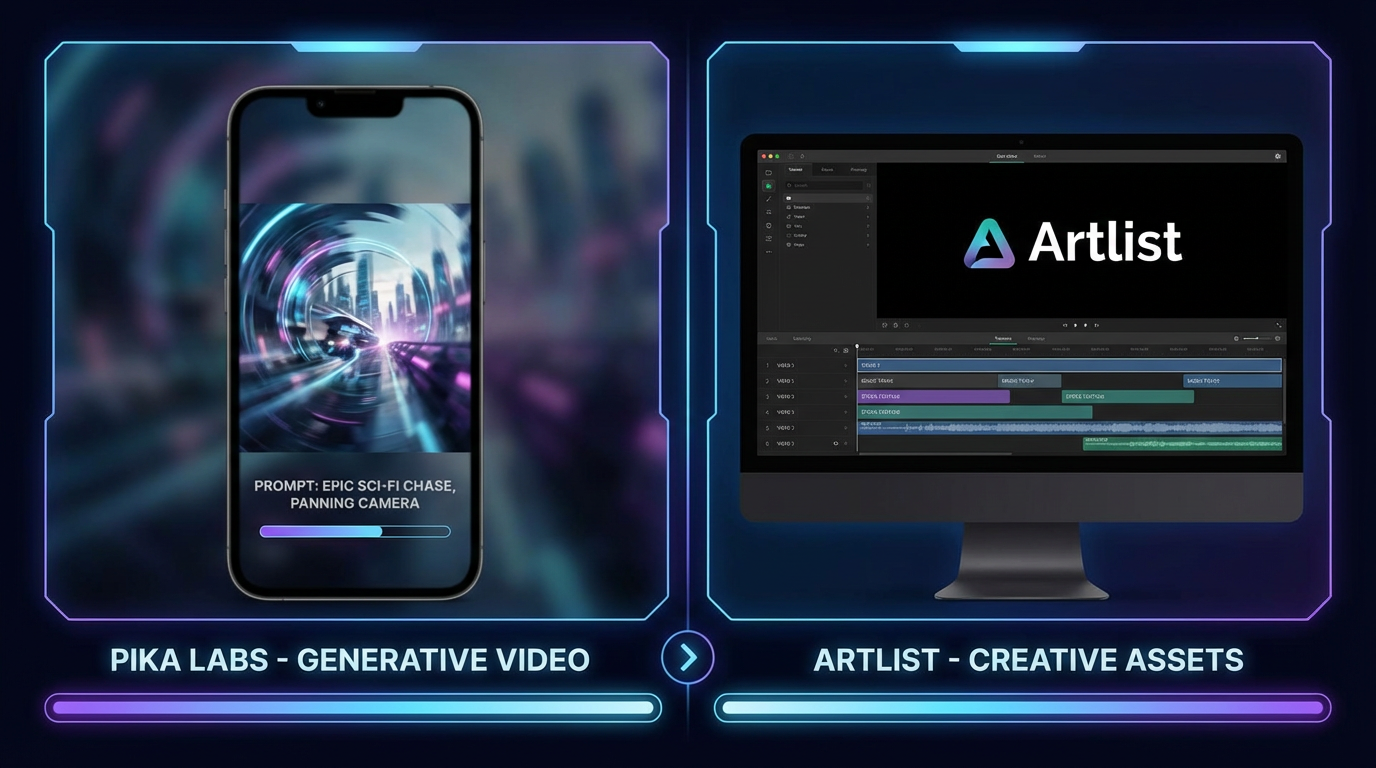
The world of AI video generation is rapidly segmenting into two distinct categories: the pure, generative engine focused solely on creating motion from a prompt, and the integrated creative ecosystem designed to deliver a final, polished product. At the heart of this division are Pika Labs vs Artlist, two platforms that, while both offering text-to-video capabilities, serve fundamentally different creative needs and workflows.
Pika Labs, a relative newcomer, has rapidly gained a reputation for its speed, accessibility, and ability to generate highly dynamic, stylized video clips, primarily operating through a Discord-based interface. Artlist, a veteran in the creative industry known for its vast library of royalty-free music and stock footage, has recently integrated its own AI video generation tools. This move transforms Artlist from a media supplier into a comprehensive content creation platform.
For content creators, marketers, and filmmakers, the choice between these two is a critical decision that impacts workflow, budget, and the final aesthetic of their projects. This comprehensive analysis will dissect the core philosophies, technical capabilities, and commercial viability of both platforms to determine which tool is the superior choice for your specific creative goals.
1. Core Philosophy: Pure Generation vs. Integrated Production
The fundamental difference between Pika Labs and Artlist lies in their core mission. Pika Labs is a generative-first tool; its sole purpose is to translate text and images into motion. It is a specialist, a high-performance engine designed for speed and creative experimentation. Its community-driven, Discord-based nature fosters a culture of rapid iteration and shared discovery 4.
Artlist, conversely, is a production-first platform. Its AI video tool is an addition to its existing, massive library of licensed music, sound effects, and stock footage 2. The philosophy here is to provide a seamless, end-to-end solution where a creator can generate a video clip, instantly score it with licensed music, and integrate it into a larger project—all within a single, commercially safe ecosystem.
This philosophical split dictates their target audiences:
- Pika Labs: Ideal for artists, hobbyists, and early-stage innovators who prioritize raw creative output, speed, and pushing the boundaries of what AI can generate. They are comfortable with a command-line interface and external editing.
- Artlist: Tailored for professional video editors, marketing agencies, and businesses that require commercial safety, a predictable workflow, and integrated access to licensed media assets.
2. The Workflow Showdown: Discord vs. Web App
The user interface and workflow are perhaps the most immediate and striking differences in the Pika Labs vs Artlist comparison.
Pika Labs: The Command-Line Creative
Pika Labs initially gained traction through its Discord bot, a workflow that is simultaneously its greatest strength and its most significant barrier to entry. Users interact with the model by typing /create commands, followed by a prompt and various parameters (aspect ratio, motion intensity, camera controls).
Pros of the Discord Workflow:
- Speed: Generation is incredibly fast, often completing clips in seconds.
- Community: The public feed is a constant source of inspiration and learning, allowing users to see the exact prompts and parameters used by others.
- Power: Advanced users can quickly chain commands and use precise motion controls.
Cons of the Discord Workflow:
- Friction: It lacks the visual, drag-and-drop intuition of a traditional app.
- Distraction: The public feed can be overwhelming and distracting.
- Isolation: The generated video is an isolated asset that must be downloaded and taken to an external editor for sound and final production.
Artlist: The Integrated Web Studio
Artlist’s AI video tool is fully integrated into its web application, providing a familiar, low-friction graphical user interface (GUI). The experience is designed to feel like a natural extension of a modern design tool.
Pros of the Web App Workflow:
- Intuition: The interface is clean, visual, and easy for beginners to navigate.
- Integration: Generated clips are immediately available within the Artlist ecosystem, ready to be paired with licensed music and stock footage.
- Simplicity: It abstracts away complex parameters, focusing on simple style and mood selectors.
Cons of the Web App Workflow:
- Control: It offers less granular control over camera movement and motion intensity compared to Pika’s command-line parameters.
- Speed: While fast, the web app experience can sometimes feel slower than the rapid-fire generation of the Discord bot.
The image below visually captures this fundamental difference in workflow:
.png)
A split screen showing the Pika Labs Discord interface on the left (text commands and parameters) and the Artlist web app interface on the right (clean, modern UI with a visible stock media library), emphasizing the difference between command-line and graphical user interface workflows.
3. Creative Output and Aesthetic
The aesthetic quality and style of the output are where the two platforms diverge most significantly, reflecting their different model training and optimization goals.
Pika Labs: Dynamic Surrealism and Motion Control
Pika Labs excels at dynamic motion and stylistic flair. Its videos often feature complex camera movements—pans, zooms, and rotations—that give the clips a cinematic, high-energy feel. Pika’s strength lies in its ability to generate surreal, artistic, and highly imaginative content that often pushes the boundaries of photorealism in favor of a striking visual style.
Key Aesthetic Features:
- Motion: Highly controllable and dynamic.
- Style: Often favors a painterly, stylized, or surreal aesthetic.
- Use Case: Excellent for concept art, music video clips, and abstract visuals.
Artlist: Clean Professionalism and Utility
Artlist’s AI video output is generally cleaner, more polished, and more focused on professional utility. The aesthetic is often geared towards motion graphics, product visualization, and content that can be easily integrated into a corporate video or social media ad. While it can generate complex scenes, its primary focus is on delivering a reliable, commercially viable asset.
Key Aesthetic Features:
- Motion: More subtle, focused on object movement rather than complex camera work.
- Style: Clean, high-resolution, and often leans towards a realistic or motion-graphic look.
- Use Case: Perfect for B-roll, background loops, and integrating with stock footage.
The following image illustrates the difference in their core aesthetic output:
.png)
A side-by-side comparison of two generated video stills. The left (Pika) is highly dynamic, with complex, flowing camera movement and a surreal aesthetic. The right (Artlist) is a clean, well-composed, but simpler motion graphic with clear text overlay, emphasizing professional utility.
4. The Ecosystem Advantage: Generation vs. Integration
The most compelling argument in the Pika Labs vs Artlist debate is the surrounding ecosystem. Pika Labs is a standalone tool, while Artlist is a fully integrated platform.
Pika Labs: The Singular Focus
Pika Labs is a specialist. It does one thing—video generation—extremely well. However, every video clip generated is a raw asset. To turn it into a final product, the creator must:
- Download the clip.
- Find licensed music and sound effects (often from a separate service like Artlist!).
- Import everything into a third-party video editor (Premiere Pro, DaVinci Resolve).
- Edit and export the final video.
This multi-step, high-friction process is standard for generative AI but adds significant time and cost.
Artlist: The End-to-End Solution
Artlist’s strength is its integration. A user generates a video clip and, within the same web environment, has immediate, unlimited access to Artlist’s massive library of licensed assets 5. This is a game-changer for commercial production:
- Music and SFX: Instantly score the video with high-quality, licensed audio.
- Stock Footage: Seamlessly blend generated clips with real-world stock footage from the Artlist library.
- Commercial Safety: All assets, both generated and stock, come with a clear, commercial-use license, simplifying legal compliance.
This integrated approach is visually represented below:
.png)
A visual metaphor showing Pika Labs as a powerful, singular rocket engine (pure video generation) and Artlist as a comprehensive Swiss Army knife (video generation integrated with music, sound effects, and stock footage). The style should be clean and illustrative.
5. Pricing and Commercial Viability
The pricing models of Pika Labs vs Artlist reflect their core philosophies, creating a clear distinction between a credit-based, consumption model and a flat-rate, subscription model.
Pika Labs: The Credit Consumption Model
Pika Labs operates on a credit system. Users purchase credits, and each second of video generation consumes a certain number of credits. This model is common in generative AI and is best suited for users with variable, project-based needs.
Key Pricing Characteristics:
- Variable Cost: The cost scales directly with usage. High-volume users will pay significantly more.
- Complexity: The system can be complex, with different tiers offering different credit rates, generation speeds, and feature access.
- Focus: The cost is focused solely on the generation of the video asset. The cost of licensed music, SFX, and editing software is separate.
Artlist: The Flat-Rate Subscription Model
Artlist operates on a simple, flat-rate subscription model 2. This model is designed for predictability and unlimited usage, which is ideal for businesses and high-volume creators.
Key Pricing Characteristics:
- Predictable Cost: A single monthly or annual fee covers unlimited access to the AI tool, music, SFX, and stock footage.
- Simplicity: The model is easy to budget for, eliminating the fear of running out of credits or incurring overage fees.
- Focus: The cost covers the entire production ecosystem, making the total cost of a finished, commercially-ready video often lower than Pika’s generation cost plus external licensing fees.
The following image compares the complexity of these two models:
.png)
A visual comparing a complex, tiered, credit-based pricing system (Pika) with a simple, flat-rate, all-inclusive subscription model (Artlist). Use abstract shapes and colors to represent the complexity vs. simplicity of the models.
6. Feature Deep Dive: Control, Consistency, and Quality
While both platforms are powerful, a closer look at their feature sets reveals their specialization.
Pika Labs: Granular Control and Motion
Pika Labs offers a suite of controls that appeal directly to the filmmaker:
- Camera Controls: Specific commands for pan, zoom, tilt, and roll, allowing for precise camera choreography.
- Motion Score: A parameter to control the intensity of movement in the scene.
- Consistency: Pika has made significant strides in temporal consistency, but the nature of pure generation means that complex, long-form coherence remains a challenge.
Artlist: Post-Production Power
Artlist’s feature set is heavily weighted toward post-production and utility:
- Seamless Integration: The ability to drag and drop generated clips directly onto a timeline with licensed music is its most powerful feature.
- Styling: While it lacks Pika’s granular camera controls, it offers simple, high-quality style transfers and presets that ensure a professional look.
- Long-Form Potential: By integrating AI-generated clips with traditional stock footage, Artlist offers a more viable path to creating long-form content than Pika’s standalone generation.
7. The Future of the Rivalry
The competition between Pika Labs vs Artlist is a microcosm of the larger generative AI market. Pika Labs is the disruptive startup, focused on pushing the technical boundaries of generation. Artlist is the established incumbent, focused on integrating the new technology into a commercially viable, end-to-end workflow.
The future will likely see a convergence:
- Pika Labs will inevitably develop a more robust, web-based GUI to appeal to a broader audience, moving away from the high-friction Discord interface. It will also need to address the need for licensed audio and commercial safety.
- Artlist will continue to improve the raw quality and control of its underlying AI model to compete with the dynamic output of Pika. Its strength will remain its ecosystem, but its generation quality must keep pace.
8. Technical Deep Dive: Model Architecture and Temporal Coherence
While the user experience of Pika Labs vs Artlist is vastly different, the underlying technical approaches to video generation also reveal key distinctions that impact the final output.
Pika Labs: The Diffusion Model Specialist
Pika Labs is built on a highly optimized, proprietary diffusion model architecture. Its primary technical focus is on maximizing the quality and controllability of the generated motion.
- Temporal Coherence: Pika has invested heavily in temporal consistency, meaning the model is trained to ensure that objects and scenes remain coherent across the entire duration of the clip. This is crucial for generating the complex camera movements and character consistency it is known for. While not perfect, Pika's ability to maintain a consistent subject identity and scene structure over several seconds is a core technical advantage.
- Motion Vector Training: Pika's model appears to be trained with a strong emphasis on motion vectors, allowing users to influence the direction and intensity of movement with simple text commands (e.g., "pan left," "zoom out"). This granular control is a direct result of its specialized model training.
- Focus on Generation: The model is purely a generative engine. It is not burdened by the need to integrate with a massive stock library, allowing its developers to focus all computational power and training data on improving the quality of the raw video output.
Artlist: The Integrated Utility Model
Artlist's AI video tool, while utilizing modern diffusion techniques, is likely optimized for speed and integration within its existing platform. The model's primary goal is to generate useful content that complements its stock library, rather than pushing the boundaries of cinematic realism.
- Speed and Efficiency: Artlist's model is designed for rapid generation, often prioritizing quick turnaround for users who need a fast visual asset to fill a gap in their timeline. This focus on utility sometimes comes at the expense of the complex, high-fidelity motion seen in Pika's output.
- Simplified Parameters: The model abstracts away complex motion controls. This simplification is a feature, not a bug, for Artlist's target audience, who are often looking for a simple visual effect or B-roll clip rather than a complex cinematic shot.
- Consistency: Artlist's temporal consistency is reliable for shorter, simpler clips, but it is not the primary technical selling point. Its strength lies in the utility of the clip once it is placed on the timeline and paired with licensed media.
9. Final Verdict: Choosing Your AI Video Partner
The choice between Pika Labs vs Artlist is a choice between a generative engine and a production ecosystem.
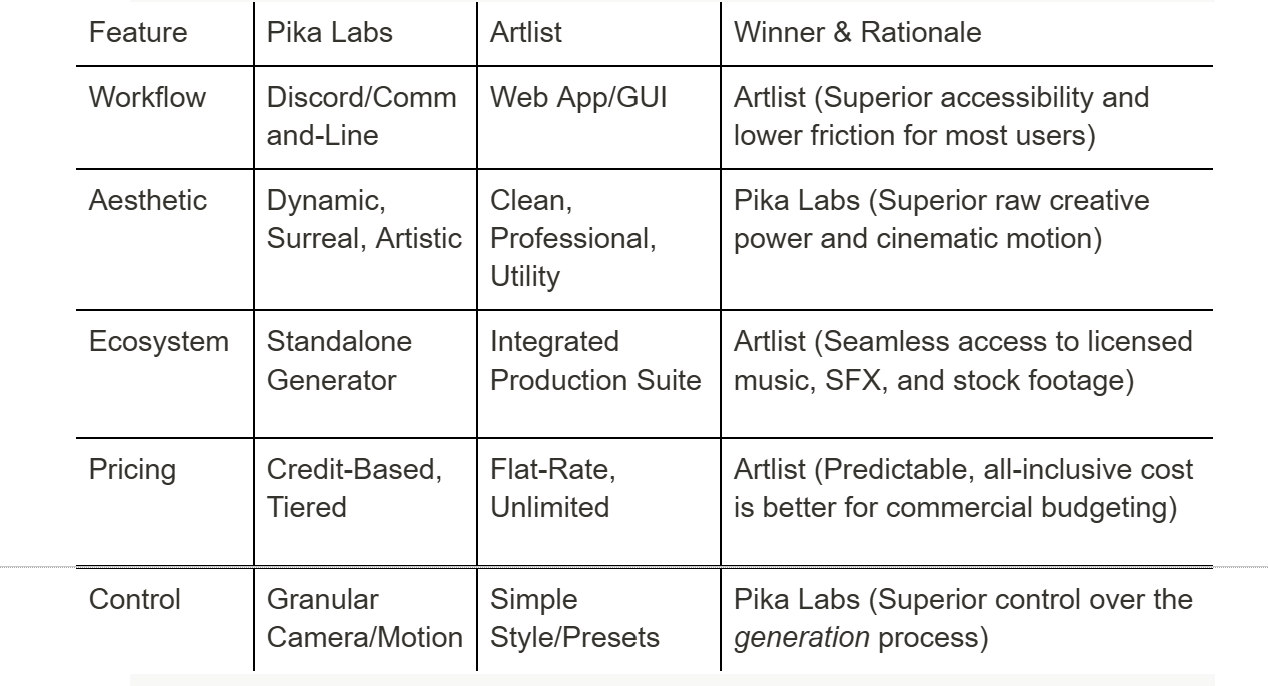
For the Creative Pioneer—the artist, the experimental filmmaker, or the content creator who needs to generate the most dynamic, visually striking, and motion-rich clips possible—Pika Labs is the superior tool. Its granular control, focus on motion, and community-driven innovation make it the best platform for pushing the boundaries of AI-generated art.
For the Commercial Producer—the marketing agency, the corporate video team, or the professional editor who needs a reliable, commercially safe, and integrated source of video assets—Artlist is the clear winner. The predictable, flat-rate pricing and the seamless, one-stop access to licensed music, SFX, and stock footage drastically reduce production friction and legal risk.
In the end, the most powerful workflow may involve both. A creator could use Pika Labs to generate a unique, high-motion, stylized hero shot, and then use Artlist to source all the necessary B-roll, music, and sound effects to complete the final, commercially-ready production. The rivalry between Pika Labs vs Artlist ensures that creators have specialized tools for every stage of the video production pipeline.