Pika Labs vs Luma AI: The Best AI Video Generator for Social Media and Speed.
Pika Labs vs Luma AI: The Best AI Video Generator for Social Media and Speed
The landscape of generative AI video is rapidly being defined by two dynamic platforms: Pika Labs and Luma AI. While both are pushing the boundaries of what is possible with text-to-video, they have developed distinct strengths that appeal to different segments of the creator economy. Pika Labs has become the go-to for rapid, stylized content, often favored by social media creators, while Luma AI, with its Dream Machine model, has focused on achieving a higher degree of photorealism and 3D-like camera movements.
For creators looking to integrate AI video into their workflow, the choice between Pika Labs vs Luma AI is a critical one that hinges on priorities: is it speed and creative iteration, or is it cinematic quality and realism? This 2500-word analysis will serve as the definitive guide, meticulously comparing their latest models, features, pricing, and suitability for various use cases, particularly in the fast-paced world of social media.
The Core Philosophy: Speed vs. Realism
The fundamental difference between the two platforms lies in their core design philosophy. Pika Labs was born from a focus on speed and accessibility, initially operating through a Discord bot and prioritizing fast turnaround for short, dynamic clips. Luma AI, conversely, has always aimed for photorealism and complex camera control, leveraging its background in NeRF (Neural Radiance Fields) technology to produce videos with a distinct 3D quality 1
.
This philosophical split directly influences the user experience and the final output. Pika Labs is often described as the "animator's tool," offering a wide array of controls for motion, style, and aspect ratio, while Luma AI is the "filmmaker's tool," prioritizing smooth, coherent motion and realistic lighting 2.
Feature Showdown: Dream Machine vs. Pika V2
Both platforms have recently launched major updates—Luma AI with Dream Machine and Pika Labs with Pika V2—significantly raising the bar for AI video generation.
1. Generation Speed and Video Length
For social media, speed is paramount. A creator needs to generate multiple variations quickly to test engagement.
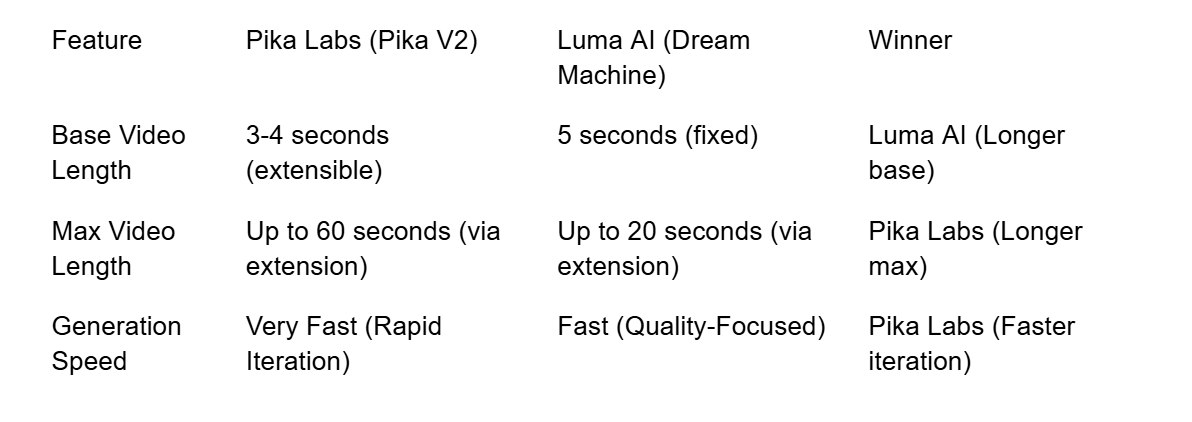
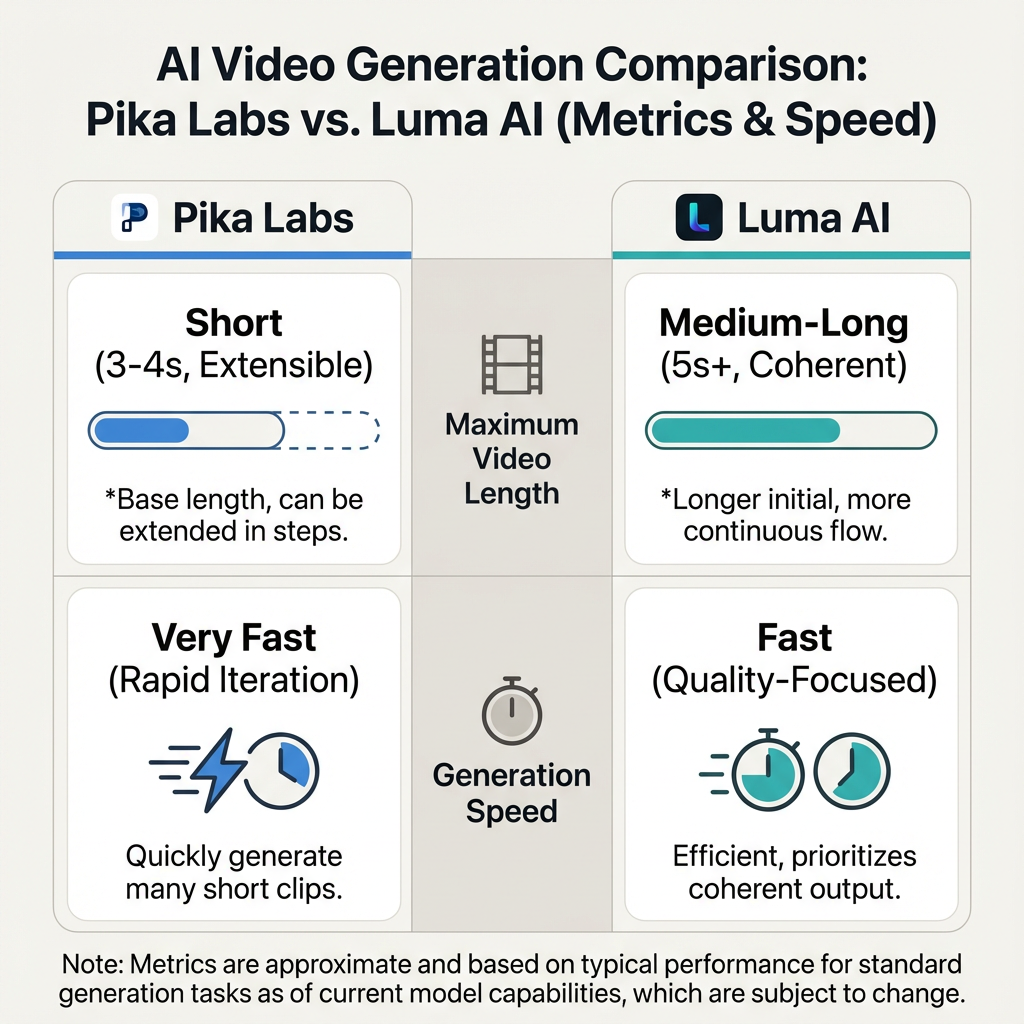
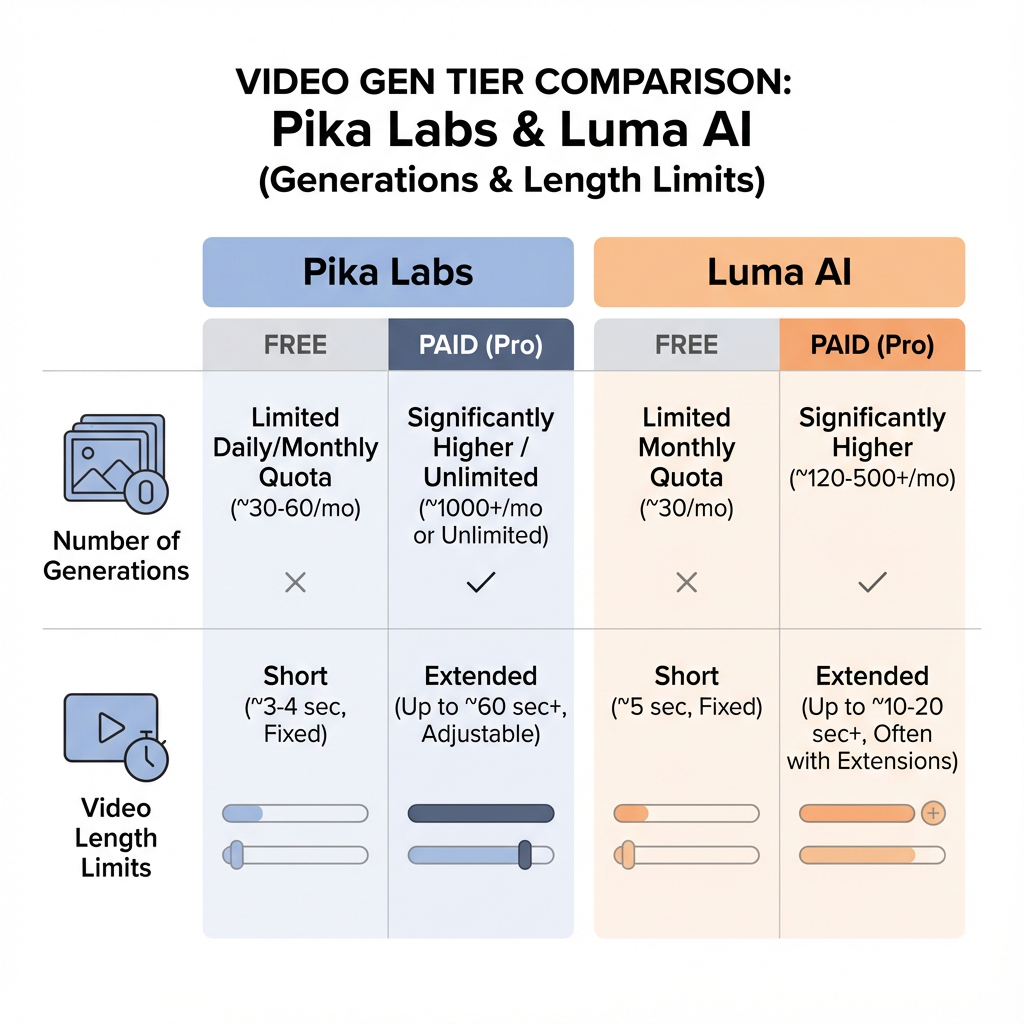
Pika Labs excels in rapid iteration. Its base clips are shorter, but they generate quickly, allowing a creator to test many prompts in a short time. The ability to extend clips up to 60 seconds gives it a significant edge for longer-form content 3.
Luma AI's Dream Machine prioritizes coherence over raw speed. Its base 5-second clips are generally smoother and more stable, but the generation time is slightly longer.
Image : Pika Labs vs Luma AI Generation Metrics
2. Cinematic Quality and Realism
When it comes to raw visual fidelity, Luma AI’s Dream Machine often takes the lead, particularly in generating photorealistic scenes with complex lighting and shadows.
•Luma AI: Its NeRF-based heritage gives it a distinct advantage in 3D consistency. Camera movements (dolly, pan, tilt) are incredibly smooth and feel physically grounded in the scene. The realism of human subjects and natural environments is currently a benchmark in the industry 4
.
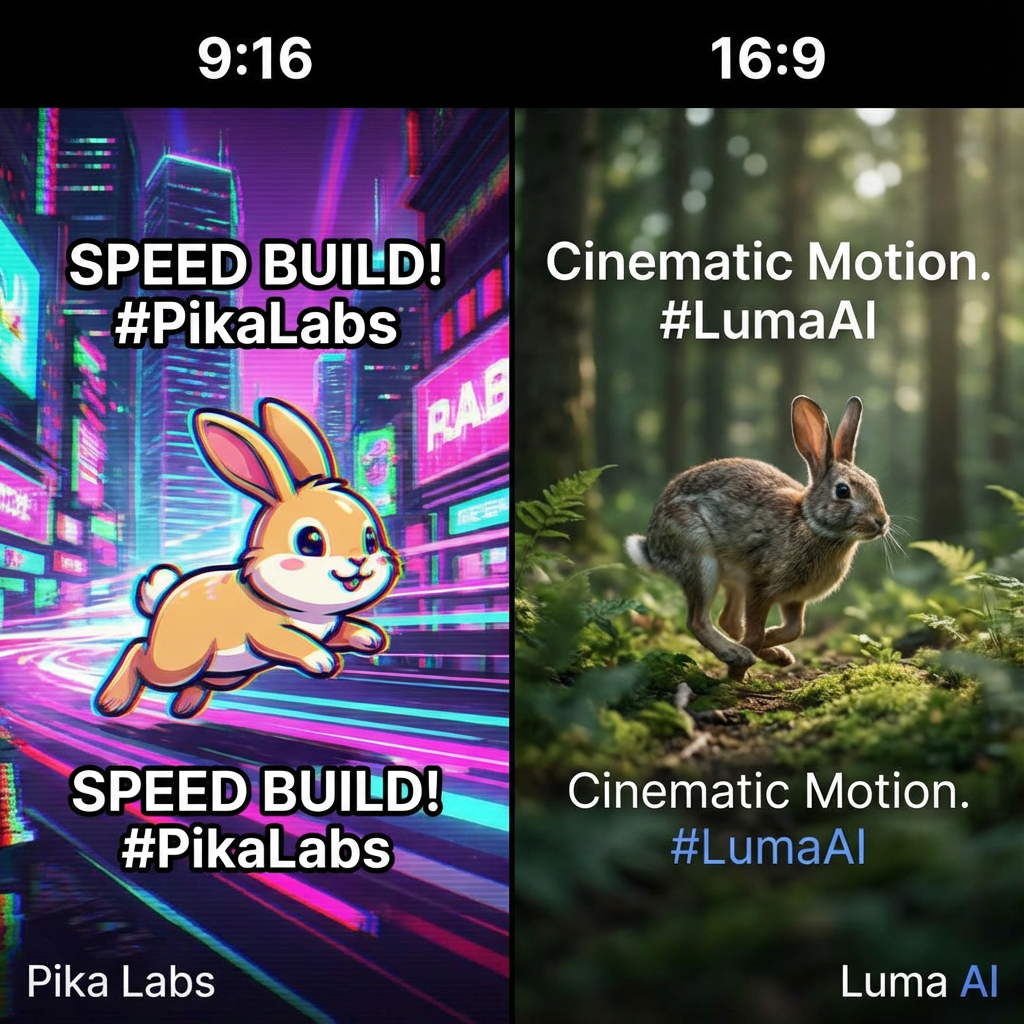
•Pika Labs: While Pika V2 has made massive strides in realism, its output still leans towards a more stylized, animated, or hyper-real aesthetic. It is excellent for motion graphics, abstract concepts, and fast-paced action, but its photorealism can sometimes fall short of Luma's best results.
Image : Pika Labs vs Luma AI Cinematic Quality Comparison
3. Creative Control and Customization
For professional use, the ability to fine-tune the output is crucial.
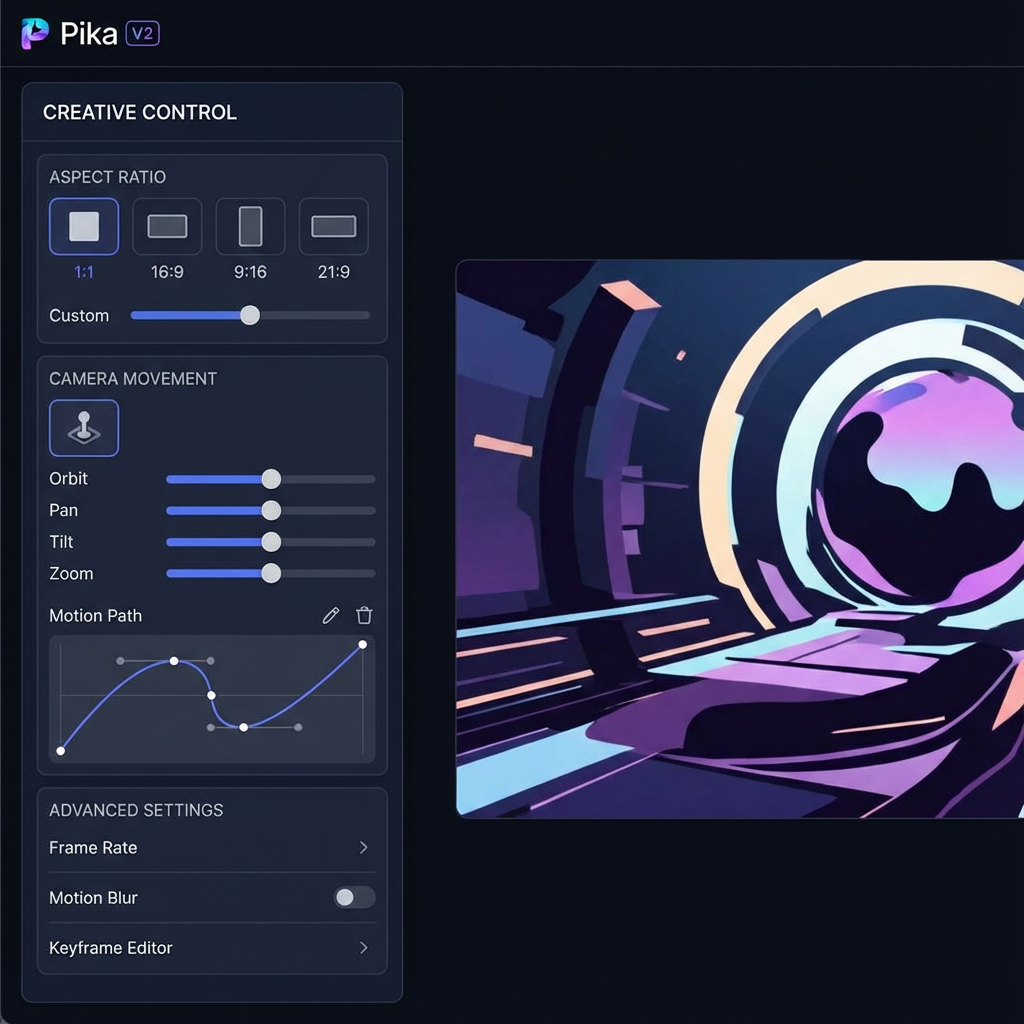
•Pika Labs: Pika V2 offers a dedicated Creative Control panel that gives users granular control over aspect ratio, camera movement (pan, tilt, zoom, orbit), and motion path editing. This level of control is invaluable for animators and motion designers who need precise, repeatable results 5.
•Luma AI: Luma’s control is more focused on the prompt and initial input. While it excels at interpreting complex camera movements from text, it offers fewer post-generation editing tools directly within the platform compared to Pika.
Image : Pika Labs V2 Creative Control Interface
Accessibility, Pricing, and Ecosystem
The platform where the tool is accessed and its pricing model significantly impact its suitability for different users.
1. Platform and Accessibility
•Pika Labs: Pika started on Discord, which made it highly accessible to a young, tech-savvy audience. It has since launched a robust web interface, but its community remains strong on Discord, offering a collaborative environment 6.
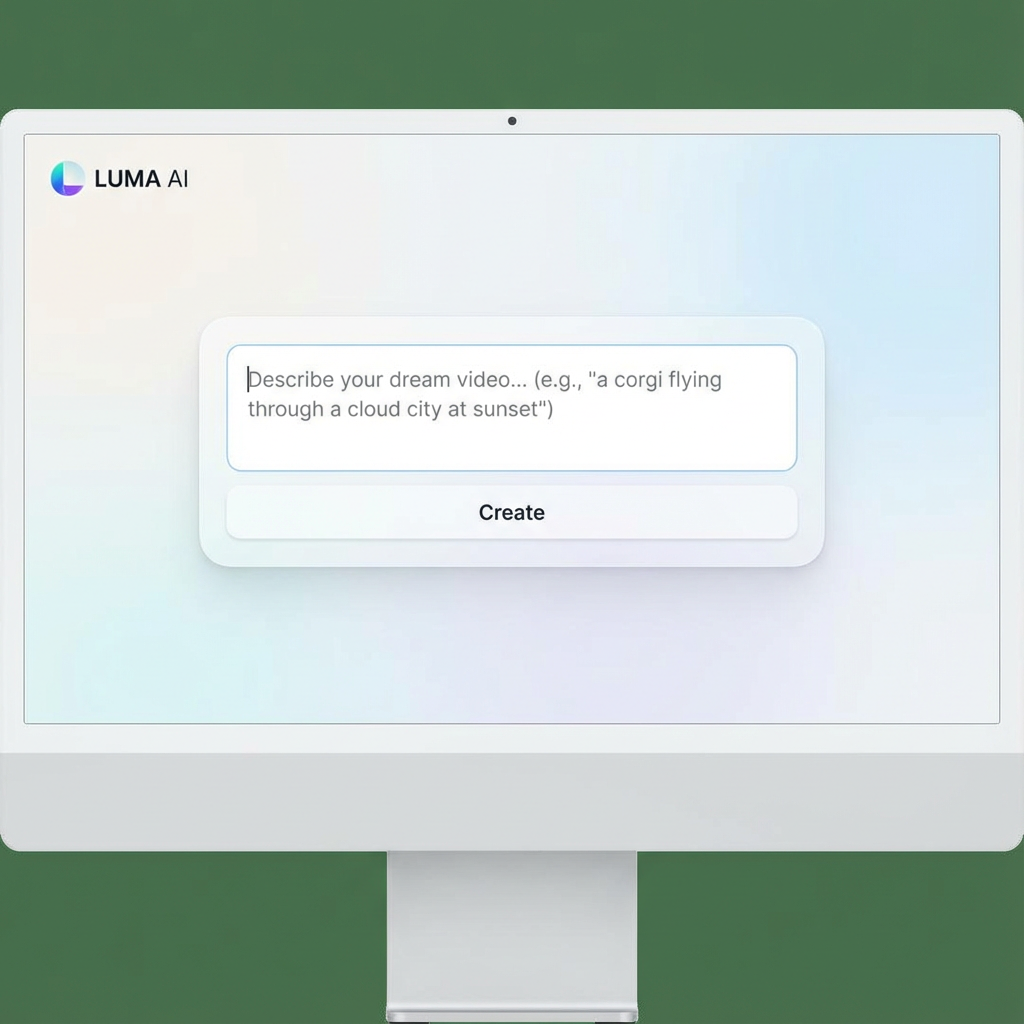
•Luma AI: Luma is primarily a web-based platform, offering a clean, professional interface that is immediately familiar to users of other creative software. This makes it slightly more appealing to users who prefer a dedicated, distraction-free workspace.
Image: Luma AI Dream Machine Interface
2. Pricing Models
Both platforms offer a free tier, but their paid plans diverge based on their target audience.
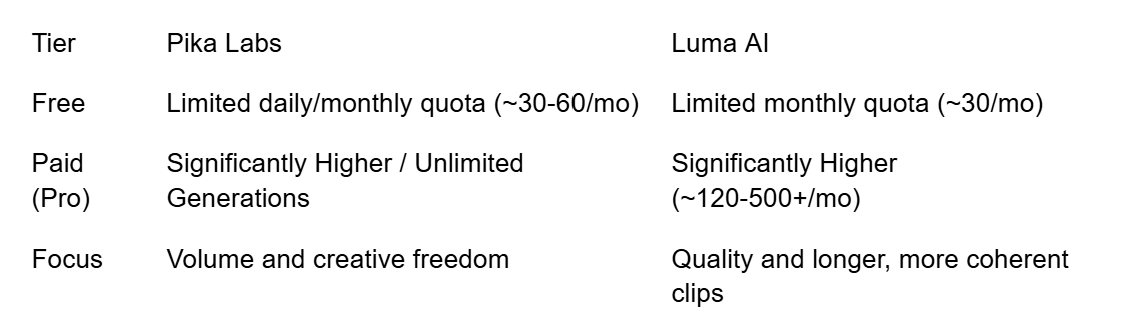
Pika Labs’ pricing is geared towards high-volume creators who need to generate a large number of short clips for social media testing. Luma AI’s pricing, while competitive, reflects its focus on higher-quality, longer-form content, where each generation is a more valuable asset 7.
Image 4: Pika Labs vs Luma AI Pricing Comparison
Use Cases: Social Media vs. Cinematic Production
The choice between Pika Labs vs Luma AI ultimately comes down to the intended use case.
Pika Labs: The Social Media Powerhouse
Pika Labs is the superior choice for:
•Rapid Content Creation: Generating dozens of short, engaging clips for platforms like TikTok, Instagram Reels, and YouTube Shorts.
•Motion Graphics: Creating abstract animations, logo reveals, and stylized visual effects.
•Community Collaboration: Leveraging the Discord community for prompt sharing, remixing, and inspiration.
•Animation: Users who want precise control over character and camera movement for animated shorts.
Luma AI: The Cinematic Specialist
Luma AI is the superior choice for:
•Photorealistic Scenes: Generating realistic landscapes, architectural visualizations, and scenes that require high visual fidelity.
•Virtual Cinematography: Creating complex, smooth camera movements (e.g., dolly zooms, crane shots) that feel physically accurate.
•3D Asset Creation: Leveraging its underlying technology for potential future integration with 3D modeling and game development pipelines.
•Professional Storytelling: Generating longer, more coherent clips suitable for narrative storytelling or high-end commercial work.
Final Verdict: Choosing Your AI Video Partner
The debate of Pika Labs vs Luma AI does not have a single winner; it has two specialized champions.
If your primary goal is speed, volume, and creative control for social media and animation, Pika Labs is the clear choice. Its rapid iteration and granular motion controls make it the most versatile tool for a high-output workflow.
If your primary goal is photorealism, cinematic quality, and 3D-like coherence, Luma AI is the superior platform. Its Dream Machine model sets the standard for visual fidelity, making it the best option for professional filmmakers and those prioritizing realism.
Ultimately, the best workflow may involve a hybrid approach, using Pika Labs for rapid prototyping and Luma AI for final, high-fidelity shots. Both platforms are evolving at a breakneck pace, and staying current with their latest updates is the only way to maintain a competitive edge in the new era of AI video generation.
Deep Dive into Creative Control and Advanced Features
The true power of an AI video generator is unlocked not just by its default output, but by the level of control it grants the user. For a commercial or professional creator, the ability to fine-tune a generation is what separates a toy from a tool.
Advanced Control Mechanisms
Pika Labs has made a strong play for the creative professional with its comprehensive suite of controls. The Motion Brush feature, for instance, allows users to paint over specific areas of an image to dictate the direction and intensity of movement, offering a level of precision that is essential for complex scenes. Furthermore, Pika’s Camera Control is not limited to simple pans and zooms; it includes orbital and dolly movements, which are crucial for cinematic storytelling. The ability to adjust the Frame Rate also gives Pika users a significant advantage in controlling the final aesthetic, allowing for the choice between a smooth, high-frame-rate look and a more stylized, lower-frame-rate animation.
Luma AI, while prioritizing realism, offers a different kind of control. Its strength lies in its prompt interpretation and its ability to maintain temporal coherence over longer clips. While it may lack the explicit sliders and dials of Pika, Luma's model is exceptionally good at translating complex, multi-clause prompts into a coherent, single-shot video. This makes it ideal for users who prefer to describe the scene and let the AI handle the technical execution, rather than manually manipulating motion paths. The 3D-aware generation of Luma means that even subtle camera movements requested in the prompt will result in a physically plausible scene, a feature that Pika, with its 2D-based generation, sometimes struggles to match.
Input Flexibility and Interoperability
The starting point for a video is as important as the generation process itself.
•Image-to-Video: Both platforms excel at turning a static image into a dynamic video. However, Luma AI's Dream Machine often produces a more subtle, realistic animation, focusing on bringing the existing elements to life. Pika Labs, on the other hand, tends to introduce more dramatic motion, making it a better choice for quickly animating a static logo or character for a social media post.
•Text-to-Video: This is the bread and butter of both tools. Pika's speed allows for rapid testing of different prompts, while Luma's focus on realism means that a single, well-crafted prompt is more likely to yield a high-fidelity result.
•Video-to-Video: This feature, which allows users to transform an existing video clip, is a powerful tool for professional editing. Pika Labs has been more aggressive in developing this feature, offering tools for style transfer and object replacement within a video. Luma AI is catching up, but its current focus remains on generating new content from scratch.
Ethical and Commercial Considerations
For any professional use, the ethical sourcing of training data and the clarity of commercial rights are non-negotiable.
Training Data and Ethics
•Luma AI: Luma has been relatively transparent about its training data, emphasizing a commitment to ethical sourcing and avoiding copyrighted material. This is a significant factor for large corporations and agencies that must adhere to strict legal guidelines.
•Pika Labs: As a platform that grew rapidly from a community base, Pika's training data history is less clear. While they have made efforts to clean their datasets, the open-source nature of some of the underlying technology can raise questions about the provenance of every image used in training. For users concerned about commercial safety and copyright infringement, Luma AI currently offers a more reassuring stance.
Commercial Rights and Monetization
Both platforms offer commercial rights to users on their paid tiers, but the specifics differ:
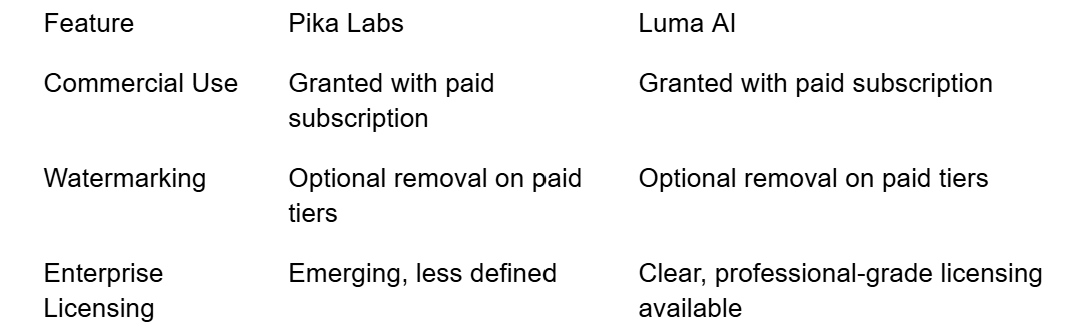
For a freelance creator or small business, both platforms provide the necessary commercial license. However, for a large studio or enterprise, Luma AI's more structured and professional-grade licensing options, coupled with its clearer stance on training data, make it the safer long-term investment.
Future Outlook and Ecosystem Integration
The future of AI video will be defined by integration and the ability to handle longer, more complex narratives.
The Race for Longer Video
The current limitation of short clips (5-20 seconds ) is the biggest hurdle for AI video. Pika Labs' ability to extend clips up to 60 seconds is a major advantage, suggesting a roadmap focused on narrative storytelling. Luma AI is also actively working on increasing its base video length and improving temporal coherence over extended periods. The platform that first reliably generates a high-quality, minute-long video will gain a significant market share.
Ecosystem and API Access
•Luma AI: Backed by significant funding and a focus on professional users, Luma is poised for deep integration into existing creative ecosystems. The availability of a robust API is a key indicator of its enterprise focus, allowing developers to build Luma's generation capabilities directly into other software.
•Pika Labs: Pika's ecosystem is currently more focused on its community and in-app features. While an API is likely on the roadmap, its immediate future is tied to improving the core web and mobile experience for individual creators.
The choice between Pika Labs vs Luma AI is a choice between two distinct futures: one where AI video is a fast, flexible tool for the masses, and one where it is a high-fidelity, integrated component of the professional film and media industry. Creators should align their investment with the platform that best reflects their long-term creative and commercial goals.