Pika, Sora vs Kling: The Ultimate 3-Way AI Video Generator Showdown
Pika, Sora vs Kling: The Ultimate 3-Way AI Video Generator Showdown
The generative AI video landscape has rapidly evolved into a three-way battle for supremacy, pitting the accessible speed of Pika against the cinematic realism of Sora and the advanced control of Kling. For creators, filmmakers, and marketers, the choice is no longer between two platforms, but a strategic decision among three distinct approaches to text-to-video generation.
This 2500-word analysis provides the definitive comparison of Pika, Sora vs Kling, exploring how each platform excels in different areas, from the speed required for social media content to the photorealism demanded by feature film production. We will break down their core technologies, compare their output quality, and analyze their accessibility to help you determine which AI video generator—or combination of them—will define your creative workflow in the coming year.
The Contenders: A Snapshot of the AI Video Titans
Before diving into the head-to-head comparisons, it is essential to understand the unique position and core philosophy of each contender.
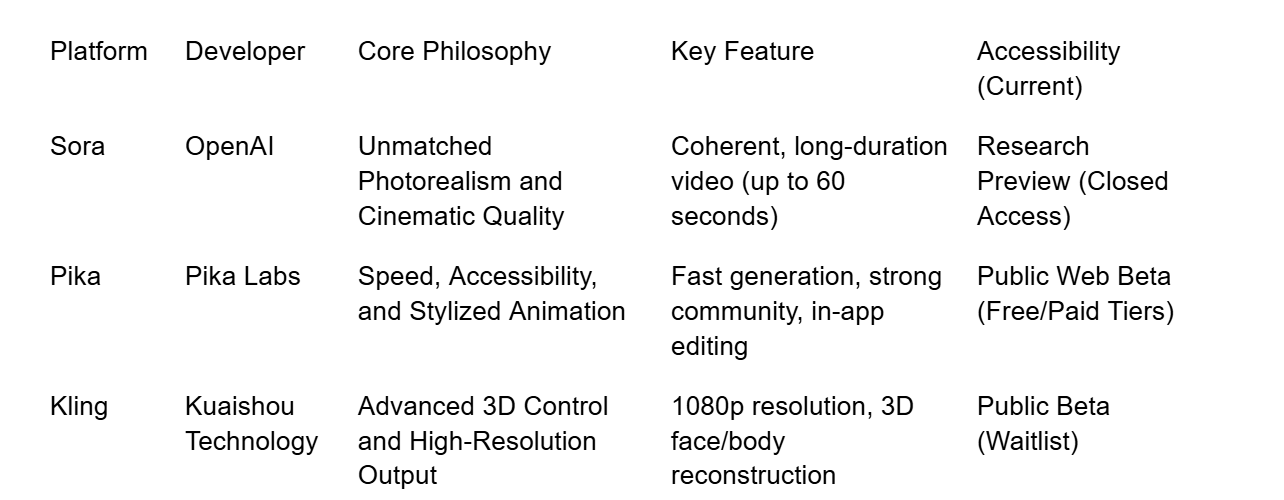
The comparison of Pika, Sora vs Kling is a study in contrasts: the closed, high-end realism of Sora, the open, fast-paced creativity of Pika, and the technically advanced, high-fidelity output of Kling.
Cinematic Quality and Photorealism: Sora’s Unmatched Domain
When the primary requirement is the sheer quality of the final image—the texture, the lighting, the temporal coherence—Sora remains the gold standard. Developed by OpenAI, Sora’s videos are characterized by their ability to maintain object permanence and simulate complex physics over long sequences, a feat that its competitors are still striving to match.
Sora’s Edge: Temporal Coherence and Physics Simulation
Sora’s most significant advantage lies in its understanding of the physical world. In a complex scene, objects do not suddenly appear or disappear, and interactions (like a ball bouncing or water splashing) adhere to realistic physical laws. This is known as temporal coherence, and it is the single most important factor separating cinematic-grade AI video from stylized animation.
Pika and Kling, while improving rapidly, still occasionally suffer from "video wobble" or objects morphing unnaturally, especially in longer clips. Pika, in particular, often leans into a more stylized, animated look, which is excellent for its target audience but falls short of photorealism. Kling’s 1080p resolution is impressive, but resolution alone does not guarantee realism; Sora’s ability to render subtle details like skin texture, hair movement, and natural lighting remains superior .
.

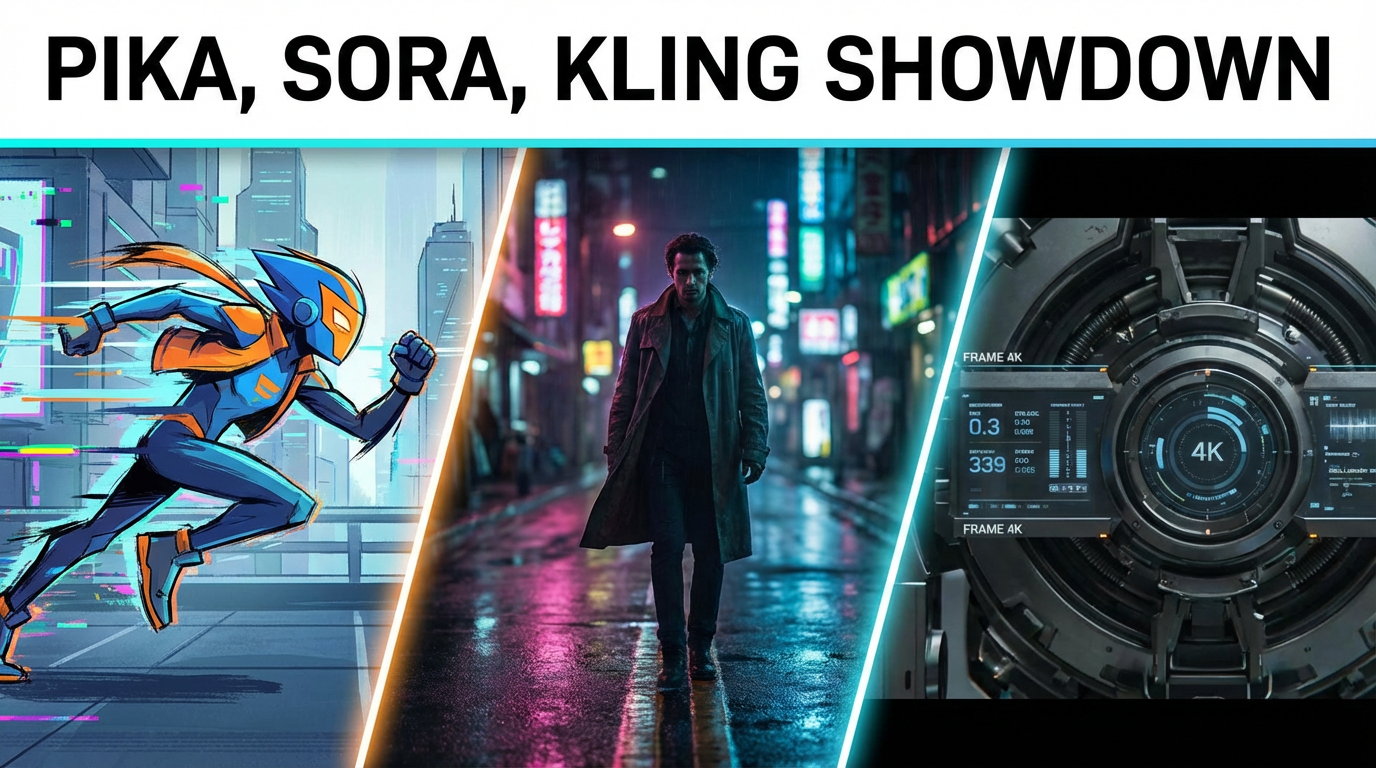
A visual comparison highlighting the distinct aesthetic of Pika (stylized), Sora (photorealistic), and Kling (high-fidelity 3D).
For a filmmaker, the ability to generate a shot that looks like it was captured by a professional camera is paramount. Sora achieves this by training on vast amounts of high-quality, licensed video data, allowing it to accurately model the world.
Accessibility and Speed: Pika’s Public Advantage
While Sora and Kling are focused on pushing the technical limits, Pika has won the hearts of the broader creator community through its accessibility and speed. Pika operates on a public web and Discord interface, offering a generous free tier and a fast generation pipeline that is crucial for social media content creation.
The Pika Advantage: Rapid Iteration and Community
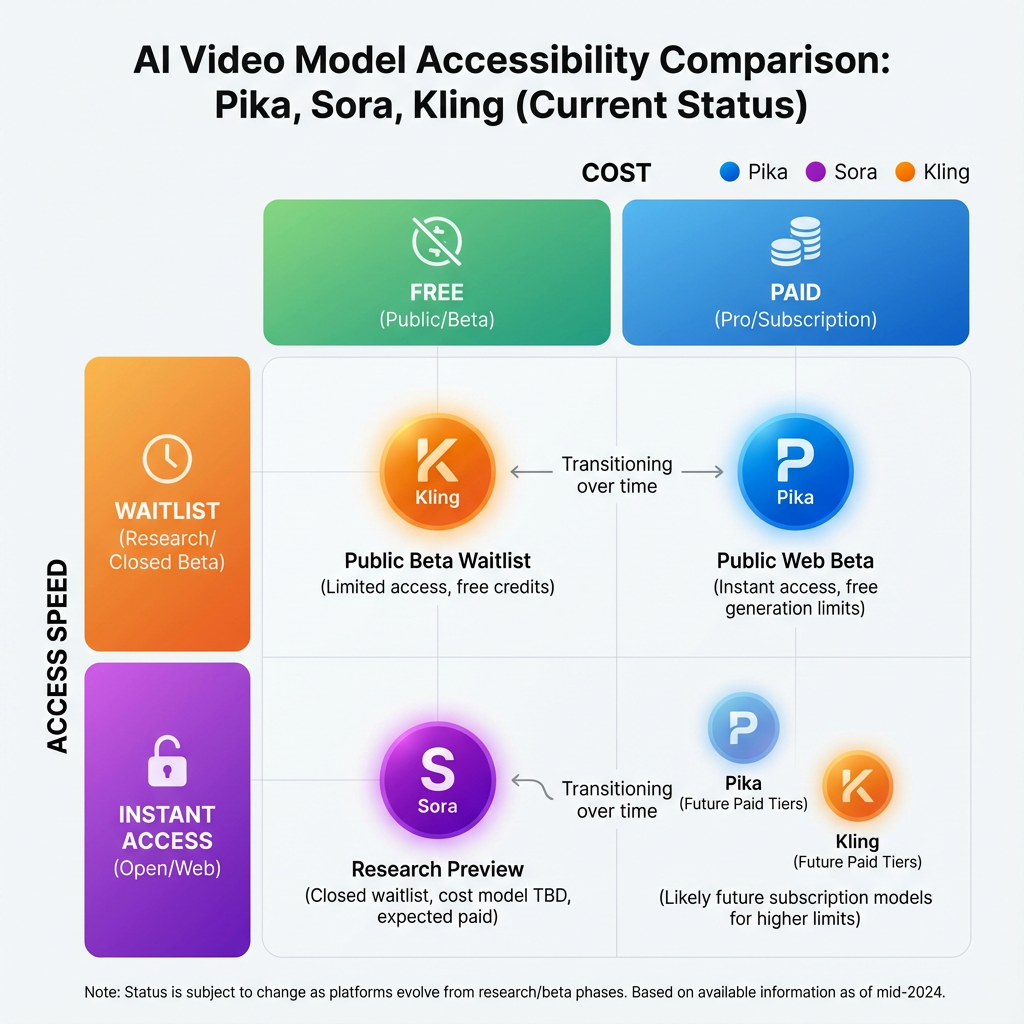
The core strength of Pika is its ability to generate a video clip in a matter of seconds, often under a minute. This rapid iteration cycle is invaluable for creators who need to test multiple concepts quickly for platforms like TikTok and Instagram Reels. The Pika, Sora vs Kling comparison on accessibility is stark:
•Pika: Instant access, free credits, fast generation.
•Sora: Closed research preview, highly limited access.
•Kling: Public beta with a waitlist, generation speed is competitive but not as fast as Pika’s rapid-fire mode.
This accessibility has fostered a massive community around Pika, leading to a wealth of shared knowledge, custom prompts, and collaborative creation. For a creator just starting out, Pika offers the lowest barrier to entry and the fastest path to publishing content 2.
Advanced Control and Resolution: Kling’s Technical Prowess
Kling, developed by the Chinese tech giant Kuaishou, has positioned itself as the technical dark horse in the Pika, Sora vs Kling race. While it may not have the global brand recognition of OpenAI or the community size of Pika, its technical specifications are designed to appeal directly to professional animators and VFX artists.
Kling’s Edge: 1080p and 3D Control
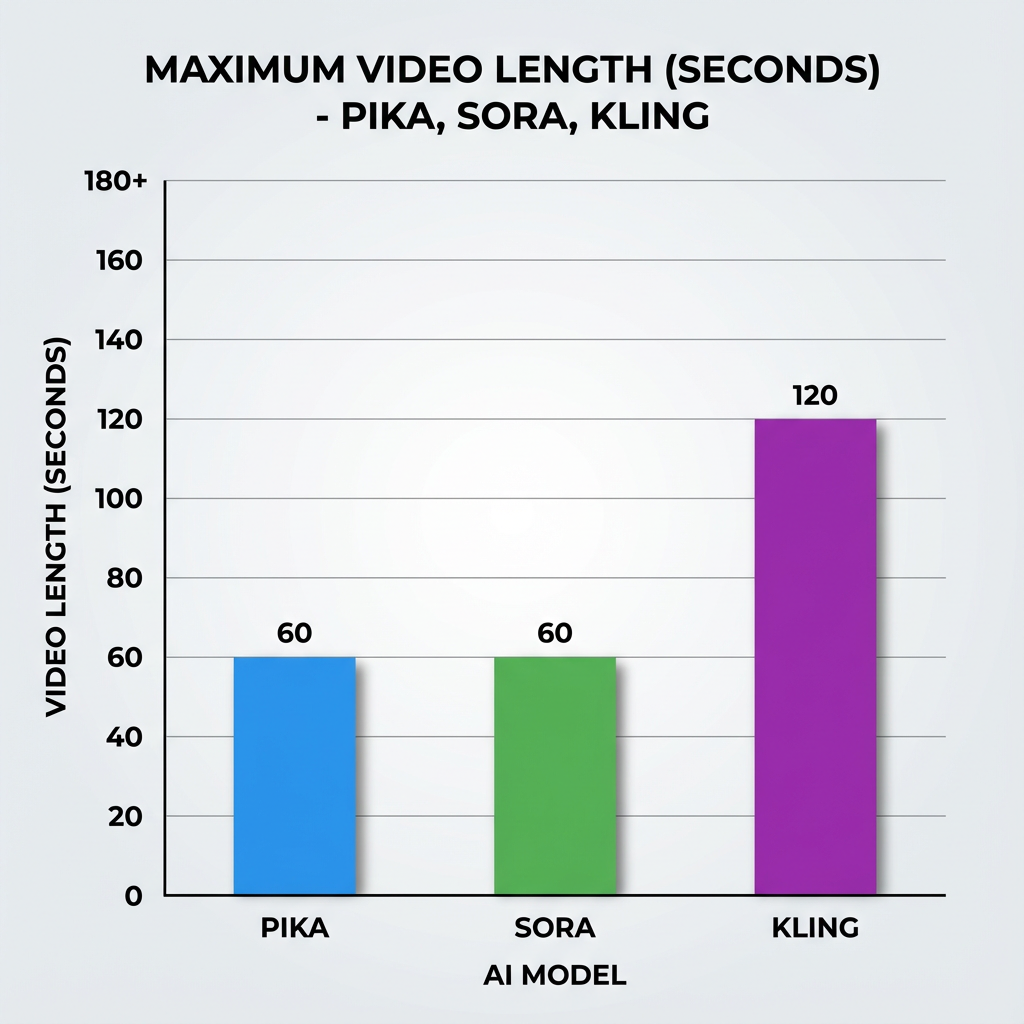
Kling’s headline feature is its ability to generate videos at a native 1080p resolution and a maximum length of 120 seconds 3
. This is a significant advantage over Sora’s 60-second limit and Pika’s typically lower-resolution output. Furthermore, Kling has demonstrated advanced capabilities in 3D face and body reconstruction, allowing for more precise control over character movement and camera angles—a feature often associated with high-end VFX software.
For a studio looking to integrate AI into a pipeline that requires high-resolution assets and fine-grained control over character performance, Kling presents a compelling, technically robust option.
The Ultimate Showdown: Key Feature Comparison
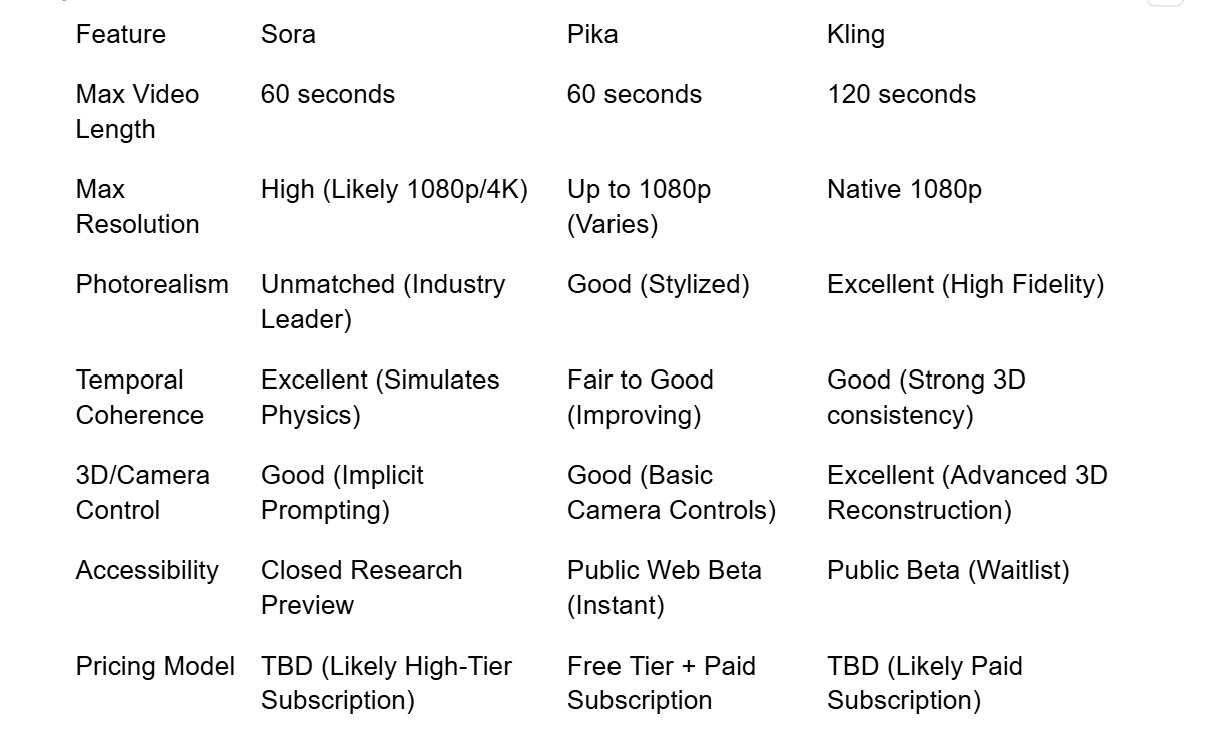
To provide a clear picture of where each platform excels, the following table breaks down the critical features in the Pika, Sora vs Kling comparison.
Deep Dive: Video Length and Coherence
The length of the generated video is a crucial metric for creators. While all three models are capable of generating clips up to a minute long, Kling’s demonstrated ability to reach 120 seconds is a significant technical milestone.

However, length is meaningless without coherence. Sora’s focus on maintaining a consistent narrative and physical world across its 60 seconds is often more valuable than a longer, less coherent clip. The Pika, Sora vs Kling debate on video length is therefore nuanced:
•For Cinematic Quality: Sora’s 60 seconds of near-perfect coherence is superior.
•For Long-Form Content: Kling’s 120 seconds offers a clear advantage, assuming its coherence holds up in the public release.
•For Social Media: Pika’s 60 seconds is more than sufficient for short-form content.
The Future of AI Video: Integration and Ecosystem
The long-term winner in the Pika, Sora vs Kling race will likely be the one that integrates best into the existing creative ecosystem.
Sora’s Integration: The OpenAI/Microsoft Stack
Sora’s future is tied to the OpenAI ecosystem, which includes integration with ChatGPT for prompt refinement and potentially Microsoft products. This means that once Sora is widely available, it will likely be accessible through a familiar, polished interface, making it a powerful tool for large enterprises already invested in the Microsoft stack.
Pika’s Integration: Community and Openness
Pika’s strength lies in its community-driven development. While not fully open-source, its rapid feature deployment and responsiveness to user feedback make it highly adaptable. Pika’s future is less about a single corporate ecosystem and more about becoming the default tool for independent creators and small studios.
Kling’s Integration: The Kuaishou/Asian Market Focus
Kling’s development by Kuaishou suggests a strong focus on the massive Asian market, where Kuaishou’s platforms are dominant. While it is a powerful tool globally, its initial integration and feature set may be optimized for that specific market, which could influence its adoption in Western creative pipelines.
Conclusion: Choosing Your AI Video Champion
The ultimate choice in the Pika, Sora vs Kling showdown depends entirely on the creator’s specific needs. There is no single "best" tool; rather, there is a best tool for a specific job.
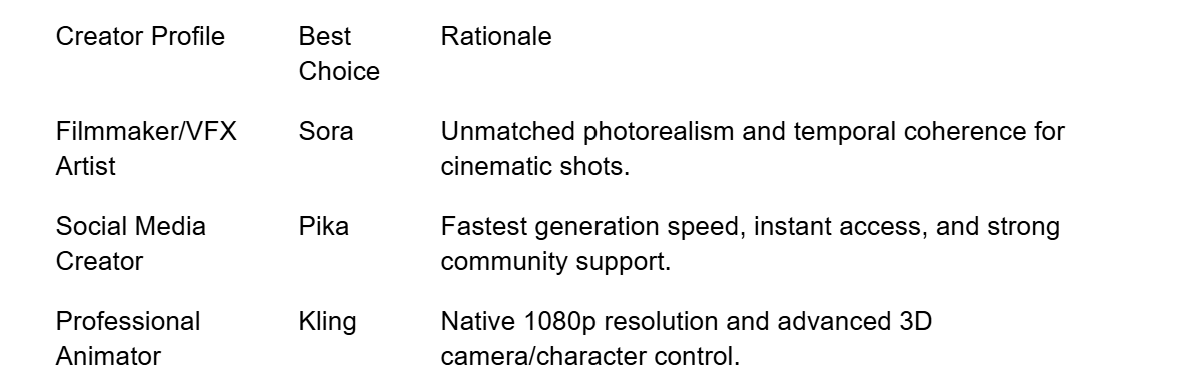
The true power, however, lies in a hybrid workflow. A professional studio might use Pika for rapid ideation, Kling for high-resolution character shots, and Sora for the final, photorealistic establishing shots. The competition between Pika, Sora vs Kling is not a zero-sum game; it is a catalyst for innovation that benefits every creator.
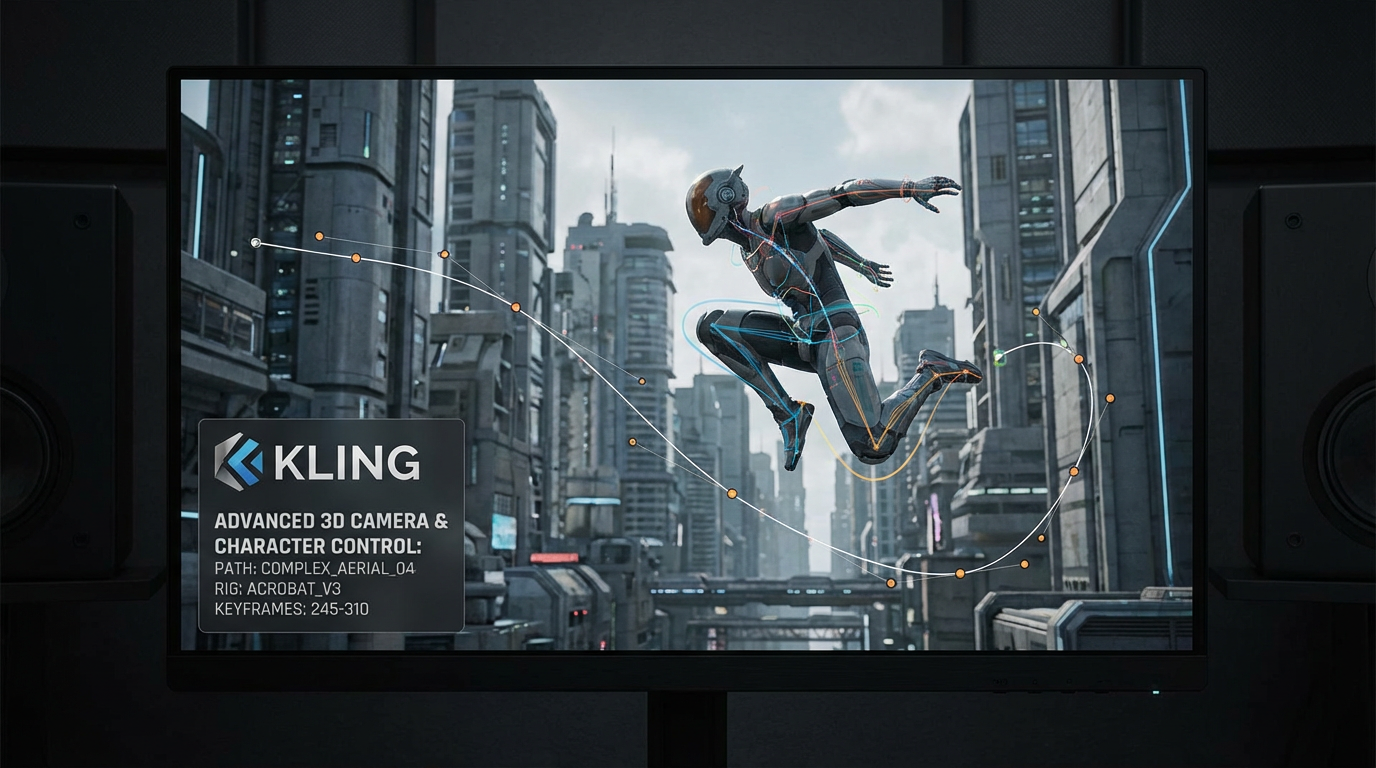
As these models continue to evolve, the gap in quality will narrow, but their core philosophies—Pika’s speed, Sora’s realism, and Kling’s control—will likely remain their defining characteristics.
Technical Deep Dive: Temporal Coherence and Physics Simulation
The true measure of a generative video model's maturity is its ability to maintain temporal coherence—the consistency of objects and motion across a sequence of frames—and accurately simulate real-world physics. This is where the Pika, Sora vs Kling comparison moves from aesthetic preference to technical capability.
Sora's Physics Engine: The Simulation Hypothesis
Sora's most revolutionary feature is its apparent understanding of physics. When a prompt involves complex interactions—such as a glass shattering, water flowing, or a character interacting with a dynamic environment—Sora's output often adheres to the laws of motion, gravity, and fluid dynamics. This is not a feature explicitly programmed but an emergent property of its massive scale and training data. This capability is what allows Sora to generate scenes that feel genuinely filmed, rather than animated. For a 60-second commercial, this means less time spent correcting unnatural movements in post-production.
Kling's 3D Control: Explicit Manipulation
Kling approaches the problem of coherence through explicit control. Its advanced 3D face and body reconstruction technology allows users to define the movement of a character or the path of a camera with greater precision than a simple text prompt. While this offers a high degree of control—a massive plus for animators—it requires more user input. The coherence is driven by the user's explicit instructions, making it a powerful tool for complex choreography but potentially slower for simple, spontaneous generation.
Pika's Stylistic Coherence: The Animator's Shortcut
Pika, on the other hand, often sacrifices photorealistic physics for stylistic coherence. Its output is frequently more akin to high-quality animation, where the rules of physics are malleable. This is not a weakness but a feature for its target audience. For a social media clip that needs a quick, punchy visual, Pika's ability to maintain a consistent style and character design is often more important than perfect photorealism. Its speed allows creators to quickly generate multiple takes until a stylistically coherent clip is achieved.
Ethical and Commercial Considerations: Training Data and Watermarking
For professional use, the ethical and commercial implications of the training data and the output's provenance are paramount. The Pika, Sora vs Kling debate takes a serious turn when discussing intellectual property and commercial safety.
Sora and OpenAI's Approach
OpenAI has stated that Sora is trained on publicly available data and licensed data, but the exact composition remains proprietary. However, the company has been a leader in implementing watermarking technology. Any video generated by Sora is expected to carry a digital signature (like the SynthID used by Google ) that is invisible to the human eye but detectable by AI tools, ensuring transparency regarding its AI origin. This is a crucial feature for media companies concerned with deepfakes and provenance.
Kling's Data and Transparency
As a model developed by a Chinese technology company, Kuaishou, the specifics of Kling's training data are less transparent to the global community. While its focus on high-fidelity output suggests a massive, high-quality dataset, the lack of public disclosure on its composition may be a point of concern for Western companies with strict IP compliance policies. Its current watermarking status is also less clear than that of its Western counterparts.
Pika's Community and Commercial Rights
Pika's commercial model is the most straightforward for individual creators. Users who pay for a subscription typically receive full commercial rights to their generated videos. While Pika's training data is also proprietary, its focus on user-generated content and community models suggests a more creator-centric approach to rights and usage.
The Future of AI Video: Integration and Ecosystem
The long-term winner in the Pika, Sora vs Kling race will be the one that integrates best into the existing creative ecosystem. The future of AI video is not a standalone tool but a feature within a larger creative suite.
Sora's Integration: The OpenAI/Microsoft Stack
Sora's future is inextricably linked to the OpenAI ecosystem, which includes integration with ChatGPT for prompt refinement and potentially Microsoft products like Azure and Copilot. This means that once Sora is widely available, it will likely be accessible through a familiar, polished interface, making it a powerful tool for large enterprises already invested in the Microsoft stack. Its API access will be a game-changer for developers building custom video applications.
Pika's Integration: Community and Openness
Pika's strength lies in its community-driven development and its rapid integration of new features based on user demand. While not fully open-source, its API and web-based platform make it highly adaptable. Pika's future is less about a single corporate ecosystem and more about becoming the default tool for independent creators and small studios who prioritize speed and a low barrier to entry. Its ability to integrate with Discord and other social platforms is a massive advantage for the creator economy.
Kling's Integration: The Kuaishou/Asian Market Focus
Kling's development by Kuaishou suggests a strong focus on the massive Asian market, where Kuaishou’s platforms are dominant. While it is a powerful tool globally, its initial integration and feature set may be optimized for that specific market, which could influence its adoption in Western creative pipelines. However, its technical superiority in 3D control makes it a prime candidate for integration into high-end VFX and animation studios globally, regardless of its initial market focus. The demand for precise control over digital assets will drive its adoption in professional pipelines.