Runway vs Google Veo: The New Era of AI Video Generation.
Runway vs Google Veo: The New Era of AI Video Generation
The competition in the generative AI video space has intensified with the emergence of two formidable contenders: Runway and Google Veo. Runway, a pioneer in the field, has continually pushed the boundaries with its Gen-3 model, while Google’s Veo, backed by the tech giant’s immense resources, has quickly established itself as a benchmark for cinematic quality. For professional creators, studios, and businesses, the choice between Runway vs Google Veo is a critical decision that will define their video production workflow for the coming years.
This 2600-word analysis provides a deep, comprehensive comparison of these two platforms, focusing on their latest iterations, technical capabilities, and ecosystem integration. We will explore how they stack up against each other in terms of cinematic quality, creative control, and commercial viability to determine which tool is best suited for the new era of AI video generation.
1. Cinematic Quality and Realism: Gen-3 vs Veo
The primary metric for any AI video generator is the quality of its output. The fan-out query Runway vs Google Veo cinematic quality is where the most significant differences lie.
Google Veo: The Pursuit of Cinematic Perfection
Google Veo, particularly the latest Veo 3 model, is engineered for high-fidelity, cinematic realism, leveraging Google’s deep expertise in computer vision and large-scale data processing.
•High Resolution and Fidelity: Veo 3 supports native 1080p and 4K renders, a crucial feature for professional production 13
. Its output is characterized by sharp detail, realistic lighting, and a deep understanding of complex scenes.
•Physical Accuracy: Veo excels at maintaining physical accuracy and temporal coherence over longer clips. It minimizes the "floating subject" or object morphing artifacts that plague less advanced models, making it ideal for narrative storytelling.
•Advanced Camera Control: Veo allows for sophisticated camera movements, including sweeping pans, dollies, and complex focus pulls, giving the user a high degree of directorial control over the final shot.
Runway Gen-3: The Creative Toolkit
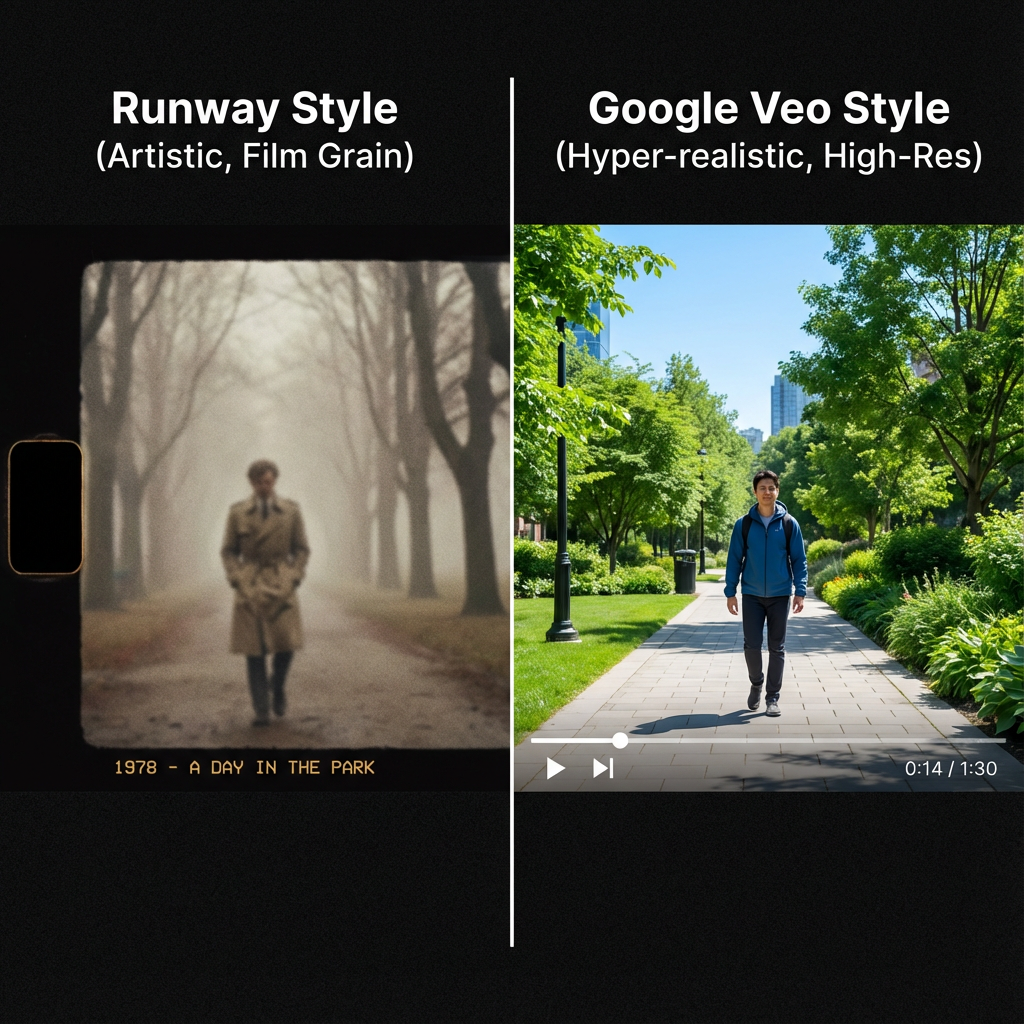
Runway’s Gen-3 model is a powerful generalist, focusing on providing a wide array of creative tools alongside high-quality generation.
•Versatile Output: Gen-3 offers a versatile output that can range from photorealistic to highly stylized, depending on the prompt. Its strength lies in its ability to quickly generate a wide variety of visual styles.
•Temporal Coherence: While Gen-3 has significantly improved temporal coherence over its predecessors, its primary focus remains on providing a comprehensive suite of tools for in-app editing and refinement, rather than solely relying on the initial generation quality.
•Turbo Mode: Runway’s Turbo mode prioritizes speed, allowing for rapid ideation and mood board creation, which is invaluable in fast-paced production environments.
2. Creative Control and Editing Features
For a professional workflow, the ability to control and edit the generated video is as important as the initial quality. The fan-out query Runway vs Google Veo creative control highlights the differing approaches of the two platforms.
Runway: The All-in-One Studio
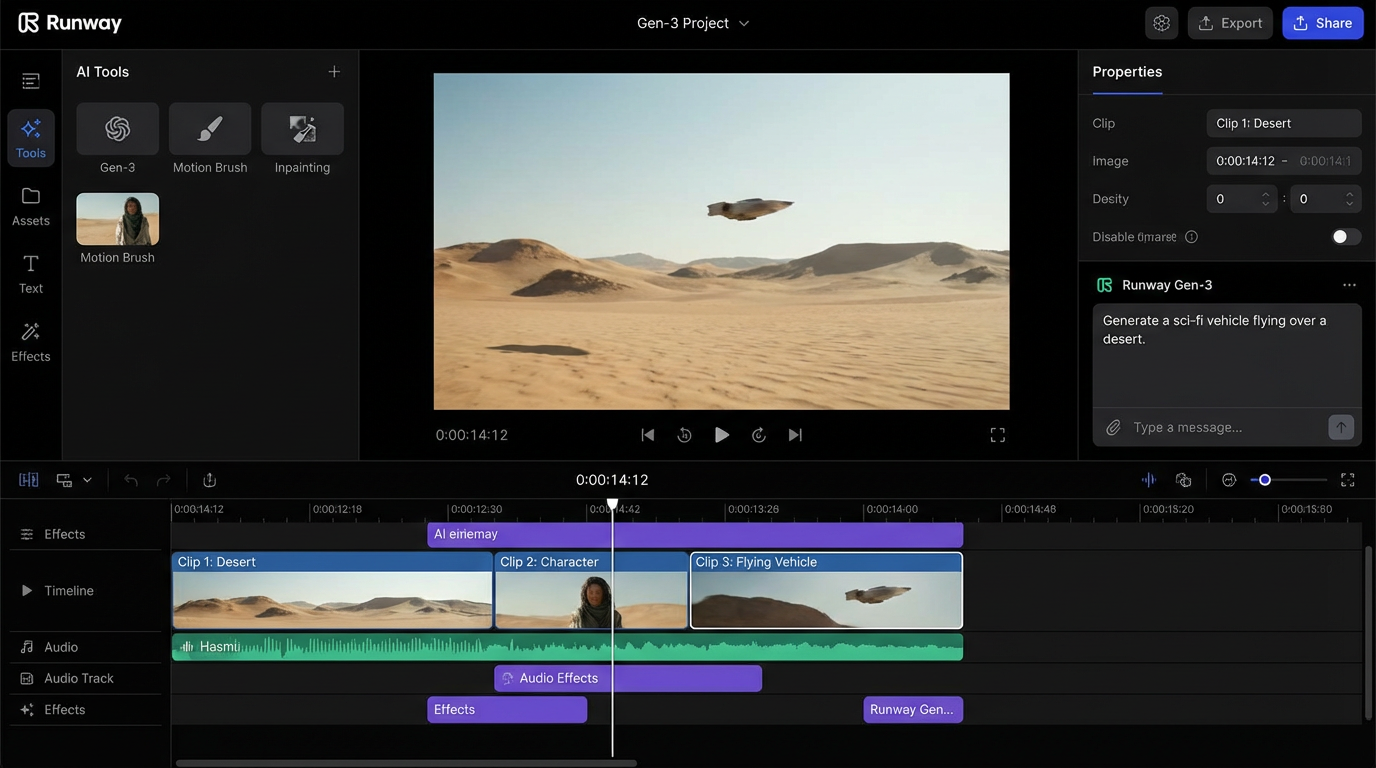
Runway is designed as an end-to-end creative suite, offering a deep set of in-app tools that extend far beyond simple text-to-video generation.
•Multi-Modal Generation: Runway supports text-to-video, image-to-video, and video-to-video, allowing creators to use existing assets as a starting point.
•Inpainting and Outpainting: These tools allow users to selectively remove objects from a scene (inpainting) or expand the frame and fill in the new area with AI-generated content (outpainting), offering unparalleled post-generation control.
•Motion Brush: This feature allows users to paint over specific areas of a static image to define the direction and intensity of motion, turning a still image into a dynamic video clip.
Google Veo: Focused on Generation
Veo’s focus is primarily on the quality of the initial generation, with less emphasis on in-app editing tools. Its control features are geared towards refining the prompt and the camera work.
•Motion Brush and Keyframing: Veo 3 includes a Motion Brush for fine-grained control over subject movement and keyframe editing, allowing users to direct the focus mid-scene 13.
•Integration with External Tools: Veo’s strategy is to integrate with existing professional editing software (like Adobe Premiere Pro or DaVinci Resolve) via API, relying on those tools for the final cut and post-production effects.
3. Ecosystem and Integration
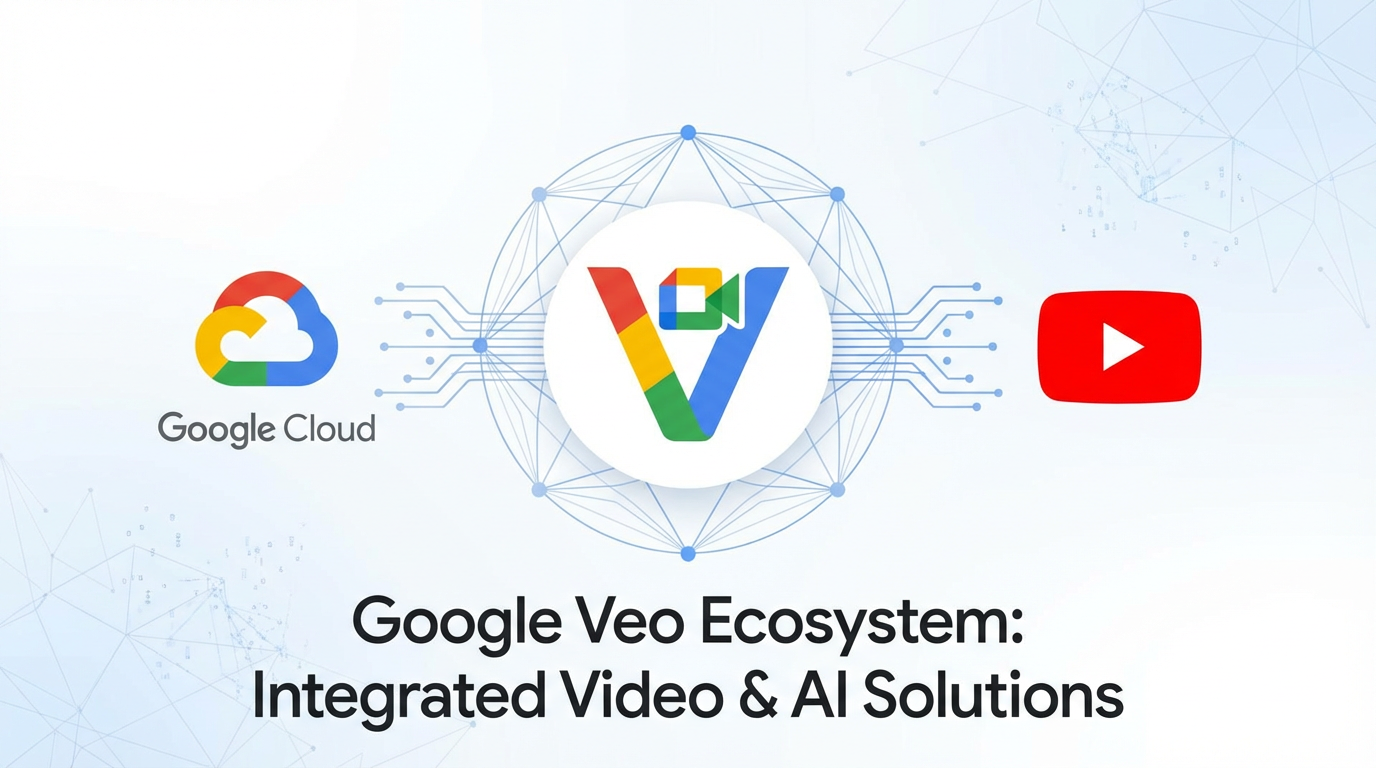
The long-term viability of an AI tool for a professional studio depends on how well it integrates with existing workflows. The fan-out query Runway vs Google Veo integration with professional tools is a key differentiator.
Google Veo: The Enterprise Solution
Veo’s strength lies in its deep integration with the Google ecosystem, positioning it as an enterprise-ready solution.
•Google Workspace Integration: Veo integrates seamlessly with Google Workspace, allowing for collaboration via Docs, asset syncing through Drive, and a familiar environment for enterprise users.
•Google Cloud Vertex AI: Veo is available through Google Cloud Vertex AI, allowing large organizations to bundle its usage with existing cloud commitments and manage spending through a unified dashboard.
•Gemini Integration: Veo is accessible through the Gemini app, making it easy for users to generate videos on the fly, a significant advantage for quick content creation 13.
Runway: The Creative Cloud Bridge
Runway has strategically positioned itself as a bridge between AI generation and the traditional creative industry, particularly the Adobe ecosystem.
•API and Premiere Pro Integration: Runway exposes a robust API and offers a dedicated Premiere Pro integration, allowing editors to trigger variations and manage assets directly from their Adobe projects.
•Showroom Pipeline: Runway’s Showroom feature allows teams to remix community scenes and download assets in layered PSD or ProRes formats, accelerating the iteration process for creative teams.
4. Pricing and Commercial Viability
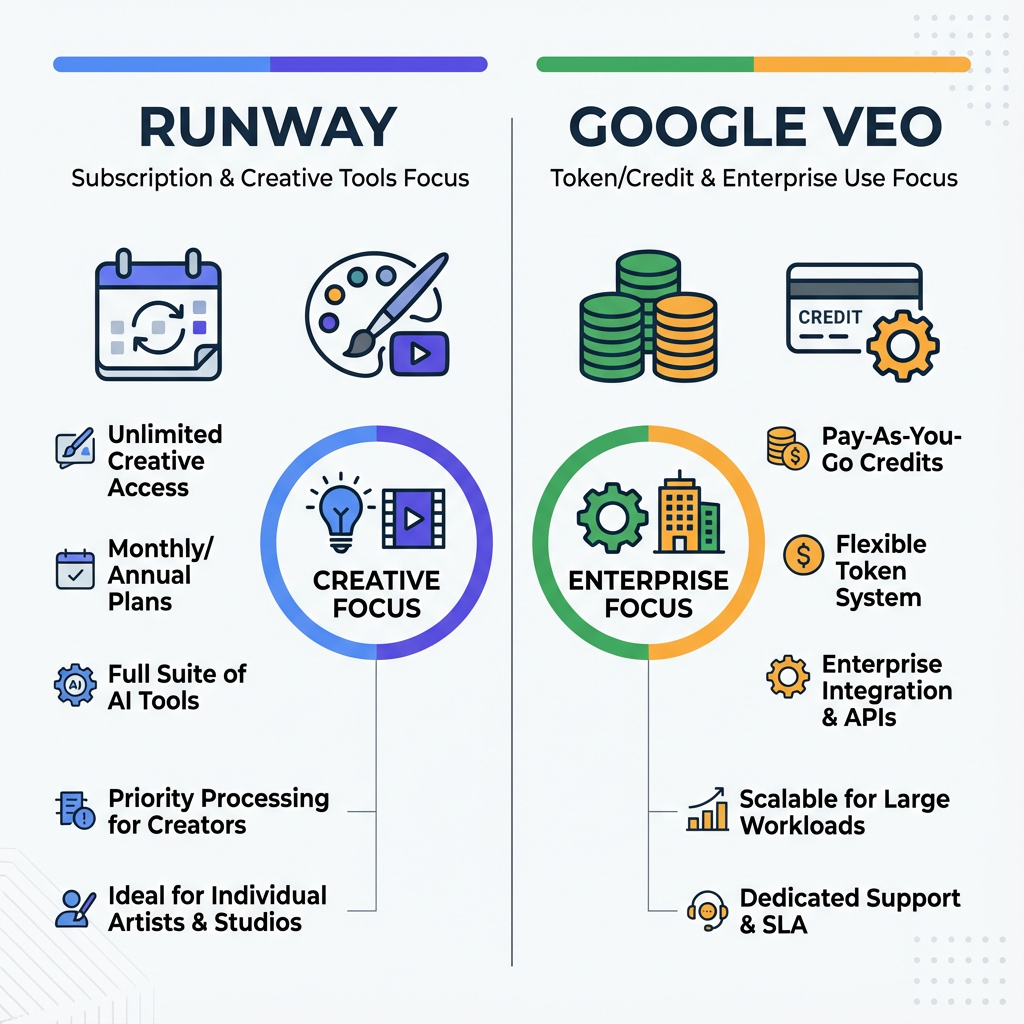
The fan-out query Runway vs Google Veo pricing and commercial viability is a crucial factor for budgeting and scaling production.
Runway: Subscription and Credit-Based
Runway operates on a clear, subscription-based model with additional render credits.
•Seat-Based Plans: Runway offers seat-based plans that make it easy for design teams to forecast spending and scale collaborative workspaces.
•Clear Credit System: The credit system is transparent, allowing users to understand the cost of generation based on the complexity and length of the video.
•Commercial Rights: Runway offers clear commercial rights for content generated on paid plans, which is essential for professional use.
Google Veo: API and Subscription Tiers
Veo’s pricing is more complex, tied to both Google’s consumer and enterprise offerings.
•Consumer Tiers: Veo is accessible through the Google AI Pro subscription (around $19.99/month), which includes a set number of "Fast" video generations per month via the Gemini app 13
.
•API Pricing: For enterprise and high-volume users, Veo’s pricing is tied to Google Cloud pricing, often calculated per second of video generated (e.g., around $0.75 per second via API) 13
. This allows for bundling with existing cloud commitments but requires more complex cost tracking.
5. The Future: Integration and Innovation
The future of Runway vs Google Veo will be defined by their respective paths to innovation.
Runway’s Path: The Creative Ecosystem
Runway’s future is focused on building the most comprehensive creative ecosystem around its core generation model. Expect more advanced in-app editing tools, deeper integration with non-Adobe creative software, and a continued focus on community-driven features. Runway aims to be the central hub for all AI-assisted video creation.
Google Veo’s Path: The Simulation Standard
Google Veo’s future is focused on pushing the boundaries of realism and physical simulation. Expect higher resolutions, longer temporal coherence, and the integration of new features like synchronized audio (dialogue, ambient, SFX) directly into the generation process, making it the standard for high-fidelity, production-ready assets 13
.
Conclusion: Which Tool Defines the New Era?
The comparison of Runway vs Google Veo reveals a complementary relationship rather than a zero-sum competition.
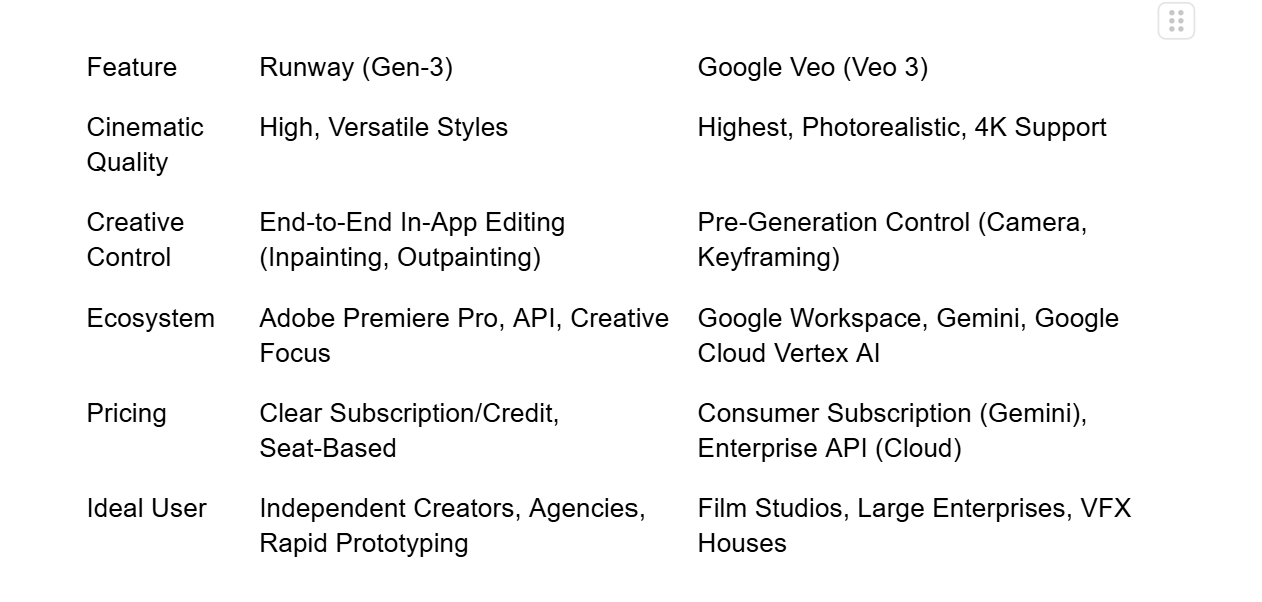
Runway is the champion of creative control and workflow integration. It is the ideal tool for creators who need an all-in-one platform for rapid iteration and post-generation refinement.
Google Veo is the champion of cinematic fidelity and enterprise integration. It is the best choice for studios and large organizations that prioritize the highest quality, most realistic output and seamless integration with a cloud-based enterprise environment.
The new era of AI video generation is defined by the strategic use of both. Creators will likely use Runway vs Google Veo in a hybrid approach: Runway for ideation and social media cuts, and Veo for final, high-fidelity narrative sequences.
6. Advanced Features and Creative Control
Beyond the core generation capabilities, the true measure of a professional tool lies in its advanced features and the degree of creative control it grants the user.

Runway: The Post-Production Powerhouse
Runway’s strength is its focus on the entire creative pipeline, particularly post-production and refinement.
•Customization and Training: Runway allows users to train custom models on their own footage, enabling the generation of highly specific characters, objects, or styles that are consistent with their brand or project. This feature is a massive advantage for studios seeking brand consistency.
•Multi-Scene Continuity: While Veo excels at temporal coherence within a single shot, Runway's platform is designed to manage and link multiple generated clips, offering tools for multi-scene continuity and seamless transitions.
•Audio Integration: Runway offers tools for generating and integrating sound effects and music, making it a more complete solution for final video output compared to Veo, which often requires external audio processing.
Google Veo: The Simulation Specialist
Veo’s advanced features are rooted in its powerful simulation engine, focusing on generating the most realistic and controllable initial shot possible.
•Native Audio Generation: Veo 3 is rumored to be capable of generating synchronized audio (dialogue, ambient, SFX ) natively with the video, a feature that would be a game-changer for realism and a significant lead over Runway 13.
•4K Native Output: Veo’s native 4K resolution output is a non-negotiable requirement for high-end film and television production, where Runway’s output often requires upscaling.
•Complex Prompt Adherence: Veo 3 has demonstrated superior ability to adhere to complex, multi-layered prompts, rendering well-detailed videos that accurately reflect the user's instructions within seconds 13.
7. Ethical and Commercial Considerations
For large enterprises and professional creators, the ethical sourcing of training data and clear commercial terms are paramount.
Runway’s Transparent Approach
Runway has been relatively transparent about its commitment to ethical AI, offering opt-out datasets for creators and publishing clear content policies.
•Content Policies: Runway enforces strict content policies and provides a clear misuse protocol, which is vital for brand safety and legal compliance.
•Creator Opt-Out: The option for creators to opt out of having their work used in training data is a significant ethical advantage that resonates with the creative community.
Google Veo’s Enterprise Guardrails
Google pairs Veo with its enterprise-level guardrails and compliance features, making it a safe choice for large corporations.
•SynthID Watermarking: Veo is paired with Google’s SynthID watermarking technology, which is built-in and difficult to remove, providing a clear audit trail for generated media 13.
•Abuse Monitoring: Google’s robust abuse monitoring and optional Safety Classifiers are tuned to detect deepfake misuse in real-time, offering a higher level of security for sensitive enterprise rollouts.
8. The Future of the Runway vs Google Veo Dynamic
The future of AI video generation will likely see these two platforms continuing to specialize in their respective domains, creating a symbiotic relationship in the professional production pipeline.
Runway: The Creative Hub
Runway will continue to be the Creative Hub, focusing on the independent creator and the rapid iteration cycle. Its strength will be in its all-in-one platform, making it the fastest tool for ideation, social media content, and the creation of highly stylized, custom-trained assets.
Google Veo: The Production Standard
Google Veo will solidify its position as the Production Standard, focusing on the highest fidelity, most realistic output, and seamless integration into enterprise and cloud-based workflows. Its future will be defined by its ability to simulate the physical world with increasing accuracy and its integration into the core Google suite of products.
The new era of AI video generation is not about choosing one over the other, but about strategically deploying both. A modern studio will use Runway vs Google Veo to cover the entire spectrum of production needs: Runway for rapid, creative exploration and post-production refinement, and Veo for the final, high-fidelity, cinematic shots that require the utmost in realism and temporal coherence.
9. The Future of the Runway vs Google Veo Dynamic
The future of AI video generation will likely see these two platforms continuing to specialize in their respective domains, creating a symbiotic relationship in the professional production pipeline.
Runway: The Creative Hub
Runway will continue to be the Creative Hub, focusing on the independent creator and the rapid iteration cycle. Its strength will be in its all-in-one platform, making it the fastest tool for ideation, social media content, and the creation of highly stylized, custom-trained assets.
Google Veo: The Production Standard
Google Veo will solidify its position as the Production Standard, focusing on the highest fidelity, most realistic output, and seamless integration into enterprise and cloud-based workflows. Its future will be defined by its ability to simulate the physical world with increasing accuracy and its integration into the core Google suite of products.
The new era of AI video generation is defined by the strategic use of both. A modern studio will use Runway vs Google Veo to cover the entire spectrum of production needs: Runway for rapid, creative exploration and post-production refinement, and Veo for the final, high-fidelity, cinematic shots that require the utmost in realism and temporal coherence.