Runway vs Kaiber: The Ultimate AI Video Generator Showdown
Runway vs Kaiber: The Ultimate AI Video Generator Showdown
The world of AI video generation is rapidly segmenting into two distinct camps: the all-in-one creative suite designed for professional workflows, and the specialized, stylistic tool built for rapid content creation. At the heart of this division are Runway vs Kaiber, two platforms that, while both generating video from text and images, serve fundamentally different creative needs and audiences.
Runway, with its flagship Gen-3 model, has positioned itself as the future of filmmaking, offering a comprehensive suite of AI Magic Tools, a non-linear editor (NLE), and a commitment to photorealistic, high-fidelity output. Kaiber, on the other hand, has carved out a niche as the go-to platform for musicians, artists, and social media creators looking to transform existing footage or images into stunning, stylized, and often psychedelic visual experiences.
For creators looking to invest their time and resources, the choice between these two is critical. This 2500-word analysis will provide a deep dive into the core differences, comparing their underlying technology, output quality, pricing models, and target users. By the end, you will know which platform is the right fit for your specific creative goals.
1. Core Philosophy: All-in-One Suite vs. Specialized Stylist
The most significant difference between the two platforms is their core mission. This philosophical divergence dictates every feature, interface choice, and pricing structure.
Runway: The Professional Creative Suite
Runway’s vision is to replace the traditional video editing suite. It is not just an AI generator; it is a complete ecosystem.
- Integrated Workflow: Runway offers a full non-linear editing environment, audio tools, and a vast array of AI Magic Tools (like Inpainting, Green Screen, and Motion Tracking) that work seamlessly together. The goal is to keep the professional creator within the Runway environment from concept to final cut.
- Generative Focus: While Runway offers stylistic options, its primary focus is on generating high-quality, photorealistic footage that can be seamlessly integrated into traditional film and video production pipelines. The emphasis is on realism and utility.
- Target Audience: The platform is clearly aimed at filmmakers, VFX artists, advertising agencies, and professional content studios who need a reliable, high-fidelity tool that can handle complex, multi-layered projects.
Kaiber: The Artistic Transformation Engine
Kaiber’s focus is narrow but deep: to transform video and images into stylized, artistic content, often used for music videos or abstract visualizers.
- Style Transfer: Kaiber excels at taking an existing video or image and applying a dramatic, consistent artistic style to it—be it anime, oil painting, cyberpunk, or abstract psychedelia. Its strength lies in the transformation rather than the generation of new, realistic scenes.
- Simplicity and Speed: The interface is designed for speed and ease of use, prioritizing a quick, visually stunning result over granular, frame-by-frame control. This makes it ideal for creators who need rapid, stylized content for platforms like TikTok, Instagram Reels, or YouTube Shorts.
- Target Audience: Kaiber’s user base is heavily skewed toward musicians, visual artists, and social media influencers who prioritize a unique, eye-catching aesthetic over photorealistic accuracy.
The visual below highlights this fundamental difference in approach.
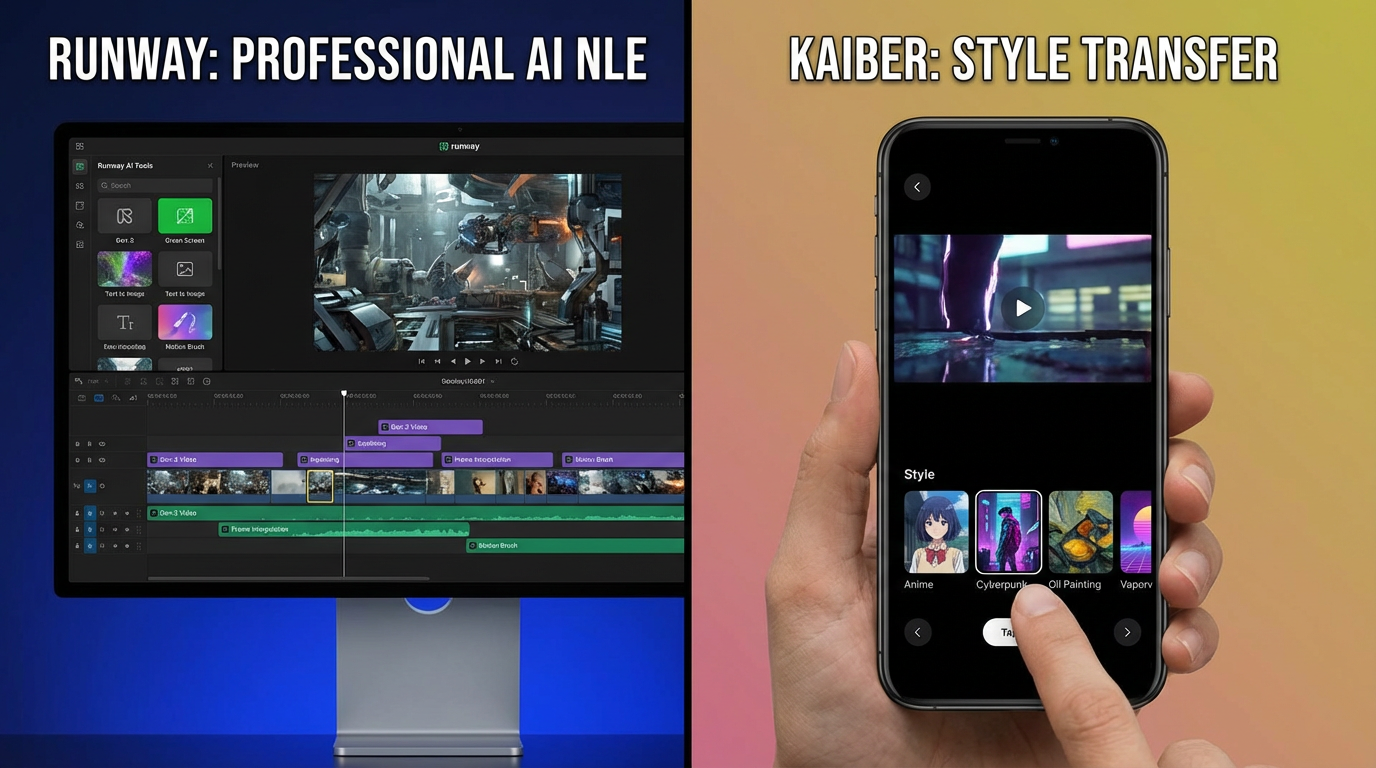
A visual showing a complex, multi-track video editing timeline with AI tools integrated (Runway) next to a simple, single-purpose interface focused on style selection (Kaiber). The Runway side should look like a professional NLE, and the Kaiber side should look like a simple mobile app screen.
2. Output Quality and Aesthetic: Photorealism vs. Psychedelia
The aesthetic output is the most immediate differentiator when comparing Runway vs Kaiber.
Runway: The Pursuit of Reality
Runway’s Gen-3 model represents the pinnacle of accessible photorealistic AI video generation.
- High Fidelity: Runway’s output is characterized by its sharp detail, accurate lighting, and impressive temporal consistency. It is designed to mimic the look of professional camera equipment, making it a powerful tool for creating realistic backgrounds, props, or even entire scenes.
- Control over Realism: The platform offers advanced controls for camera movement, depth of field, and aspect ratio, allowing users to fine-tune the realism of the generated footage to match their existing live-action shots.
- The Future of VFX: Runway is increasingly seen as a tool for visual effects, capable of generating complex shots that would traditionally require expensive CGI or green screen work.
Kaiber: The Embrace of Artistry
Kaiber’s strength lies in its ability to generate highly stylized, artistic, and often abstract video content.
- Style-Driven: Kaiber’s models are trained to apply dramatic, transformative effects. The goal is not realism but a unique, artistic interpretation of the input. This is why it is so popular for music videos, where the visuals are meant to be evocative and surreal.
- Image-to-Video Excellence: Kaiber excels at taking a single image and animating it in a chosen style, a process often referred to as "style transfer" or "motion painting." This allows artists to bring their static artwork to life with a dynamic, flowing aesthetic.
- Temporal Consistency Trade-off: While Kaiber has improved, its focus on style transformation can sometimes lead to a "wobbly" or less temporally consistent look compared to Runway’s Gen-3. However, this is often embraced as part of the artistic effect.
The image below provides a direct visual comparison of the aesthetic outputs.
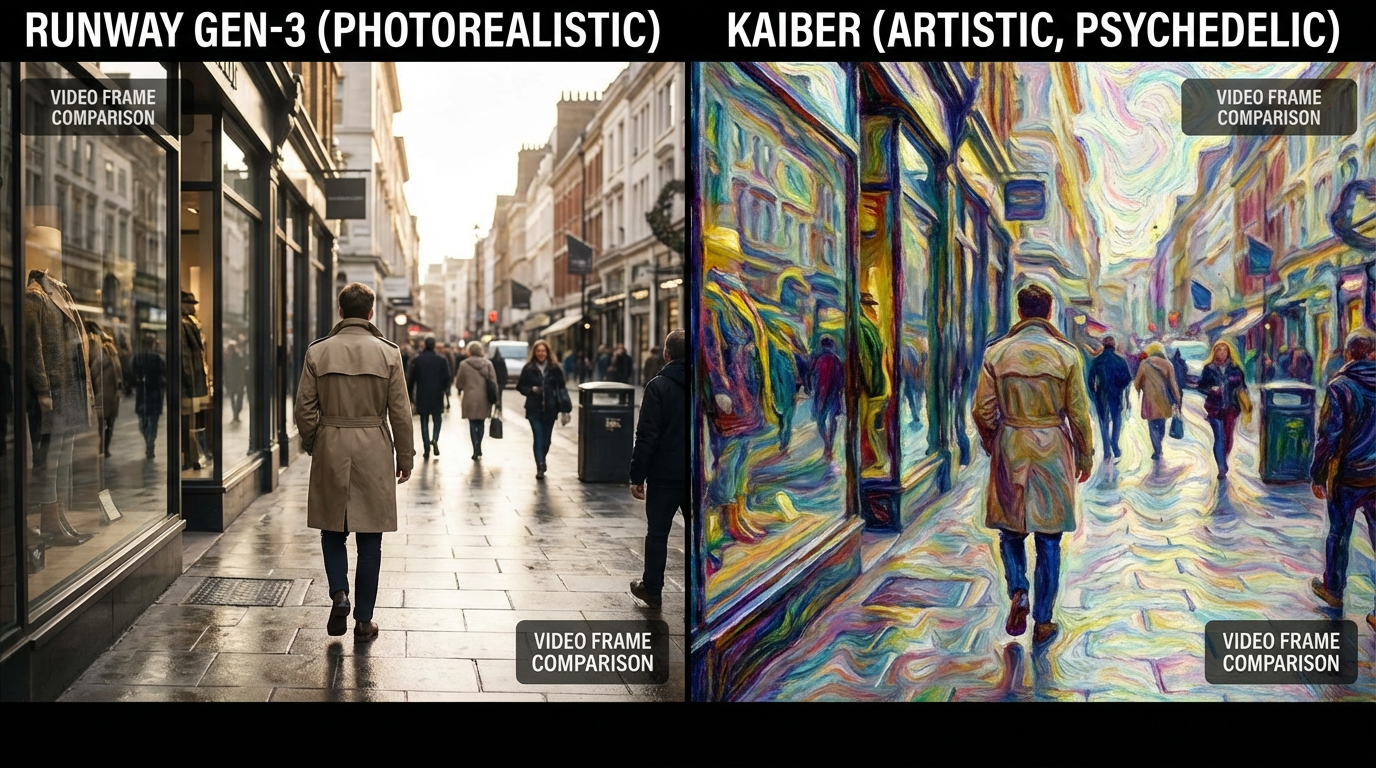
A side-by-side comparison of a video frame. The left side is a photorealistic, high-fidelity image of a person walking in a city (Runway Gen-3 style). The right side is a highly stylized, artistic, almost psychedelic, oil-painting-style video frame of the same scene (Kaiber style).
3. Control and Customization: Granular vs. Presets
The level of control a user has over the final output is a key factor for professional integration.
Runway: Granular, Keyframe-Level Control
Runway offers a deep level of control that appeals to experienced video editors and animators.
- Keyframe Animation: Runway allows users to keyframe various parameters, including camera movement, object motion, and prompt influence, giving them frame-by-frame precision over the generated clip. This is essential for integrating AI footage into a larger, controlled narrative.
- Multi-Modal Tools: Beyond generation, Runway’s suite of tools—like Motion Brush, which allows users to paint motion onto specific areas of a static image—provides a level of fine-tuning that is unmatched by simpler platforms.
- Integration with Traditional Tools: The output from Runway is designed to be easily exported and integrated into professional NLEs like Adobe Premiere Pro or DaVinci Resolve, treating the AI generation as another form of footage acquisition.
Kaiber: Simple, Preset-Driven Control
Kaiber prioritizes ease of use, offering control through simple sliders and a wide array of artistic presets.
- Style Strength Slider: Control in Kaiber is often managed through a simple slider that dictates the "strength" of the style transfer, allowing users to quickly adjust the artistic intensity without needing to understand complex parameters.
- Initial Image Influence: A major control point in Kaiber is the initial image or video input. The model uses this as a strong foundation, making the selection of the starting asset a crucial creative decision.
- Ease of Use: For a user who wants a quick, stylized result without a steep learning curve, Kaiber’s simplicity is a massive advantage. It abstracts away the technical complexity, allowing the user to focus purely on the aesthetic outcome.
The image below compares the complexity of the control interfaces.
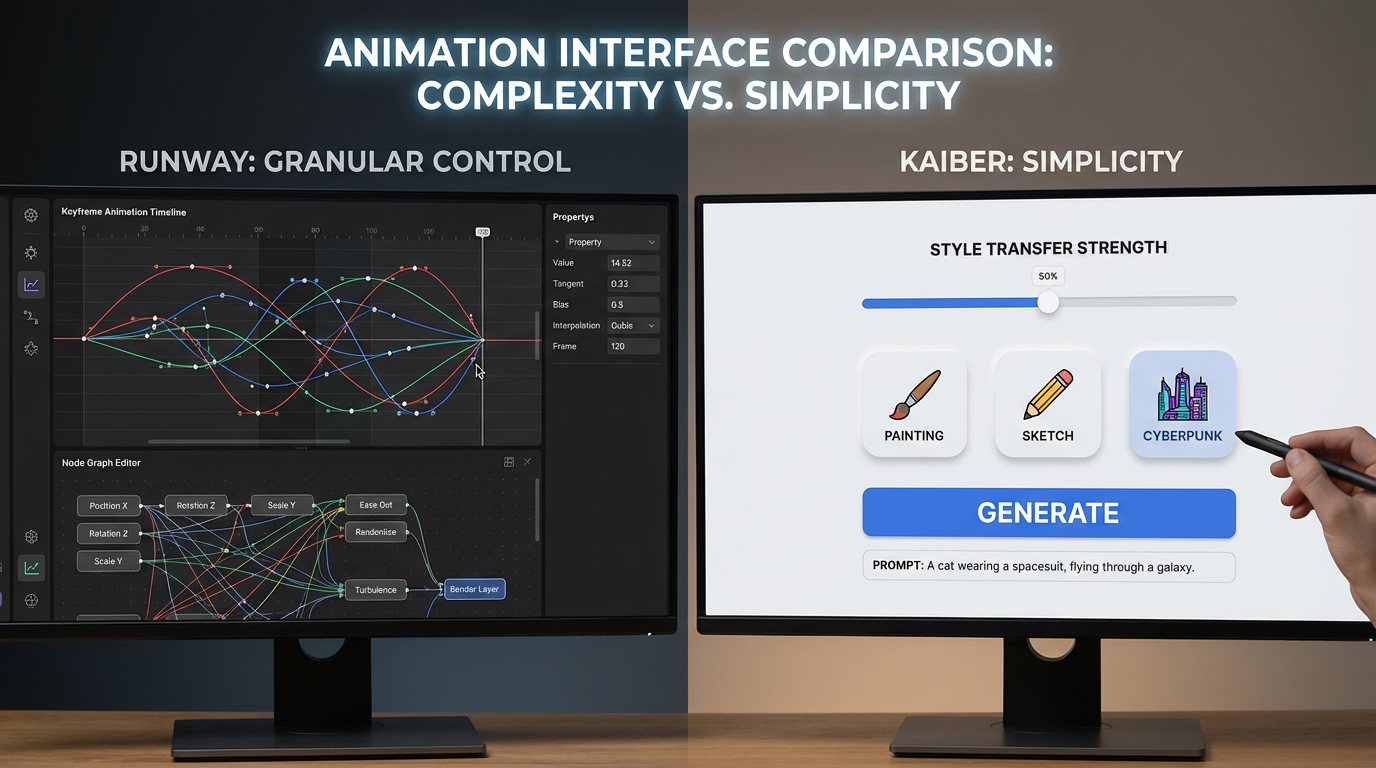
A visual showing a complex keyframe animation panel with multiple nodes and curves (Runway) next to a simple style transfer slider with a few artistic presets (Kaiber). The Runway side should emphasize granular control, and the Kaiber side should emphasize simplicity.
4. Pricing and Business Model: Subscription vs. Credits
The cost structure of Runway vs Kaiber reflects their different target audiences and computational demands.
Runway: Subscription and Integrated Credits
Runway operates on a tiered subscription model that includes a fixed amount of credits per month, with the option to purchase more.
- Predictable Cost: The subscription model offers a predictable monthly expense, which is favorable for businesses and professionals who budget for software licenses. The cost covers not just the generation but also the entire suite of editing and AI tools.
- Credit System: Runway’s credit system is designed to be a utility. Generating a minute of high-resolution video consumes a significant number of credits, reflecting the high computational cost of its advanced models.
- Free Tier: Runway offers a generous free tier that allows users to test the platform, but the credit limit is quickly reached, pushing serious users toward a paid plan.
Kaiber: Credit-Based, Pay-As-You-Go
Kaiber primarily uses a credit-based system, often with a focus on the length of the generated video.
- Variable Cost: Kaiber’s model is more pay-as-you-go, which is ideal for casual users or those with sporadic needs. A musician creating one music video every few months can purchase a small credit pack without committing to a monthly subscription.
- Focus on Video Length: The cost is directly tied to the duration and resolution of the output, making it easy for users to calculate the expense of a specific project.
- Accessibility: The lower barrier to entry, often starting with a free trial and small, affordable credit packs, makes Kaiber highly accessible to students, hobbyists, and independent artists.
The image below illustrates the difference in pricing models.
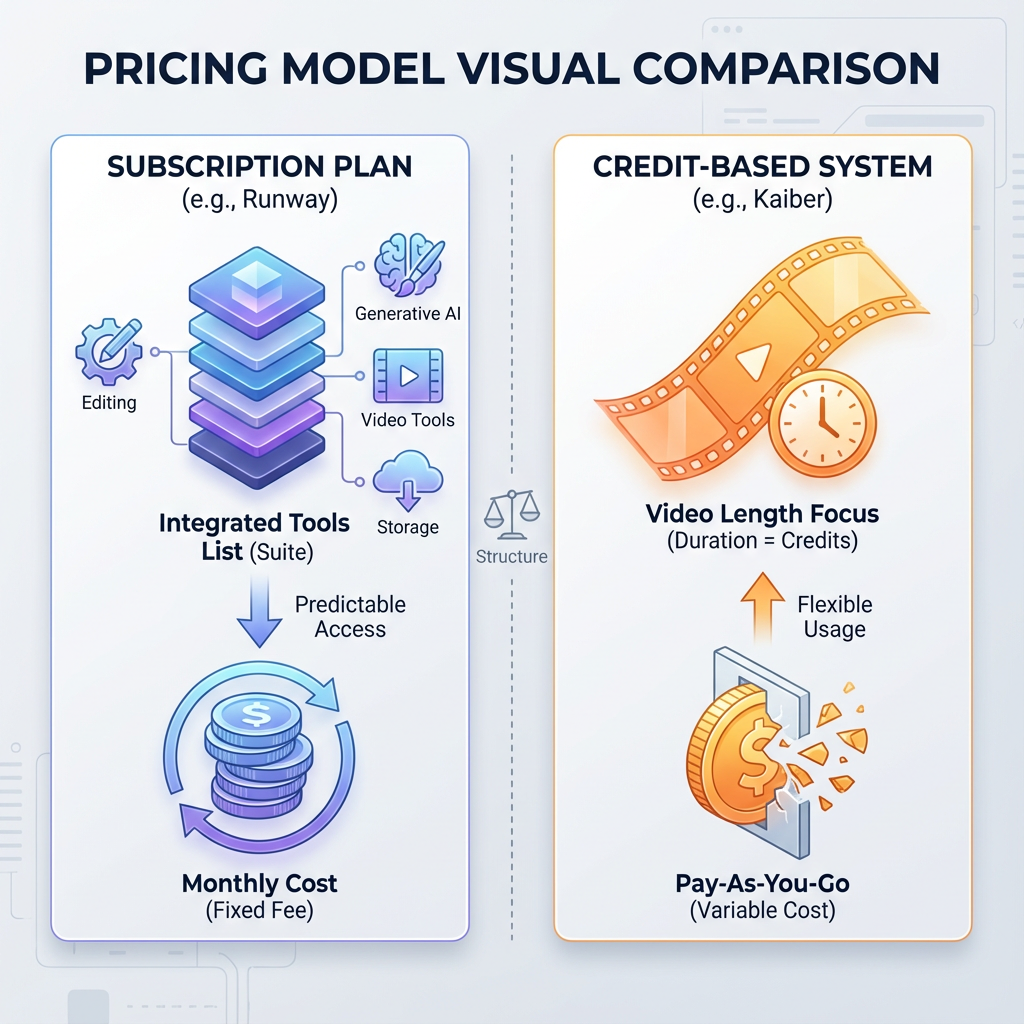
A visual comparing a detailed subscription plan with a list of integrated tools and monthly cost (Runway) and a simple credit-based system with a focus on video length and pay-as-you-go (Kaiber). Use abstract icons for money and features.
5. Target Audience and Use Cases
The choice between Runway vs Kaiber ultimately comes down to the user's primary goal.
Runway Use Cases
Runway is the clear choice for professional, high-stakes video production.
- VFX and Film: Generating realistic backgrounds, replacing green screens, creating complex camera moves, and adding visual effects to live-action footage.
- Advertising and Marketing: Creating high-fidelity product visualizations and cinematic commercials.
- Prototyping: Rapidly generating realistic storyboards and animatics for film production.
Kaiber Use Cases
Kaiber is the specialist for artistic and social media content.
- Music Videos: Transforming band footage or abstract concepts into stylized, dynamic music videos. Kaiber has been used by major artists for this purpose 1.
- Social Media Content: Quickly generating eye-catching, short-form videos with unique artistic filters for platforms like TikTok and Instagram.
- Artistic Exploration: Experimenting with different artistic styles and bringing static artwork to life with motion.
The image below compares the target audiences.
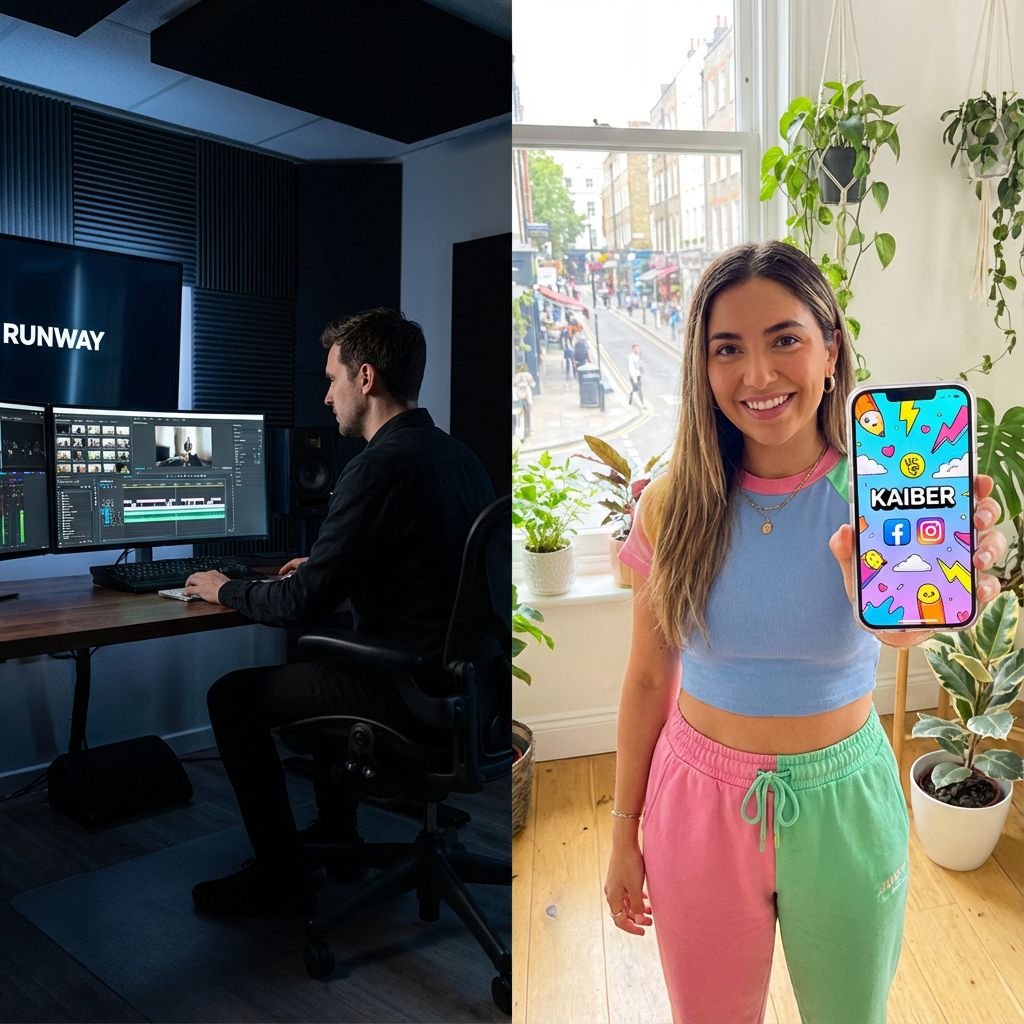
A split image showing a professional film editor in a dark studio with multiple monitors (Runway) and a social media content creator smiling while using a phone with a bright, colorful interface (Kaiber).
Conclusion: Which AI Video Generator Reigns Supreme?
The question of which platform is "better" is entirely dependent on the user's needs. Neither platform is objectively superior; they are simply designed for different jobs.
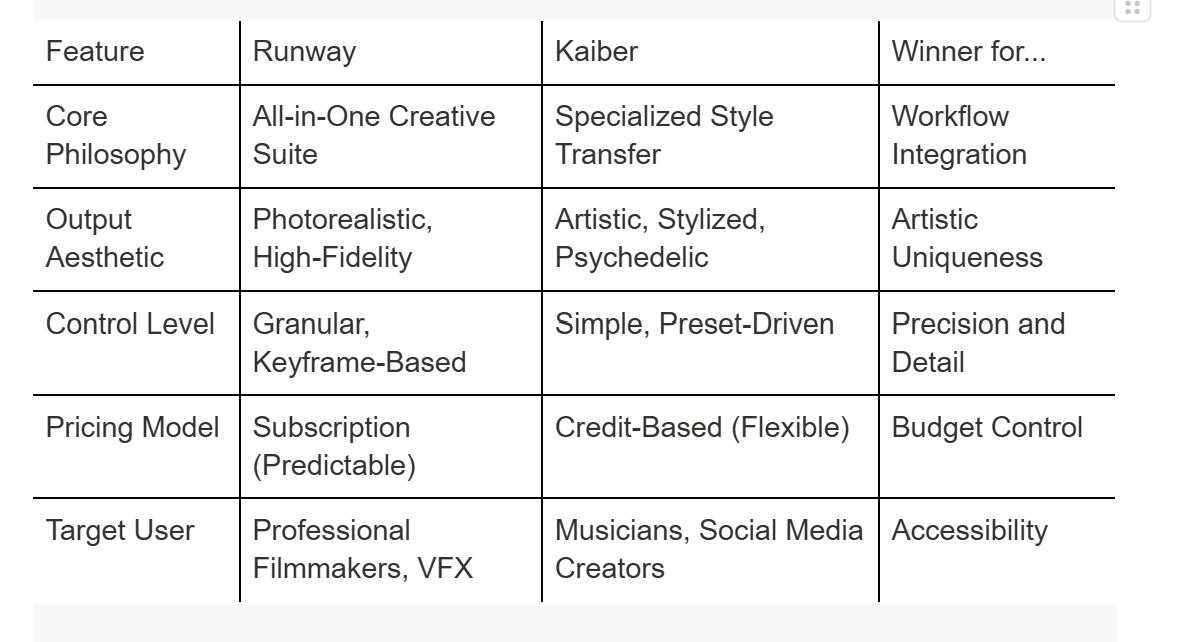
For the professional filmmaker or VFX artist who requires unprecedented realism, long-form coherence, and technical precision, Runway is the current and likely future standard. Its ability to simulate the real world with such fidelity makes it an indispensable tool for pre-visualization and complex scene generation.
However, if your goal is to create visually stunning, highly stylized, and unique content quickly and affordably, particularly for music or social media, Kaiber is the unmatched specialist. Its focus on artistic transformation and its flexible credit system make it the perfect tool for the independent creator.
The competition between Runway vs Kaiber is a healthy one, driving innovation in both the professional and artistic spheres of AI video generation. Creators are fortunate to have such powerful, yet distinct, options available today.
6. Feature Deep Dive: Generative Tools and Future Roadmap
Beyond the core video generation capabilities, the supplementary AI tools offered by each platform further define their utility and target market.
Runway's Generative Ecosystem
Runway's strength lies in its ecosystem of over 30 "AI Magic Tools," which are designed to enhance and manipulate existing footage, not just generate new clips.
- Generative Fill and Inpainting: This is a killer feature for professional VFX. Users can paint over an object in a video and use a text prompt to replace it with something else, or simply remove it entirely (Inpainting). This level of post-production manipulation is crucial for film and advertising workflows.
- Motion Brush: This tool allows users to selectively animate parts of a static image, giving them precise control over which elements move and how. This bridges the gap between still image generation and full video generation.
- Future Roadmap: Runway is clearly focused on achieving Artificial General Intelligence (AGI) for video. Their roadmap emphasizes longer, more complex, and more controllable video generation, pushing the boundaries of photorealism and simulation. They are aiming to be the foundational layer for all future video production.
Kaiber's Style-Focused Toolkit
Kaiber's additional features are all centered around enhancing the artistic transformation process.
- Evolution Feature: Kaiber's "Evolution" feature allows users to create a seamless, narrative-driven transition between two different styles or concepts. This is highly valuable for music videos where a visual journey or transformation is desired.
- Audio Reactivity: A key feature for Kaiber is its ability to use audio input to influence the visual generation, making it a truly reactive tool for music visualization. The visual changes and pacing can be directly tied to the beat and rhythm of a song.
- Future Roadmap: Kaiber's roadmap is likely focused on expanding its library of unique, high-quality artistic models and improving the temporal consistency of its style transfer. They are aiming to be the world's best tool for artistic video transformation, rather than a general-purpose NLE.
7. The Verdict: Choosing Your Creative Partner
The choice between Runway vs Kaiber is a strategic decision that should be based on your primary creative output and budget.
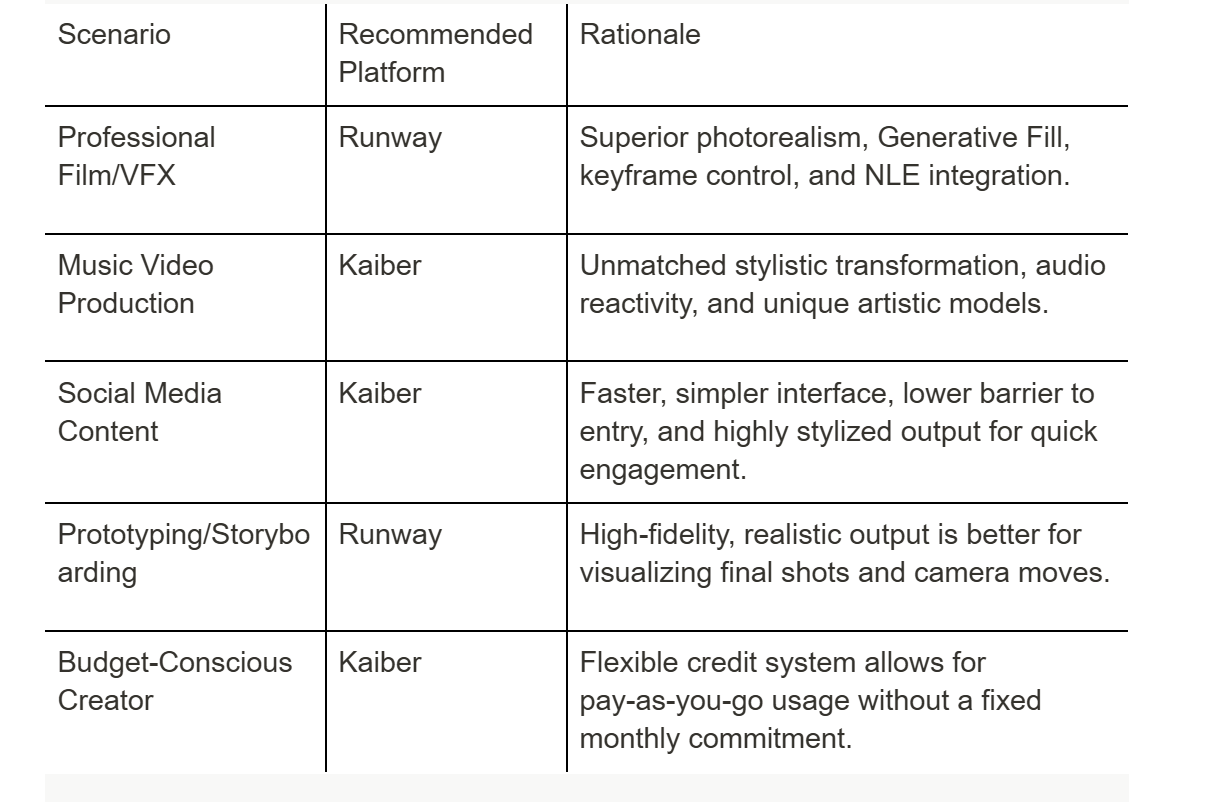
Ultimately, the competition between Runway vs Kaiber is a boon for all creators. Runway is pushing the limits of realism and professional integration, while Kaiber is democratizing artistic expression and making stunning visual effects accessible to everyone. The best tool is the one that fits your hand, your project, and your budget.