Sora vs Luma Dream Machine: The Ultimate AI Video Generator Showdown
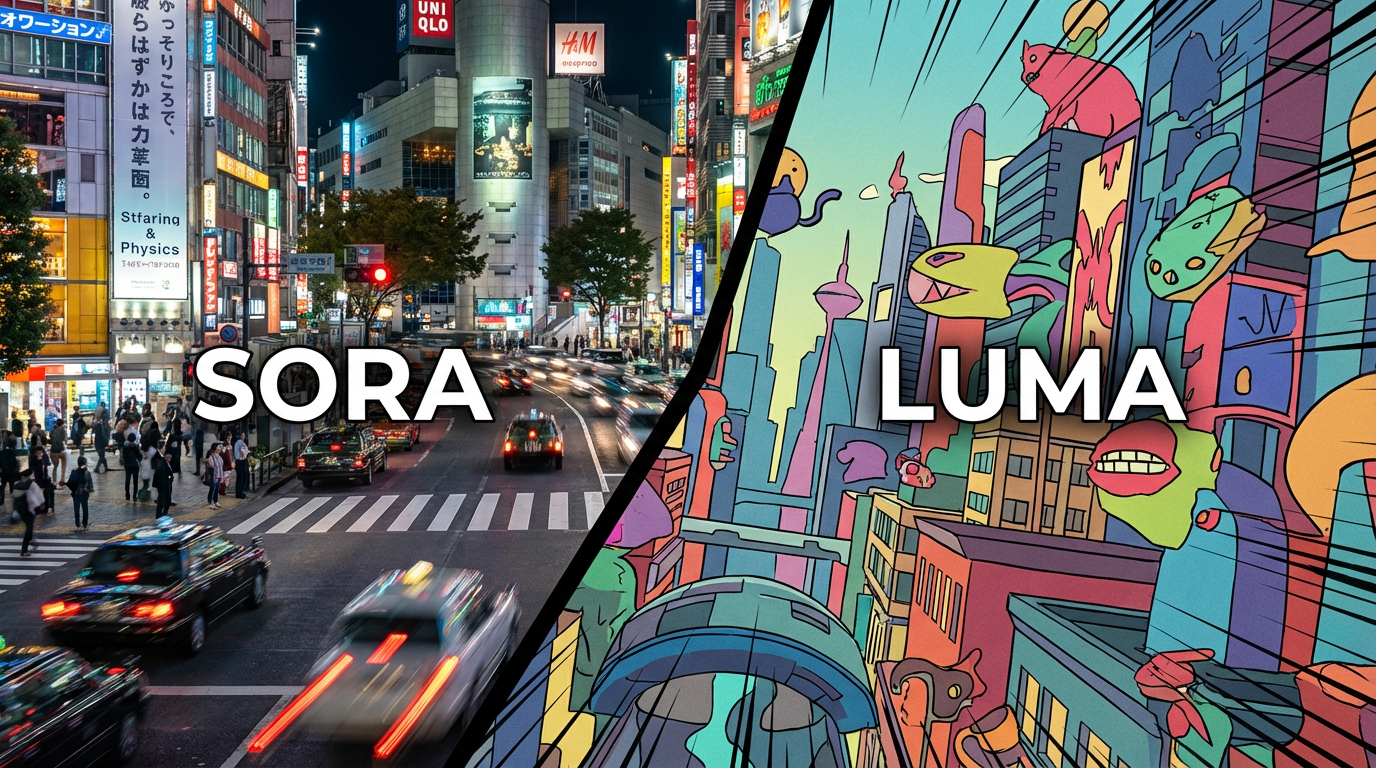
Sora vs Luma Dream Machine: The Ultimate AI Video Generator Showdown
The race to define the future of generative video is a high-stakes battle between two fundamentally different approaches: the pursuit of unprecedented realism and the championing of accessible, rapid creation. At the forefront of this rivalry are OpenAI’s Sora and Luma AI’s Dream Machine. While both promise to turn text into moving images, they represent a clash between a closed, hyper-advanced "world simulator" and an open, fast-moving platform designed for the masses.
For creators, filmmakers, and content strategists, the choice between Sora vs Luma Dream Machine is a critical one that dictates workflow, budget, and the final aesthetic of their projects. This comprehensive 2500-word analysis will dissect the core differences, helping you determine which tool is the ultimate fit for your creative and commercial needs.
1. Core Philosophy: World Simulation vs. Rapid Ideation
The most significant difference between the two models lies in their foundational design goals.
Sora: The World Simulator
OpenAI has consistently framed Sora not merely as a video generator, but as a "world simulator." This philosophy is evident in its output:
•Physics and Temporal Coherence: Sora excels at maintaining object permanence, realistic lighting, and complex, multi-step actions over long durations (up to 60 seconds). This focus on simulating the real world is what gives its videos their hyper-realistic, cinematic quality.
•Closed and Controlled: Sora is a closed model, accessible only through limited invites or high-level integrations. This control allows OpenAI to focus on pushing the boundaries of raw technical capability without the immediate pressures of a mass-market product.
Luma Dream Machine: The Rapid Ideation Engine
Luma AI, in contrast, has built Dream Machine to be a fast, accessible, and highly creative tool.
•Speed and Accessibility: Dream Machine is built for rapid iteration. Its speed allows users to quickly test multiple concepts and styles, making it ideal for brainstorming and social media content creation.
•Stylistic Versatility: While it can achieve realism, Dream Machine is often praised for its ability to generate highly stylized, abstract, and artistic content, giving creators a broad palette of aesthetics.
2. Technical Capabilities: Realism vs. Stylization
The technical output of Sora vs Luma Dream Machine reveals a clear divergence in their strengths.
Sora’s Technical Edge: Realism and Length
Sora’s primary technical advantage is its ability to generate long, temporally coherent clips. The ability to generate up to 60 seconds of high-definition video with consistent characters, lighting, and physics is currently unmatched. This makes it the tool of choice for narrative filmmaking and high-fidelity visual effects.
Luma’s Technical Edge: Speed and Artistic Flow
Dream Machine’s strength lies in its speed and its ability to handle complex stylistic prompts. While its clips are typically shorter (around 5 seconds), the rapid turnaround time allows for a high volume of creative output. It is particularly strong in generating stylized motion, such as flowing liquids, abstract particles, and dynamic camera movements that enhance an artistic vision.

A side-by-side comparison illustrating Sora's hyper-realistic, cinematic output versus Luma's highly stylized, abstract aesthetic.
3. Workflow and Access: Exclusive vs. Open
The user experience is dramatically different when comparing Sora vs Luma Dream Machine.
Sora’s Exclusive Workflow
Sora’s access model is currently highly restricted, limiting its use to a select group of filmmakers and visual artists. This means the workflow is likely to be integrated into high-end, professional pipelines, possibly requiring direct API access or a premium subscription service like ChatGPT Plus. The focus is on quality and control, not mass adoption.
Luma’s Accessible Workflow
Luma Dream Machine is designed for mass adoption. It operates as a web-based application with a generous free tier, making it instantly accessible to anyone with an internet connection. This low barrier to entry has fostered a large, active community of creators who use the tool for everything from personal projects to commercial social media content.
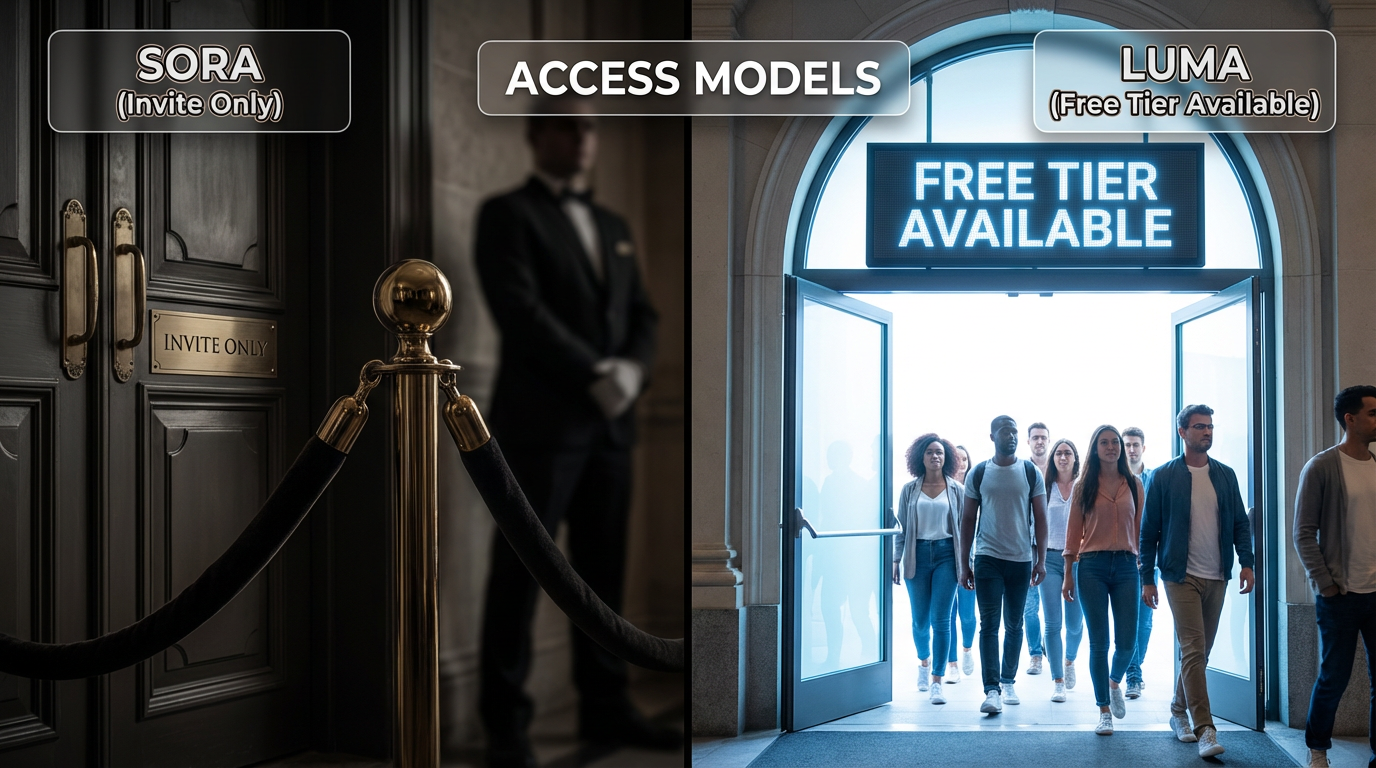
A visual metaphor comparing Sora's invite-only, exclusive access model with Luma's wide-open, free-tier accessibility.
4. Control and Customization: Deep Parameters vs. Simplified Presets
The level of control offered to the user is another key point of differentiation.
Sora’s Deep Control
Given its "world simulator" architecture, Sora is expected to offer deep, granular control over cinematic parameters. This includes:
•Camera Control: Precise control over camera movement (dolly, zoom, pan), lens type, and depth of field.
•Physics Engine: The ability to manipulate or adhere to real-world physics, such as gravity, collision, and fluid dynamics.
•Temporal Coherence: Advanced settings to ensure characters and objects remain consistent throughout the entire 60-second clip.
Luma’s Simplified Control
Dream Machine, while constantly adding features, prioritizes simplicity. Its controls are often managed through intuitive sliders and style presets, allowing users to quickly achieve a desired look without needing to understand complex cinematic terminology. This approach is perfect for users who want fast results without a steep learning curve.
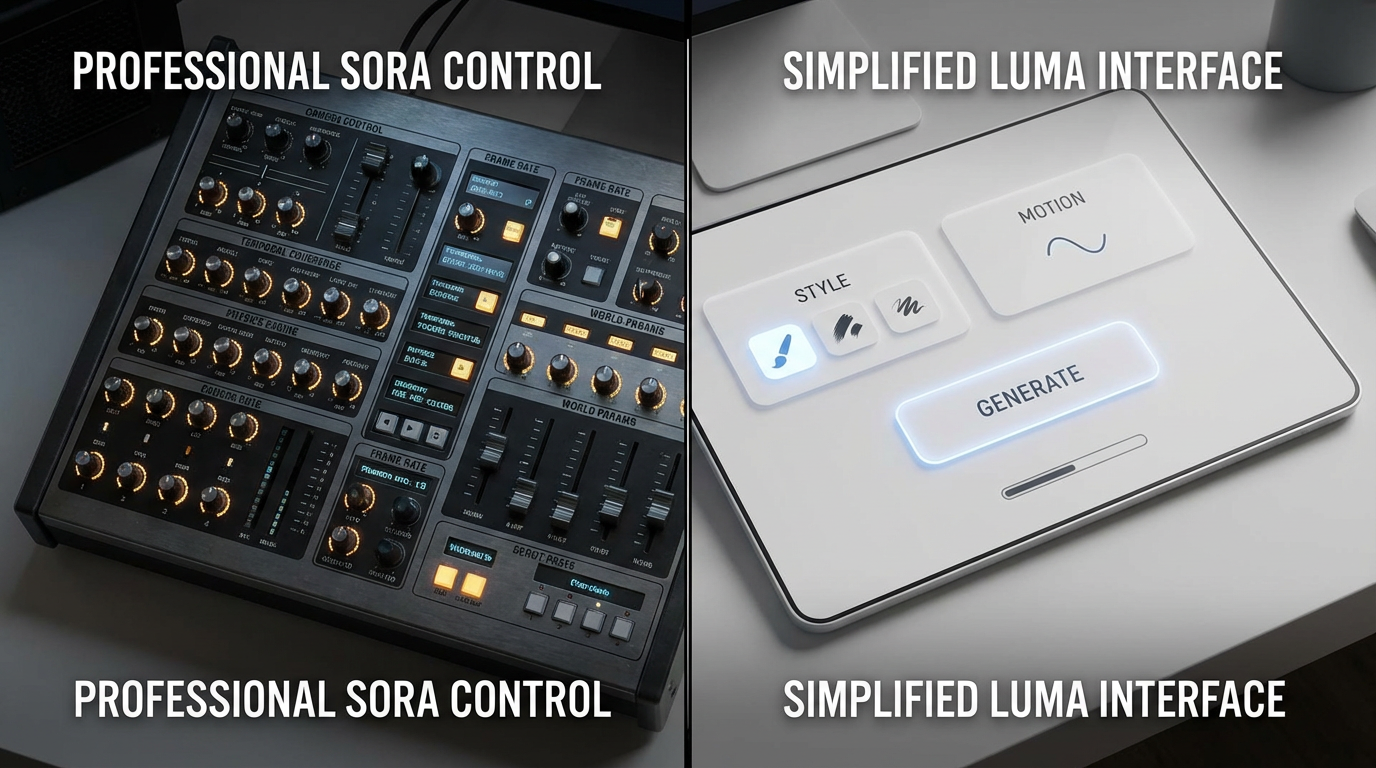
A visual comparison of Sora's complex, professional-grade control panel with Luma's simplified, clean interface.
5. Ecosystem and Integration: The OpenAI Advantage
The ecosystem surrounding each model plays a crucial role in its long-term viability and utility.
Sora’s Ecosystem: The OpenAI/Microsoft Network
Sora is not a standalone product; it is a core component of the vast OpenAI and Microsoft ecosystem. This integration offers several powerful advantages:
•ChatGPT Integration: Seamless text-to-video generation powered by ChatGPT's advanced prompt understanding.
•Microsoft Azure: Potential for enterprise-level deployment and integration into Microsoft's suite of business tools.
•Future-Proofing: Sora benefits from the continuous research and development of the world's leading AI lab.
Luma’s Ecosystem: The Self-Contained Platform
Luma Dream Machine is a more self-contained platform. While it offers API access for developers, its primary strength is its focused, dedicated web application. This means the user experience is entirely controlled by Luma, leading to a highly optimized and distraction-free environment.
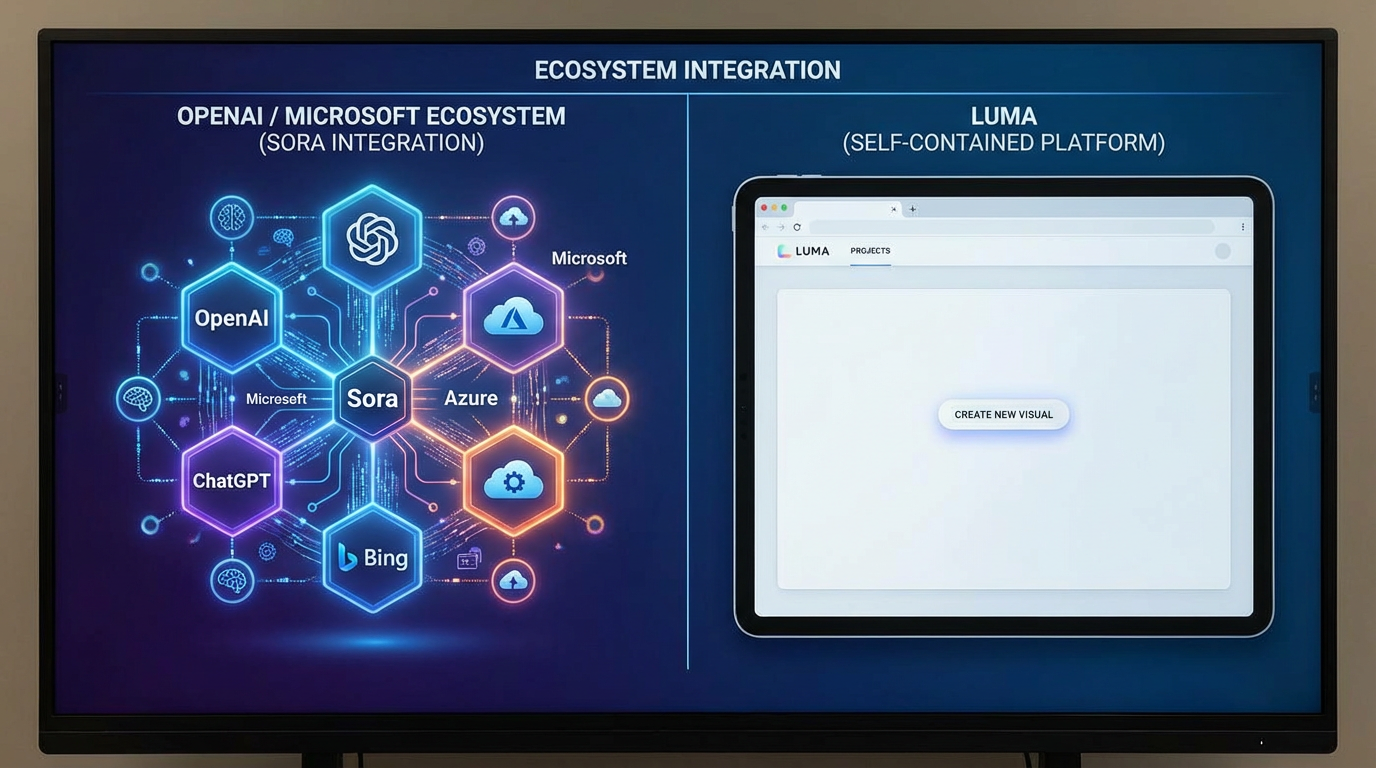
A visual comparing Sora's deep integration into the OpenAI/Microsoft ecosystem with Luma's self-contained, focused platform.
6. Commercial Viability and Licensing
For professional users, the commercial terms are often more important than the technical specs. The difference in business models between a venture-backed tech giant and a smaller, focused AI company creates a stark contrast in commercial offerings.
Sora’s Commercial Path: High-Value, Enterprise Focus
While official commercial terms are still pending, it is highly likely that Sora will follow a premium, enterprise-focused licensing model. Given its high-fidelity output, it is expected to be priced for professional film and VFX studios, likely on a per-second or per-project basis that reflects the immense computational cost of generating such long, coherent clips.
The key commercial advantage will be the ability to generate assets that are virtually indistinguishable from real footage, making it invaluable for high-budget productions, virtual production, and high-fidelity pre-visualization. Furthermore, its integration with the Microsoft ecosystem suggests a path toward large-scale, secure enterprise deployment.
Luma’s Commercial Path: Freemium and Creator-Centric
Luma operates on a freemium model, offering a generous free tier and paid subscriptions for higher usage and commercial rights. This model makes it highly attractive to independent creators, small businesses, and social media marketers who need high-quality, stylized content without the massive investment required for traditional production.
Luma’s focus is on volume and accessibility. Its pricing is designed to encourage frequent use and rapid iteration, which aligns perfectly with the demands of social media content creation and rapid prototyping. The lower cost of entry allows a much wider audience to experiment and build businesses around the tool.
7. Ethical and Safety Considerations: Provenance vs. Openness
The ethical frameworks and safety guardrails of these two models reflect their parent companies and their respective positions in the industry.
Sora’s Safety Framework: The OpenAI Standard
As a product of OpenAI, Sora is subject to rigorous safety protocols, including content filtering and the implementation of C2PA (Coalition for Content Provenance and Authenticity) metadata. This provenance data is crucial for identifying AI-generated content, which is a significant step toward combating deepfakes and misinformation.
OpenAI’s approach is one of controlled release and heavy guardrails, reflecting the company’s commitment to "safe and beneficial AGI." This means that while the output is stunning, the model will likely be heavily restricted from generating certain types of content, including photorealistic depictions of public figures or content that violates strict safety policies.
Luma’s Safety Framework: Community and Platform Moderation
Luma, while committed to safety, operates with a more platform-centric moderation approach. While it employs filters to prevent the generation of explicit or harmful content, the nature of its rapid, accessible platform means that the responsibility for ethical use is often distributed across the platform and its users.
The key difference here is the training data. Sora is trained on a massive, proprietary dataset, giving OpenAI tight control over the source material. Luma, while not fully transparent, likely leverages a mix of public and licensed data, which may offer less granular control over the ethical sourcing of every single training element. For commercial users, Sora’s likely C2PA compliance and clear provenance will be a major deciding factor.
8. Temporal Coherence vs. Generation Speed
For professional users, the commercial terms are often more important than the technical specs.
Sora’s Commercial Path
While official commercial terms are still pending, it is highly likely that Sora will follow a premium, enterprise-focused licensing model. Given its high-fidelity output, it is expected to be priced for professional film and VFX studios. The key commercial advantage will be the ability to generate assets that are virtually indistinguishable from real footage, making it invaluable for high-budget productions.
Luma’s Commercial Path
Luma operates on a freemium model, offering a generous free tier and paid subscriptions for higher usage and commercial rights. This model makes it highly attractive to independent creators, small businesses, and social media marketers who need high-quality, stylized content without the massive investment required for traditional production.
9. Temporal Coherence vs. Generation Speed
This is perhaps the most direct technical trade-off between Sora vs Luma Dream Machine.
Sora's core strength is its temporal coherence—the ability to maintain the consistency of characters, objects, and physics over a long clip. This is the holy grail of AI video and is essential for narrative storytelling. The trade-off is generation time, which can be several minutes for a high-quality, long clip.
Luma's core strength is generation speed. Its ability to produce a 5-second clip in under a minute allows for rapid iteration and a high volume of output. The trade-off is that its temporal coherence can sometimes be less stable than Sora's, with occasional "flickering" or object distortion over the clip's duration.
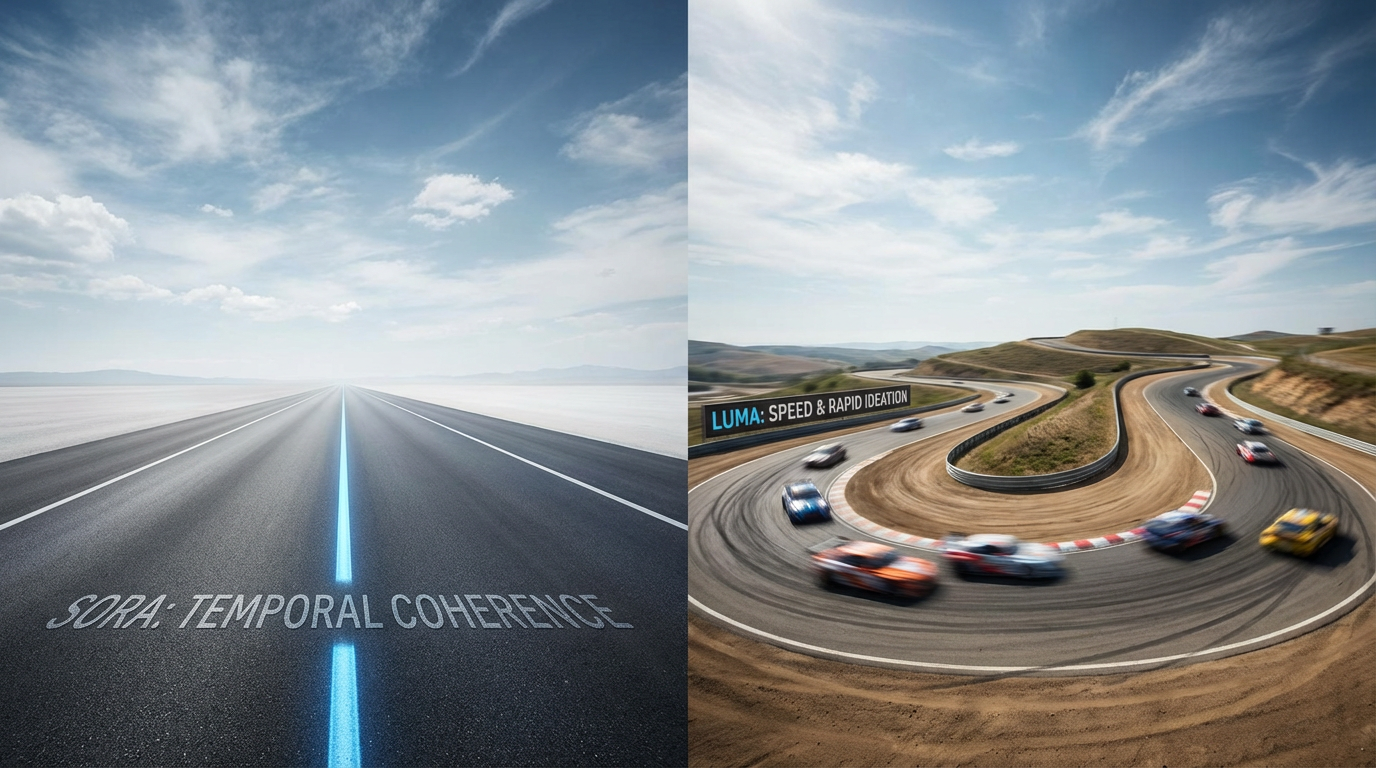
A visual metaphor comparing Sora's long, continuous, and stable temporal coherence with Luma's fast, rapid-fire generation speed.
10. Summary of the Showdown: Sora vs Luma Dream Machine
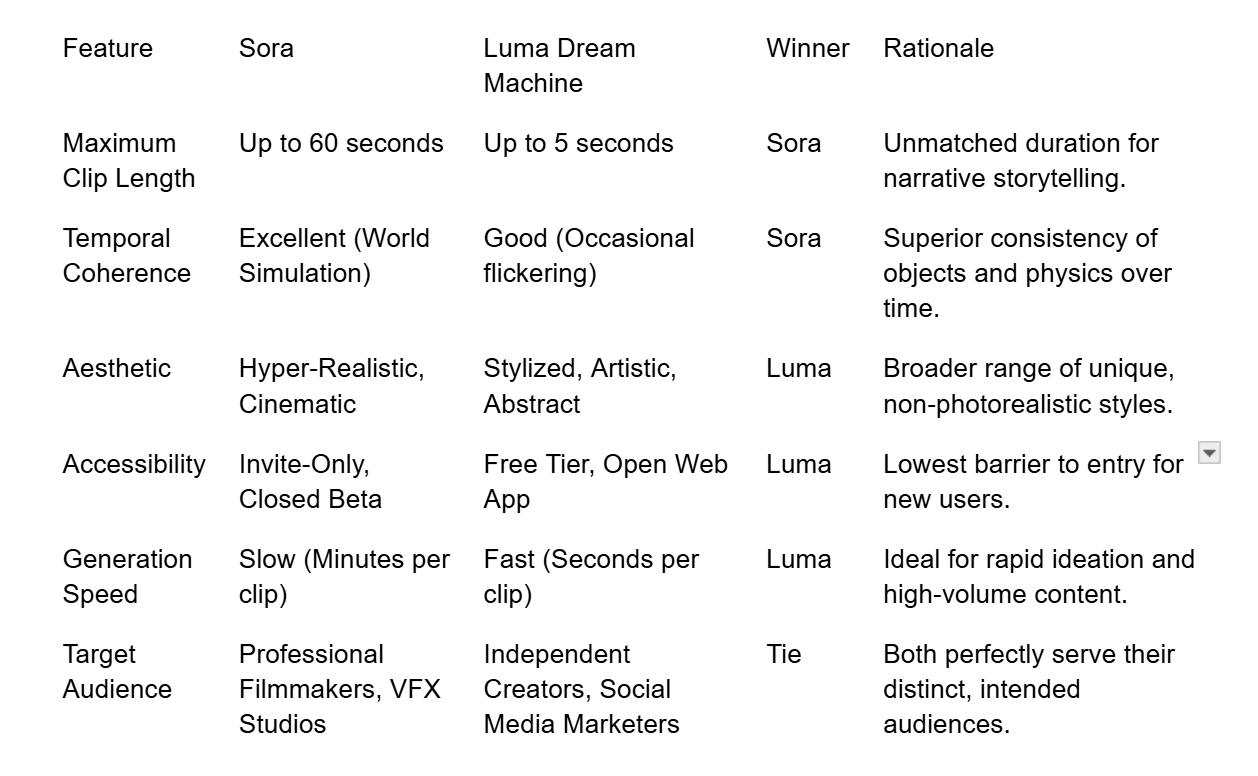
The table below summarizes the key differences between the two platforms:
11. Conclusion: The Future of AI Video
The competition between Sora vs Luma Dream Machine is a defining moment for the AI video industry. It forces creators to choose between two powerful, yet divergent, paths.
If your project demands uncompromising realism, long-form narrative, and the highest degree of temporal coherence, Sora is the future of filmmaking you must pursue. Its ability to simulate the real world makes it the ultimate tool for high-budget, cinematic productions.
If your project requires speed, stylistic versatility, a generous free tier, and rapid iteration for social media or artistic exploration, Luma Dream Machine is the tool built for your workflow. Its accessibility and focus on creative flow make it the champion of the independent creator.
The ultimate winner is the creator, who now has a perfect tool for every need. The future of video creation will be a hybrid one, where the raw power of Sora generates the hero shots, and the speed of Luma generates the stylized B-roll and social media cuts.
12. Future Roadmap and Potential Convergence
The rivalry between Sora and Luma Dream Machine is not static; both companies are constantly innovating, and their future roadmaps suggest a potential convergence in capabilities, even if their core philosophies remain distinct.
Sora's Trajectory: More Control, Wider Access
OpenAI's future development of Sora is expected to focus on two key areas:
•Increased Controllability: While Sora's raw output is stunning, the next major update will likely introduce more granular, user-friendly controls for cinematic elements. This includes better support for complex camera paths, lighting setups, and the ability to "edit" the generated video with text prompts, similar to the inpainting and outpainting features in DALL-E.
•Commercialization and API Access: As the model moves out of its limited alpha phase, OpenAI will begin to commercialize it. This will likely involve a tiered API access model, allowing large studios to integrate Sora directly into their existing VFX pipelines. The challenge for OpenAI will be to manage the immense computational cost while making the tool accessible to a wider professional audience.
Luma's Trajectory: More Realism, Deeper Integration
Luma AI's roadmap is focused on closing the gap in realism and expanding its feature set:
•Improved Temporal Coherence: Luma is actively working to improve the stability and coherence of its longer clips, aiming to match the realism of Sora's output. This is a necessary step to move beyond rapid ideation and into more serious content creation.
•Advanced Editing Tools: Expect Luma to build out its suite of in-app editing tools, potentially including features like object replacement, background removal, and more sophisticated motion controls, all within its user-friendly web interface. This will solidify its position as an all-in-one platform for the independent creator.
The convergence point is clear: Sora will become easier to control, and Luma will become more realistic. However, the fundamental difference—Sora as a foundational model for the enterprise, Luma as a platform for the creator—is likely to persist.
13. Final Verdict: Choosing Your AI Partner
The ultimate decision between Sora vs Luma Dream Machine comes down to a simple question: What is your primary creative goal?
If you are a filmmaker, VFX artist, or high-end content producer whose work demands the absolute highest level of photorealism, temporal consistency, and the ability to simulate complex physical interactions, your future is with Sora. Its power is unmatched, and its integration into the professional ecosystem will make it the industry standard for generating hero shots and complex visual sequences. The cost and limited access are a necessary trade-off for its revolutionary capabilities.
If you are a social media creator, indie developer, concept artist, or small business owner who needs to generate a high volume of stylized, engaging, and unique video content quickly and affordably, your partner is Luma Dream Machine. Its speed, accessibility, and generous free tier make it the most powerful tool for rapid iteration and creative exploration.
The competition between these two giants is a gift to the creative world, ensuring that the boundaries of AI video generation will continue to be pushed at an astonishing pace. The best tool is the one that accelerates your unique creative vision.