Stable Diffusion vs Dream by Wombo: The Ultimate AI Image Generator Showdown
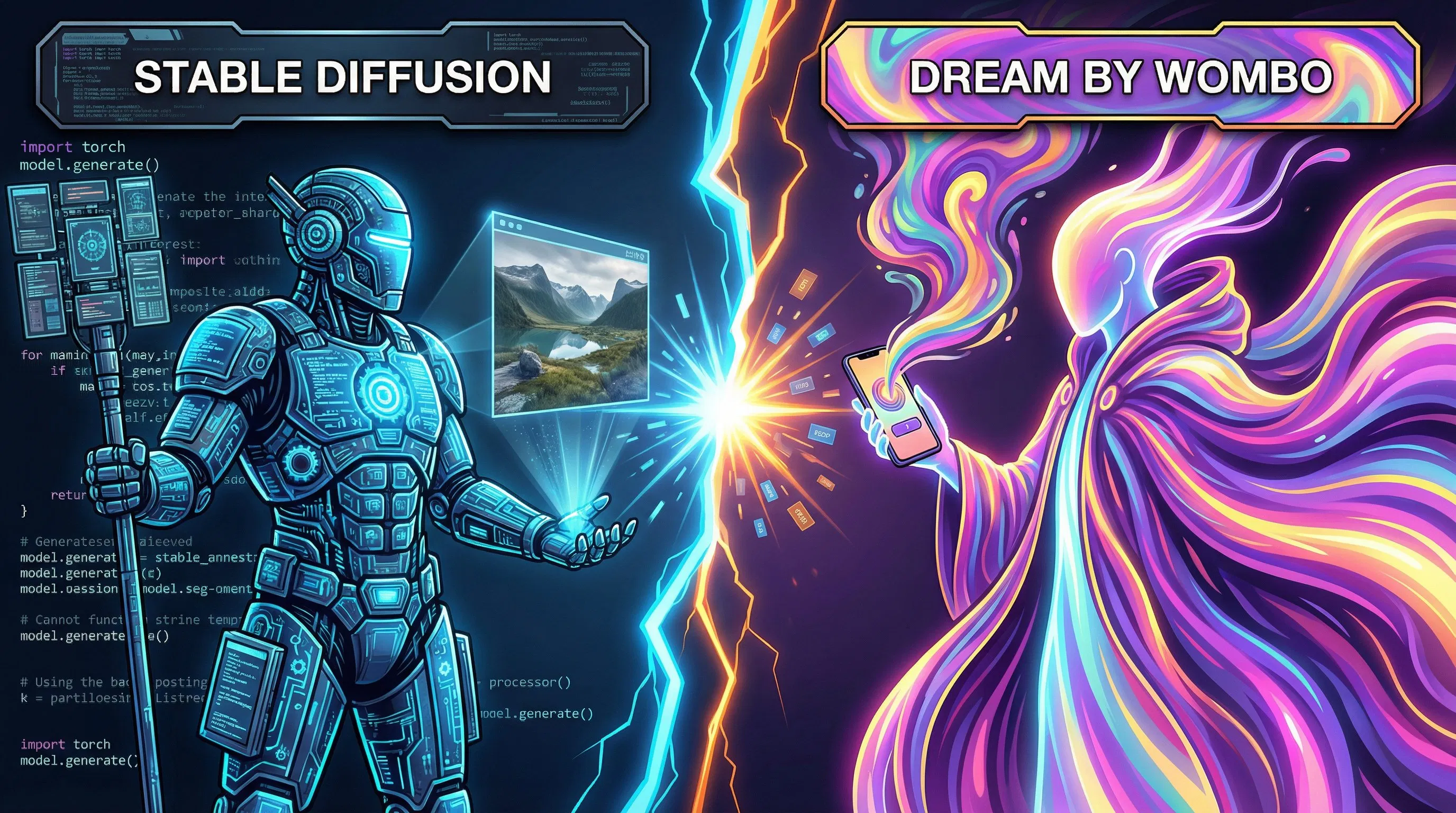
The landscape of AI image generation is broadly divided into two major camps: the open-source, highly customizable ecosystem championed by Stable Diffusion, and the proprietary, user-friendly mobile experience offered by Dream by Wombo. This dichotomy represents a fundamental choice for creators: do you prioritize ultimate control, flexibility, and a zero-cost entry barrier, or do you value speed, simplicity, and a polished, mobile-first interface?
The debate of Stable Diffusion vs Dream by Wombo is not merely a comparison of two apps; it is a look at two contrasting philosophies of AI art creation. Stable Diffusion is the powerful, complex engine for the dedicated enthusiast and professional, while Dream by Wombo is the accessible, instant gratification tool for the casual user and mobile artist. This comprehensive 2500-word analysis will dissect the core differences, compare their feature sets, and provide a definitive guide to help you choose the right tool for your specific needs in 2025.
1. Core Philosophy: Open-Source Freedom vs. Proprietary Simplicity
The foundational difference between these two platforms dictates every other feature and user experience element.
Stable Diffusion: The Open-Source Powerhouse
Stable Diffusion is an open-source latent diffusion model that has spawned an entire ecosystem of tools, models, and communities . Its philosophy is built on transparency, customization, and community contribution.
•Decentralized Control: The core model is freely available, allowing users to run it locally on their own hardware or through various third-party web interfaces (like Automatic1111 or ComfyUI). This decentralization means no single entity controls the development or the user's output.
•Infinite Customization: The ability to use custom checkpoints, LoRAs (Low-Rank Adaptation), and textual inversions means the model can be fine-tuned to an almost infinite degree, catering to hyper-specific artistic styles and use cases.
•Variable Cost: The cost is variable, depending on the user's setup. Running it locally is free (minus hardware and electricity), while using cloud services incurs a pay-as-you-go fee.
Dream by Wombo: The Curated Mobile Experience
Dream by Wombo is a proprietary, closed-source application that prioritizes ease of use and instant results, primarily through a mobile app .
•Centralized Simplicity: The platform is a single, unified application with a clean, intuitive interface. The user is shielded from the underlying technical complexity, making it ideal for beginners.
•Curated Styles: Instead of offering granular control, Dream by Wombo provides a curated list of artistic styles (e.g., "Vibrant," "Fantasy," "Steampunk") that users select before generating an image.
•Predictable Cost: The cost is predictable, based on a subscription model or a clear credit system, which is common for mobile applications.
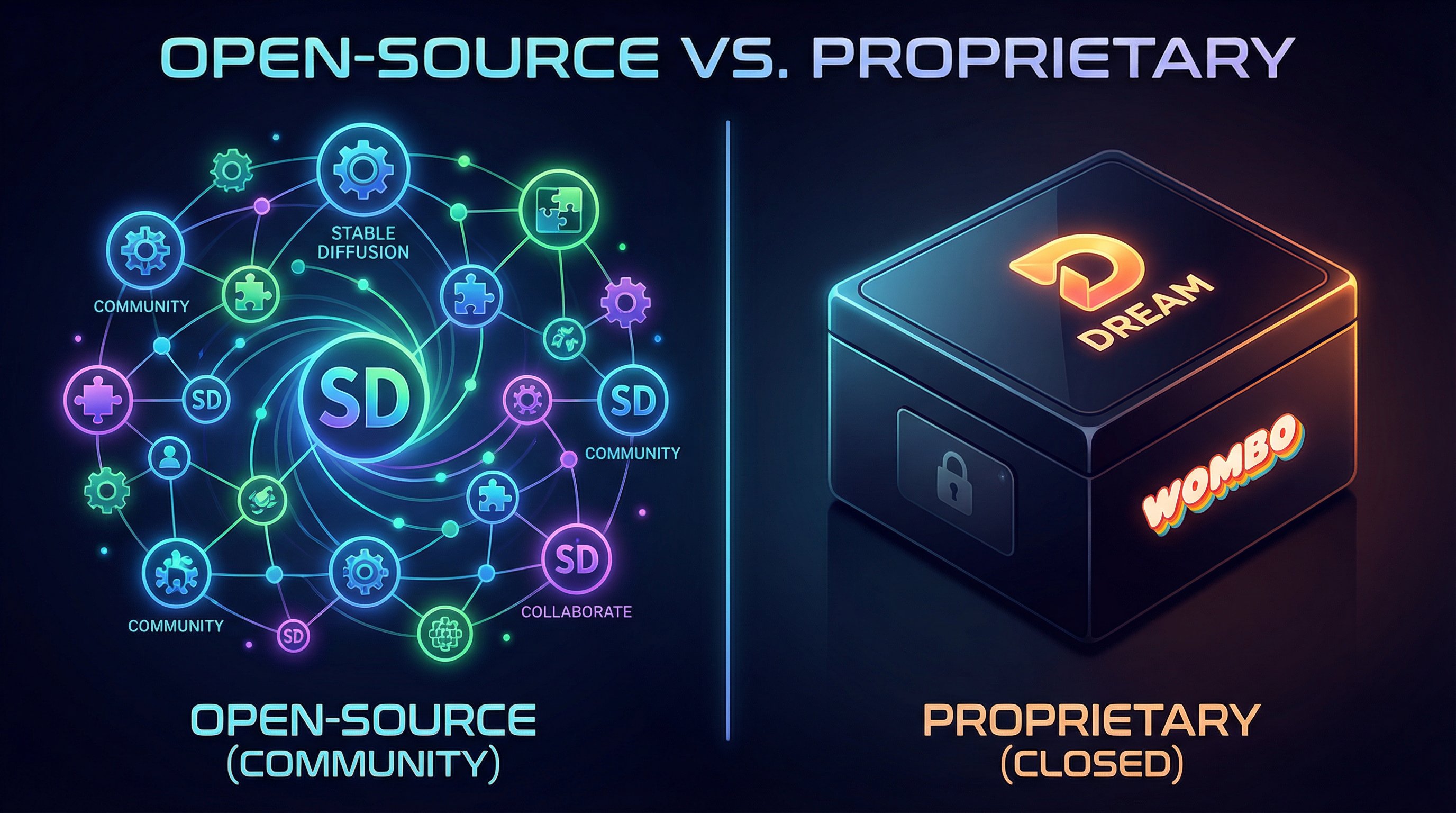
A visual metaphor for open-source vs. proprietary. On the left, a complex, interconnected network of nodes and community logos (representing Stable Diffusion's open-source nature). On the right, a sleek, closed, branded box with a single company logo (representing Dream by Wombo's proprietary nature).
2. Creative Control: Granular Parameters vs. Style Presets
The level of creative control is the most significant functional difference in the Stable Diffusion vs Dream by Wombo comparison.
Stable Diffusion: The Artist's Workbench
Stable Diffusion offers a level of granular control unmatched by most proprietary platforms. This control is essential for professionals who need to maintain consistency and precision across projects.
•Advanced Parameters: Users can directly manipulate parameters such as CFG Scale (Classifier-Free Guidance), Sampling Steps, Sampler Method, and Seed Number. These controls allow for precise replication and fine-tuning of results.
•ControlNet Integration: The integration of ControlNet allows users to impose external constraints on the generation process, such as pose, depth, canny edges, and segmentation maps. This transforms text-to-image into a powerful, controlled design tool.
•Negative Prompting: The ability to use highly detailed negative prompts is a core feature, allowing users to explicitly tell the model what not to include, leading to cleaner, more refined images.
Dream by Wombo: The Instant Art Generator
Dream by Wombo sacrifices deep control for immediate, aesthetically pleasing results.
•Style-First Approach: The primary control mechanism is the selection of a pre-defined style. The model is heavily guided by this choice, often producing highly stylized and unique images that require minimal prompt engineering.
•Limited Parameters: Users have very few parameters to adjust. The focus is on the text prompt and the style selection, making the process fast but less repeatable.
•Focus on Fun: The platform is designed for quick, fun, and shareable results, making it excellent for social media content and personal experimentation, but less suitable for professional design work requiring specific outputs.
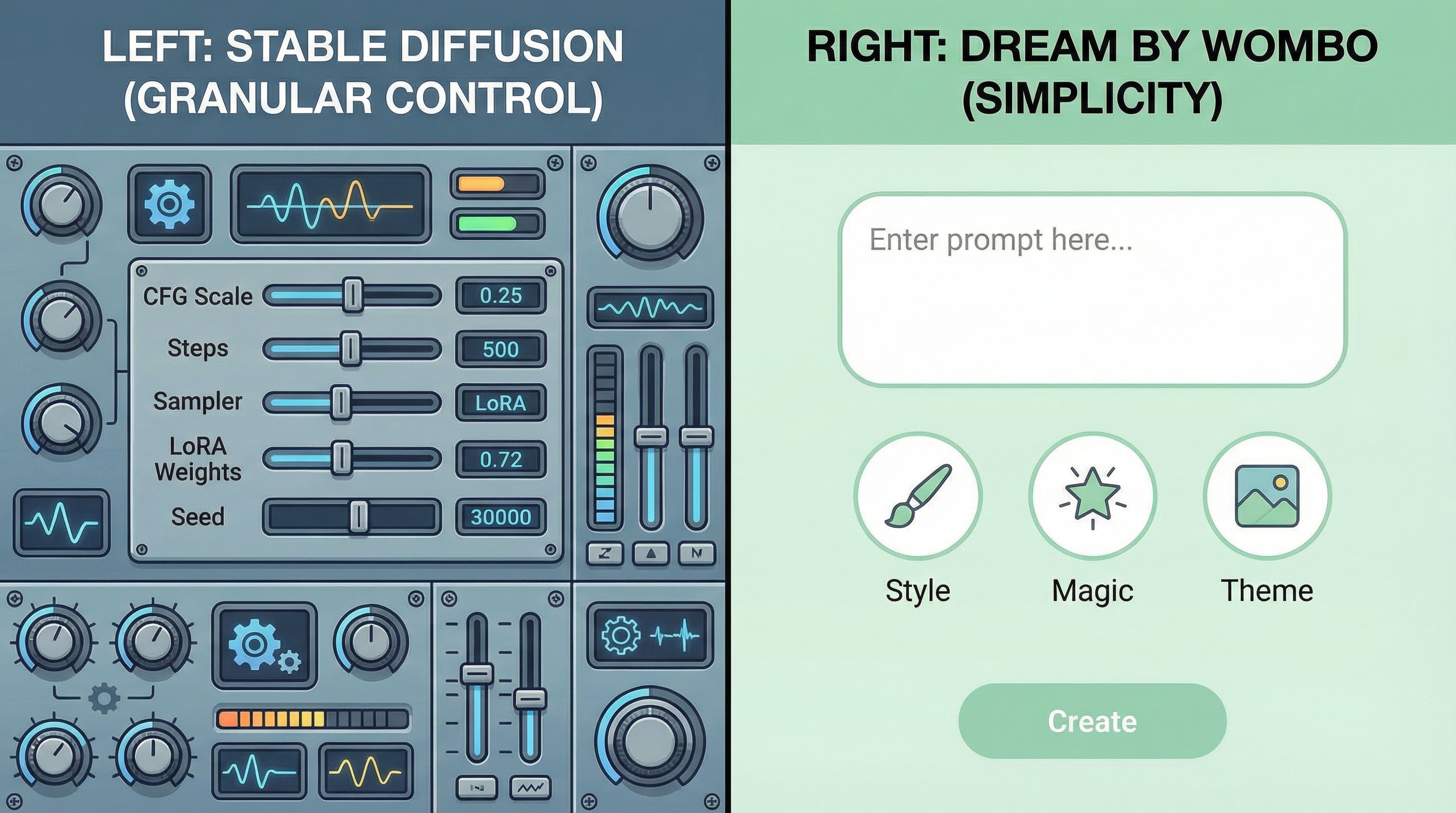
A side-by-side comparison of creative control interfaces. On the left, a detailed control panel with sliders for CFG, steps, sampler, and LoRAs (representing Stable Diffusion's granular control). On the right, a simple, clean interface with only a few style buttons and a text prompt box (representing Dream by Wombo's simplicity).
3. Model Variety and Ecosystem: A Library vs. A Gallery
The sheer volume of available models and extensions creates a massive gap between the two platforms.
Stable Diffusion: A Universe of Models
The open-source nature of Stable Diffusion has led to an explosion of community-trained models, checkpoints, and extensions.
•Custom Checkpoints: Thousands of custom models exist, trained on specific datasets (e.g., anime, photorealism, architectural design), allowing users to achieve highly specialized aesthetics.
•LoRAs and Embeddings: LoRAs and Textual Inversions allow users to inject specific characters, objects, or styles into any base model, providing a dynamic and ever-expanding toolkit.
•Community-Driven Development: The ecosystem is constantly evolving, with new tools and features being released daily by a global community of developers.
Dream by Wombo: A Curated Selection
Dream by Wombo offers a limited, but high-quality, selection of styles and models.
•Internal Development: All models and styles are developed and curated internally by the Wombo team, ensuring a consistent level of quality and performance within the app.
•Style Focus: The platform focuses on providing a few dozen distinct, popular styles that appeal to a broad audience, rather than the niche specialization of the Stable Diffusion ecosystem.
•No External Models: Users cannot import or use external models, which limits the artistic range but ensures a stable, bug-free experience.

A visual comparison of model variety. On the left, a vast library of different models (e.g., Realistic Vision, Anime, various checkpoints) on a shelf (representing Stable Diffusion's ecosystem). On the right, a small, curated selection of pre-set styles (representing Dream by Wombo's limited but focused options).
4. User Experience and Accessibility: Desktop vs. Mobile
The primary interface for each tool reflects its target user and use case.
Stable Diffusion: Desktop-First and Complex
Stable Diffusion is fundamentally a desktop-first experience, often requiring a powerful GPU for local installation or reliance on a web-based cloud service.
•Web UI Complexity: Interfaces like Automatic1111 are powerful but can be overwhelming for new users, featuring dozens of tabs, sliders, and configuration options.
•Hardware Dependency: For local use, a significant investment in a dedicated GPU is required, creating a high barrier to entry for the average user.
•Learning Curve: The learning curve is steep, requiring users to understand concepts like latent space, sampling methods, and prompt weighting to achieve optimal results.
Dream by Wombo: Mobile-First and Instant
Dream by Wombo is designed for the modern mobile user, prioritizing speed and simplicity.
•Dedicated Mobile App: The app is highly optimized for touch screens, offering a seamless, fast experience for generating art on the go.
•Instant Results: Generations are typically very fast, often completing in seconds, which is ideal for quick content creation and experimentation.
•Zero Setup: There is no hardware requirement or complex setup; users simply download the app and start generating immediately.
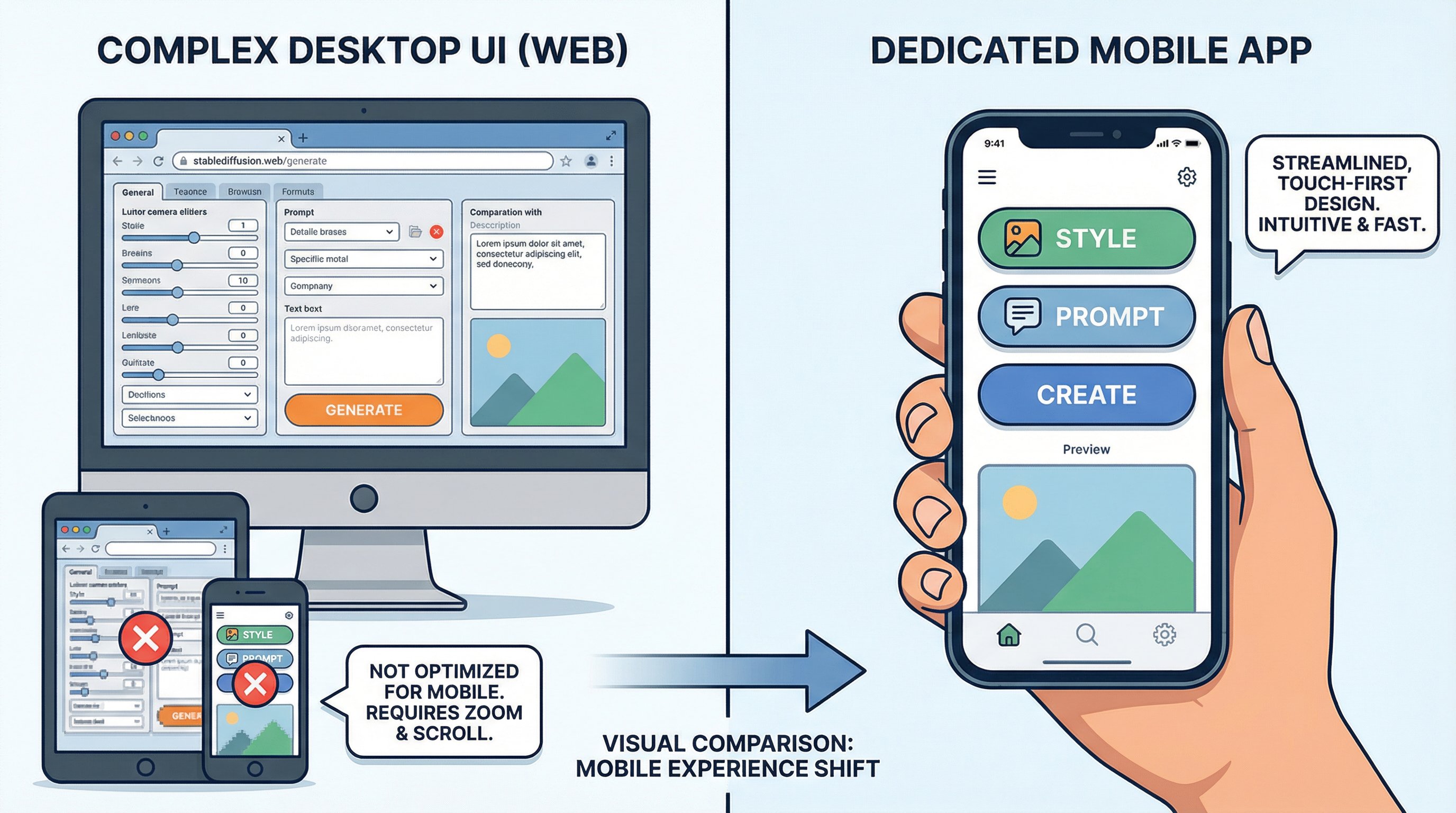
A visual comparison of mobile experience. On the left, a desktop screen showing a complex web UI (representing Stable Diffusion's primary interface). On the right, a clean, dedicated mobile app interface on a smartphone screen (representing Dream by Wombo's mobile-first approach).
5. Commercial Use and Licensing: Clear Ownership vs. Open-Source Ambiguity
The commercial viability of the generated art is a crucial factor for professional users.
Stable Diffusion: Clear Ownership, Complex Licensing
The output from Stable Diffusion is generally considered to be owned by the user, but the licensing of the models themselves can be complex. This complexity is a significant factor in the Stable Diffusion vs Dream by Wombo debate for professional users. Stable Diffusion's core model is governed by the CreativeML Open RAIL-M License, which is permissive for commercial use but includes important restrictions against generating illegal or harmful content. Users must be aware that using custom checkpoints or LoRAs may introduce additional, less clear licensing terms.
•User Ownership: The generated images are typically owned by the user, with no restrictions on commercial use, provided the user adheres to the license of the specific model checkpoint used (e.g., CreativeML Open RAIL-M License).
•Self-Hosting Advantage: When running the model locally, the user has maximum control over the data and output, which is often preferred by companies with strict data privacy requirements.
•Legal Responsibility: The user is responsible for ensuring their use of the model and the resulting art complies with all relevant licenses and laws. This requires a high degree of user diligence, as the open-source nature means there is no central authority providing legal indemnification, a key difference from enterprise-focused tools. The advantage, however, is the complete freedom to use the output in any commercial venture without royalty payments to the model creator.
Dream by Wombo: Simple Terms, Limited Flexibility
Dream by Wombo offers straightforward commercial terms, but with less flexibility. The platform's closed nature simplifies the legal landscape considerably. The user only needs to adhere to Wombo's Terms of Service, which clearly delineate commercial rights for paid subscribers. This simplicity is a major draw for small businesses and content creators who want to avoid the legal ambiguity of the open-source world.
•Commercial Rights: Paid subscribers are typically granted commercial rights to the images they generate, making the legal aspect simple and clear.
•Terms of Service: The terms are governed by Wombo's Terms of Service, which are easy to read and understand, removing the need to track multiple model licenses.
•No Data Control: Since the generation happens on Wombo's servers, users have no control over the underlying data or the model's operation.
6. Pricing and Cost Model: Variable vs. Predictable
The cost structure of Stable Diffusion vs Dream by Wombo is a reflection of their underlying technology and service delivery.
Stable Diffusion: The Variable Cost Model
The cost of using Stable Diffusion is highly variable and depends entirely on the user's chosen method of access.
•Local Use: The cost is effectively zero, save for the initial hardware investment and negligible electricity costs. This is the most cost-effective option for high-volume generation.
•Cloud Services: Services like RunPod or specialized web UIs charge based on GPU time or a credit system, making the cost variable based on the complexity and volume of generations.
•Free Access: Numerous free web interfaces exist, often supported by ads or limited by queue times, offering a completely free entry point.
Dream by Wombo: The Predictable Subscription Model
Dream by Wombo uses a clear, tiered subscription model, which is common for consumer-facing apps.
•Free Tier: A free tier is available, often with ads and slower generation times, but it provides a great way to test the platform.
•Subscription Tiers: Paid tiers offer faster generation, ad removal, and access to exclusive styles and features for a predictable monthly fee.
•Credit Purchases: Users can often purchase one-off credit packs for high-volume use, but the core value proposition is the predictable monthly cost.
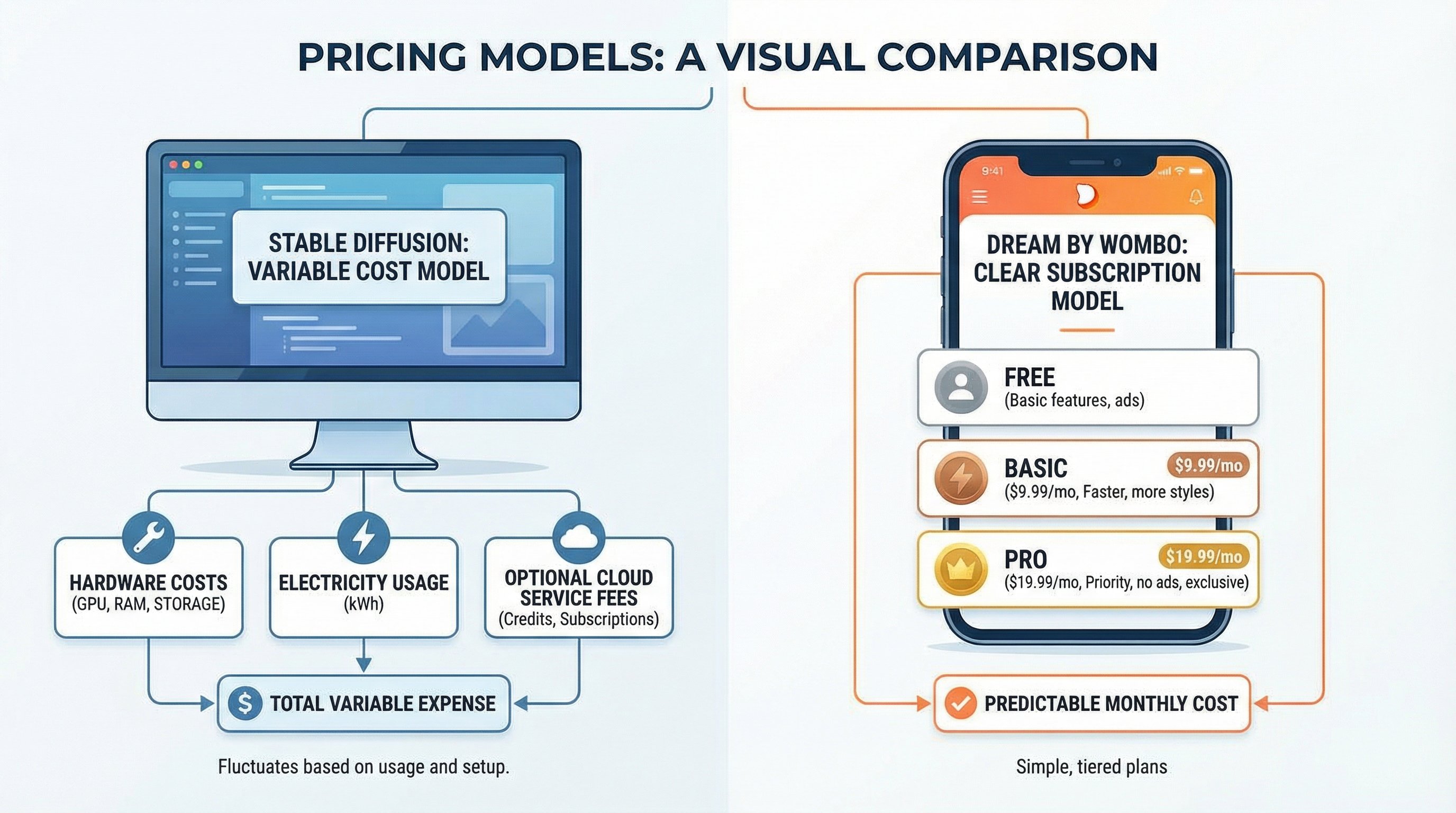
A visual comparison of pricing models. On the left, a computer screen showing a breakdown of hardware costs, electricity usage, and optional cloud service fees (representing Stable Diffusion's variable cost). On the right, a mobile phone screen showing a simple, tiered subscription plan with a "Free" option (representing Dream by Wombo's clear, subscription-based cost).
7. Final Verdict: Choosing Your AI Art Path
The choice between Stable Diffusion vs Dream by Wombo boils down to a single question: Control vs. Convenience.
•Choose Stable Diffusion if:
•You are a professional artist, developer, or enthusiast who requires granular control over every aspect of the generation process (CFG, Samplers, ControlNet).
•You need access to a vast, specialized ecosystem of custom models, LoRAs, and community-driven tools.
•You are willing to invest time in a steep learning curve and potentially invest in dedicated hardware for the most cost-effective, high-volume generation.
•Choose Dream by Wombo if:
•You are a casual user, hobbyist, or social media content creator who prioritizes speed, simplicity, and a mobile-first experience.
•You prefer a curated, high-quality aesthetic and are happy to choose from a pre-defined list of styles.
•You value a predictable, low-cost subscription model and a zero-setup barrier to entry.
8. Community and Future Outlook: The Ecosystem Battle
The long-term trajectory of both platforms in the Stable Diffusion vs Dream by Wombo competition is heavily influenced by their respective communities and development models.
Stable Diffusion's Unstoppable Community
The Stable Diffusion community is a global, decentralized force. Its future is guaranteed by the sheer number of developers, artists, and researchers contributing to its core model and ecosystem. New features, models, and interfaces are released constantly, often outpacing proprietary competitors. The community acts as a massive, free R&D department, ensuring that Stable Diffusion remains at the cutting edge of AI art technology.
Dream by Wombo's Curated Growth
Dream by Wombo's community is primarily focused on sharing and enjoying the art created within the app. Its future is tied to the Wombo company's ability to secure funding and maintain a competitive edge in the rapidly evolving mobile app market. Development is focused on enhancing the user experience, adding new curated styles, and improving the speed and quality of its internal models. While it lacks the raw innovation of the open-source world, it offers a more stable, predictable, and consumer-friendly experience.
The competition between Stable Diffusion vs Dream by Wombo highlights the two major directions of AI art: the deep, technical customization of the open-source world and the polished, accessible experience of the consumer app market. Both are valid paths, and the right choice depends entirely on your creative goals and technical comfort level. Ultimately, the choice between Stable Diffusion vs Dream by Wombo is a choice between being a power user who builds their own tools and a consumer who values a seamless, ready-to-use product.